History of the Flight
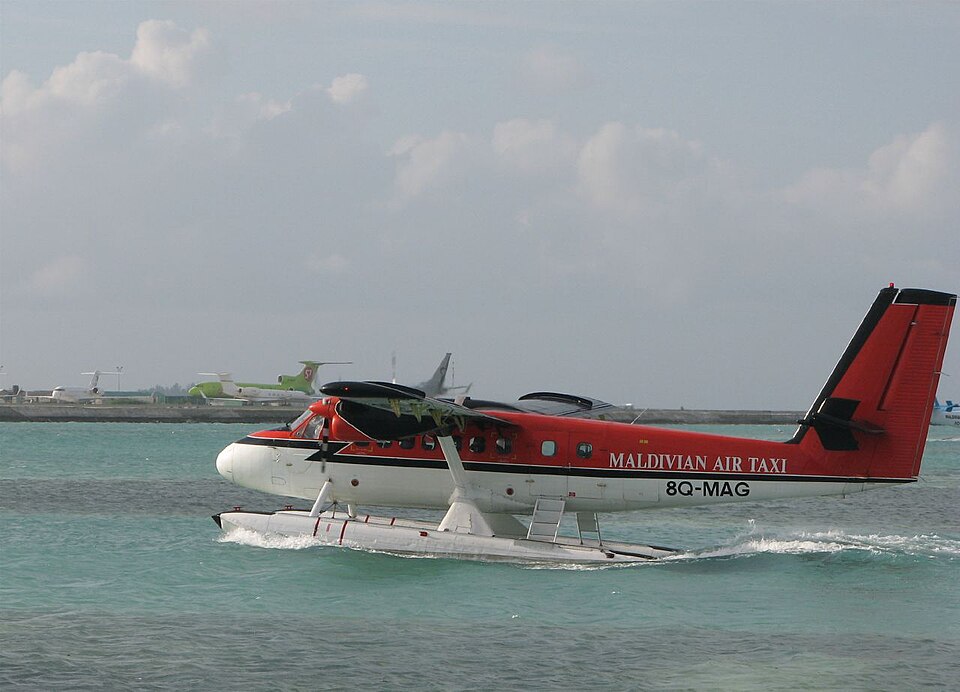
On 2 June 2009, a De Havilland DHC-6-200 Twin Otter floatplane, registration 8Q-MAG, operated by Maldivian Air Taxi Pvt. Ltd., departed from a floating platform attached to the jetty at Halaveli Island Resort (North Ari Atoll) at 0945 hours local time. The aircraft carried three crew and four passengers for a 40-minute photo flight. The sky was clear with good visibility; wind was from the west at 8–10 knots.
After takeoff, the aircraft climbed and levelled. The co-pilot vacated the right front seat, which was taken by a passenger (the cameraman). The co-pilot then occupied the third row left seat. The aircraft made several right-banked orbits around the island at the initial altitude, then descended to lower heights and performed further orbits over the lagoon for photography. A passenger wearing a headset informed the pilot-in-command (PIC) that all required shots had been obtained and that landing could commence. The PIC initiated a descending right turn while keeping the passenger in the co-pilot seat to offer a different view. Before completing the turn, the right wing and/or float contacted the water. The PIC attempted to level the aircraft but lost control; the aircraft skidded on the water.
Injuries and Damage
The accident resulted in two minor injuries—one crew member and one passenger. The other five occupants were uninjured. All seven escaped the aircraft without fatalities. The aircraft sustained substantial damage: both wings were broken at the roots; the left float detached; the right float broke near its forward end and became lodged between the engine and fuselage, blocking the co-pilot exit; the empennage was twisted anticlockwise and upside down; both propeller blades were twisted; a large cut from a propeller was noted behind the captain’s seat; the co-pilot’s windscreen was broken into two halves and nearly detached; the right-hand passenger window was damaged; and the aircraft nose area was badly crushed. The depth of water at the wreckage site was about 1 metre. The aircraft came to rest heading north-northeast.
Personnel Information
The PIC, a 30-year-old Maldivian male, held an Airline Transport Pilot Licence (Aeroplanes) and a Class 1 medical. He had 3,556 total flight hours, with 3,240 hours on the DHC-6 and 863.7 hours as PIC. The co-pilot, a 22-year-old Maldivian male, held a Commercial Pilot Licence (Aeroplanes) and a Class 1 medical, with 1,974 total flight hours, 1,688 hours on type, and 150 hours as SIC. A cabin crew member, a 30-year-old Maldivian male, also held relevant licenses.
Aircraft Information
The aircraft, manufacturer De Havilland of Canada, model DHC-6-200 Twin Otter, serial number 224, was manufactured in April 1969. It was owned by Kenn Borek Air Ltd. and registered in the Maldives (8Q-MAG). Total flying hours since manufacture were 33,685.0 hours; the last periodic inspection (EMMA #24) was carried out at 33,572.0 hours, 113.0 hours before the accident. Both engines were Pratt & Whitney Canada PT6A-27 models, and propellers were Hartzell HC-B3TN-3DY.
Causal Factors
The Accident Investigation Coordinating Committee identified the following causal factors:
- The PIC’s decision to fly the aircraft, other than for take-off and landing, lower than an altitude allowed by CAD regulations and Company Operations Manual.
- A passenger occupying the co-pilot seat.
- No effective means established by the operator to ensure that amendments to regulations, guidance, and procedures are communicated to the crew appropriately and in a timely manner.