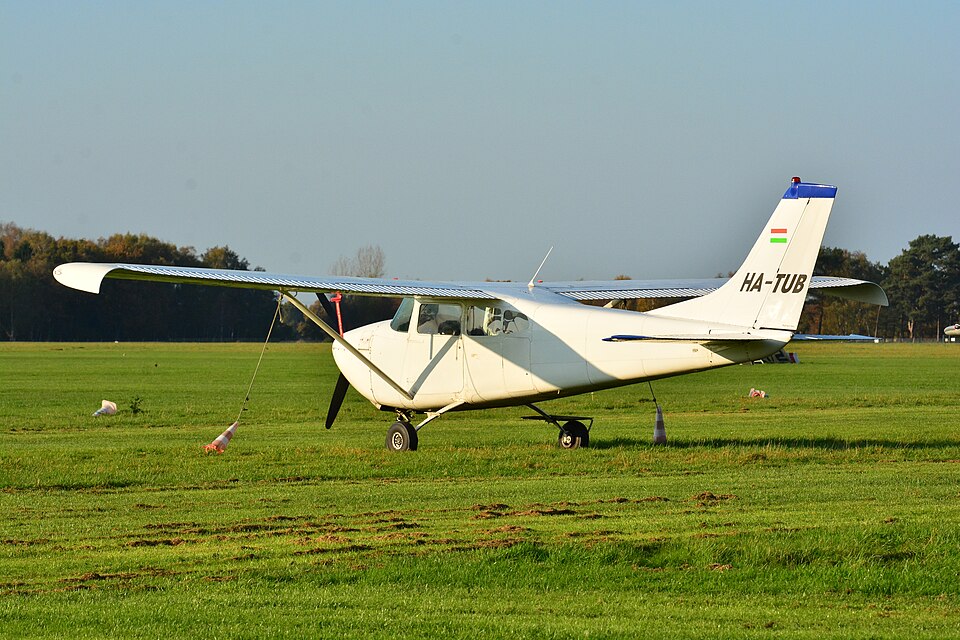
Flight Summary
On 3 June 2021 at approximately 15:00 local time, a Cessna 182 D (registration HA-TUB) departed from the Poreč airstrip (RPUS) with a pilot and four parachutists. The flight climbed without incident to 3,300 ft for the parachute jump. After the jump, the pilot began a descent. At around 1,300 ft, the pilot applied power to plan the approach, but the engine did not respond. The pilot directed the aircraft toward the runway and checked the controls. Realizing the runway could not be reached, the pilot landed on terrain short of the threshold of runway 01. The aircraft nosed over and came to rest inverted.
Aircraft and Pilot Information
The aircraft was a 1961 Cessna 182 D Skylane, serial number 18253201, powered by a Teledyne Continental Motors O-470-R engine with a McCauley D3A32C411-C/82NDA-4 propeller. It had accumulated 1,977.10 Tach hours (5,386.66 total hours). The aircraft was owned and operated by Avia-Rent KFT. Its certificate of airworthiness was issued on 9 March 2021, and a 100-hour inspection was performed on 31 March 2021 at 1,950.88 Tach hours.
The pilot, a Croatian male born in 1978, held a valid CPL(A) license with SEP, MEP, IR/ME, and A320 ratings, issued by Slovenian authorities in 2019. He had 656.46 total flight hours, including 28.07 hours on the Cessna 182 (14.19 in the last 90 days) and a total of 251.71 hours on similar Cessna 172 and 206 models. He held a valid medical certificate without limitations issued on 6 November 2020.
Injuries
No injuries occurred. The pilot was the sole occupant.
Damage
The aircraft was found inverted approximately 230 meters before the threshold of runway 01. Fuel smell (100LL) was present. Damage included skin and stringer breaches on the fuselage, right wing spar and skin damage, left wing brace fracture and tip damage, and the nose landing gear separated from the fuselage. All damage was consistent with landing on uneven terrain and overturning. The aircraft was later righted and moved for detailed examination.
Investigation Findings
The Croatian Air, Maritime and Railway Accident Investigation Agency (AIN) determined that the cause of the engine power loss was very likely carburetor icing during descent. The accident sequence was consistent with a loss of engine power due to carburetor icing, leading to a forced landing short of the runway.
Probable Cause
The safety investigation determined that the accident very likely occurred due to carburetor icing during the aircraft's descent.