History of the Flight
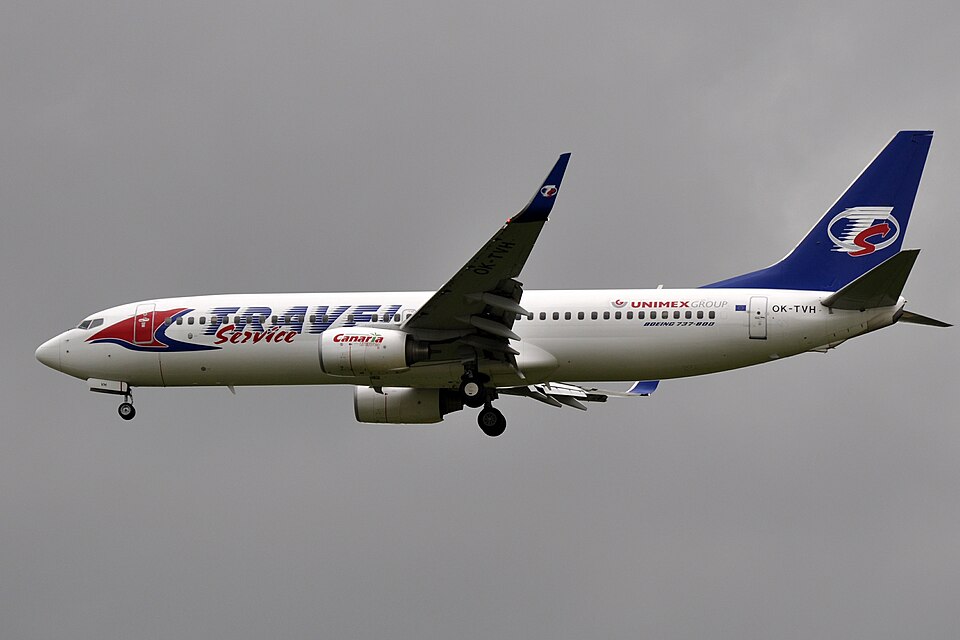
On 25 November 2016, a Boeing B737- aircraft, registration OK-TVH, leased by Oman Air from Travel Services TVS, departed from gate 14L at Salalah Airport at 0453 LT for a flight to Muscat Airport. During the take-off roll, the pilot-in-command heard a loud noise and decided to perform a rejected take-off, stopping the aircraft on Runway 07. The pilot requested a passenger step. Oman Air certifying staff inspected the aircraft and found both right-hand side main wheels burst. They began replacing the wheels on the runway but were unable to position the main wheel jack due to excessive load on one side of the aircraft. They used a nose wheel jack to aid positioning, which resulted in damage to the runway surface. After several attempts, they replaced both tires on wheels No. 3 and 4 and towed the aircraft to the stand.
Damage to Aircraft
After the rejected take-off, certifying staff found main wheel tires No. 2, 3, and 4 damaged; these were replaced. On 27 November 2016, inspectors from the Directorate General of Civil Aviation and Regulation (DGCAR) conducted a further inspection at Muscat Airport. They noted several dents on the right-hand wing trailing edge inboard aft flaps lower skin, inboard main flaps skin, and the right-hand wing panel before the inboard main flaps. These dents were not recorded in the technical log or on the aircraft damage chart. The findings were reported to TVS certifying staff for evaluation, who determined that all dents were satisfactory and within Structural Repair Manual (SRM) limits.
Similar Occurrences
In the four months prior to this incident, the Public Authority for Civil Aviation (PACA) had received several reports of tire incidents, with failures occurring on wheels No. 3 and 4. Initial indications suggested that probable causes included low tire pressure, core valve leakage, foreign object debris (FOD), and internal tire damage.
Factors Affecting Tires
A well-documented factor affecting tires is heat. Heat may originate from an external source, but internal heating from brakes during normal operations is considered the primary source of temperature rise in aircraft tires. Under high aircraft loads, heat build-up is accelerated by excessive taxi speed and/or long taxi distances. Decreased inflation pressure also leads to increased tire temperature. Tire integrity and reliability may be compromised when these conditions occur in combination.
Conclusion
The investigation revealed the following findings:
1. No evidence indicated that the flight crew did not perform the pre-flight inspection. 2. Number 3 tire tracks were found along the taxiway and continued onto the runway, suggesting low tire pressure and resulting tire de-cap. 3. Number 4 tire tracks began on the runway due to excessive load on that tire after the No. 3 tire de-cap, leading to its burst.
There was no indication that the runway was a contributing factor. No TVS certifying staff were available during the incident. Oman Air certifying staff could not position the main wheel jack due to the excessive load on one side of the aircraft; they used an ATR jack as support to gain clearance. The runway surface was damaged during the aircraft jacking procedure.
Recommendations
1. The operator's daily check should be revised to include nominal tire pressure and allowable limits in accordance with the manufacturer's aircraft maintenance manual requirements. 2. Tire pressure readings should be recorded in the technical log before and after adjustment by an engineer. 3. The operator should review single-engine taxiing procedures and consider discontinuing single-engine operation. 4. The operator should ensure that proper aircraft tools and equipment are available at the airport.