Occurrence
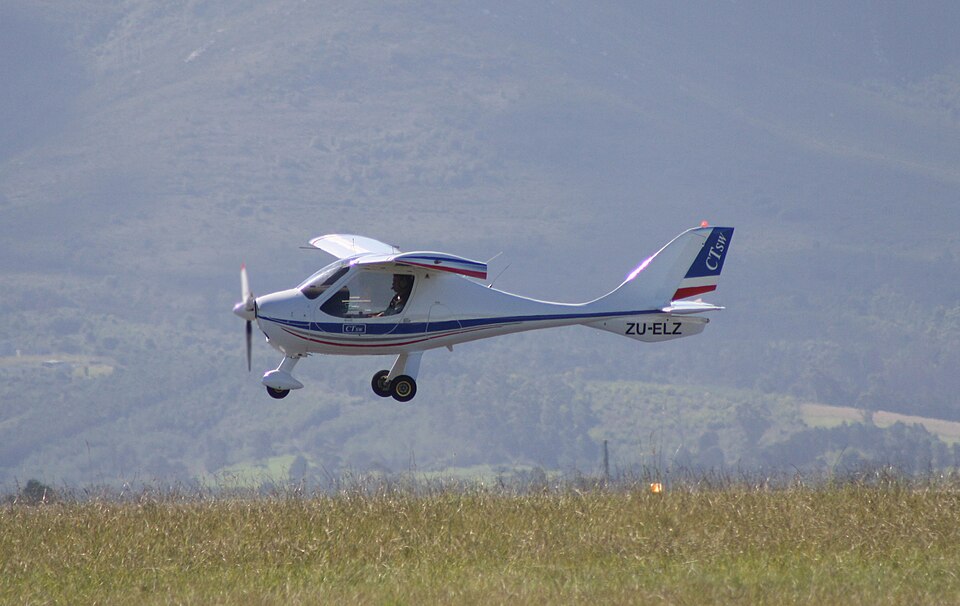
On Wednesday, 2 August 2023, at 1115Z, a pilot conducted a private flight from Ceres Aerodrome (FACE) to Robertson Aerodrome (FARS) in a Flight Design CTSW light aircraft, registration ZU-ELZ. The flight was conducted under visual meteorological conditions (VMC) by day, in accordance with Part 94 of the Civil Aviation Regulations (CAR) 2011 as amended.
According to the pilot, a pre-flight check revealed no anomalies, and the flight to Robertson was uneventful. However, during the landing roll on Runway 28, the right main landing gear strut failed. The aircraft veered to the right of the runway and came to a stop in bushy terrain. The aircraft sustained damage to the right main landing gear and the right wing tip. The pilot disembarked without injury.
Post-Accident Inspection
A post-accident inspection of the aircraft by the approved person (AP) on 10 August 2023 found that the right main gear strut had a severe subsurface crack that propagated undetected on one side of the strut, with signs of discolouration on the two metal halves at the lower bolt attachment area. The crack went undetected during periodic inspections, leading to the strut breaking off during the landing roll due to overloading.
Findings
The pilot held a National Pilot Licence (NPL) issued initially on 29 July 2014 and reissued on 24 January 2022, valid until 23 January 2024. The pilot's Class 2 medical certificate was issued on 11 January 2023 with an expiry date of 11 January 2024 and a restriction to wear suitable corrective lenses.
The aircraft's last annual inspection was conducted on 30 June 2023 at 845.4 airframe hours, after which a Certificate of Release to Service (CRS) was issued valid until 1 June 2024 or 880.0 hours, whichever came first. No hard landings were recorded in the flight folio pages from 9 October 2021 to 2 August 2023.
The aircraft's Authority to Fly certificate was originally issued on 15 June 2019 and renewed on 6 June 2023 with an expiry date of 30 June 2024. The Certificate of Registration (C of R) was issued to the present owner on 4 April 2007.
Maintenance Issues
The inspection procedure (Figure 6) required that the landing gear strut be inspected for cracks, signs of delamination/debonding, and security hardware. The AP followed the manufacturer's maintenance requirements as outlined in Figure 6 but did not comply with Service Bulletin SB-ASTM-CTSW-02 issued on 15 October 2008. This Service Bulletin required removal of the bracelet to allow proper inspection of the area where the fatigue crack originated. No records were found indicating that dye penetrant inspection was conducted during the annual inspection. The Service Bulletin required compliance every 300 hours; at 858 airframe hours, the aircraft should have been inspected twice had the bulletin been complied with.
Probable Cause(s)
The right main landing gear failed during the landing roll due to a fatigue crack that may have been caused by galvanic corrosion at the main landing gear lower attachment point, which caused the aircraft to veer off to the right of the runway.
Contributing Factor(s)
- The AP failed to adhere to the Service Bulletin, which resulted in the failure of the landing gear during the landing roll.
- The absence of detail in landing gear inspection at the 100-hour maintenance procedure manual.
Safety Action(s)
None specified.
Recommendation
It was recommended to the Director of Civil Aviation (DCA) to consider reviewing internal processes for verifying and validating aircraft airworthiness prior to issuance of the renewed Authority to Fly.