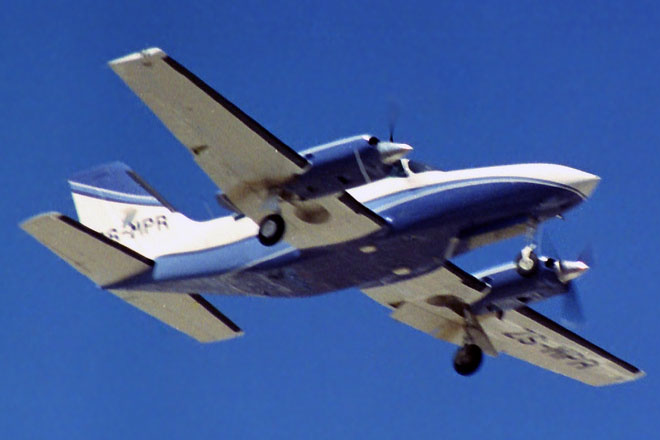
Occurrence Summary
On 14 August 2025 at 0730Z, a Cessna 402C (registration ZS-MPR) departed Wonderboom Airport (FAWB) for a private flight to Lephalale (Ellisras) Airport (FAER) in Limpopo province. The pilot and five passengers were on board. The flight was conducted under visual meteorological conditions by day, in accordance with Part 91 of the South African Civil Aviation Regulations.
Upon arrival at FAER, the pilot completed unmanned joining procedures and aligned for final approach to Runway 09. The aircraft touched down and rolled approximately 100 to 150 metres before the pilot felt a yaw to the left. He applied full right rudder for about 50 metres, but the aircraft yawed further left, departed the runway, and came to rest in bushy terrain adjacent to the runway. No injuries occurred, but the aircraft sustained substantial damage and was later recovered to an approved maintenance facility.
Sequence of Events
The pilot stated that he was not familiar with FAER and had difficulty finding information about the airport during flight preparation. During the approach, the aircraft was established at 120 knots indicated airspeed (KIAS) and touched down at 110 KIAS, exceeding the Cessna 402C Pilot's Operating Handbook recommended landing speed of 95 knots. The investigation noted that this higher speed likely increased cockpit workload and reduced the pilot's ability to maintain alignment with the runway centreline. The aircraft touched down to the left of the centreline.
Shortly after touchdown, the left wing struck vegetation on the left edge of the runway. Video footage from the recovery team showed that the left wing tip broke off near the first impacted tree, and the outer wing section was found approximately 60 metres down the runway in the direction of landing. The aircraft continued for about 120 to 150 metres while the left wing impacted vegetation, eventually severing the outboard wing section. The pilot's rudder and brake inputs were negated by the continued veering, and the aircraft came to rest 50 metres beyond the location of the outer wing section.
Aircraft and Pilot Information
The aircraft, a Cessna 402C serial number 402C-1017, had a valid Certificate of Airworthiness expiring 15 July 2026 and a total of 3518.3 airframe hours at the time of the accident. The latest mandatory inspection was conducted on 9 June 2025. Post-accident inspection found no signs of system failure or malfunction that could have caused the veer.
The pilot held a Commercial Pilot Licence issued in 2017 and reissued on 30 January 2025, with a Class 1 medical certificate valid until February 2026. He had 3678.6 total flying hours, with 62.4 hours on the Cessna 402C type, of which 18.7 hours in the previous 90 days and 2.4 hours on 10 August 2025.
Findings
- The pilot executed an unstable approach with a landing speed exceeding the recommended value.
- The aircraft touched down left of the runway centreline.
- Vegetation along the left edge of the runway was struck, causing progressive wing damage and loss of directional control.
- The runway safety areas were absent; the runway edges had substantial vegetation.
- Weather was good and not a factor.
Probable Cause
The probable cause, as stated in the official report, was an unstable approach which resulted in the aircraft touching down to the left of the runway centreline and impacting vegetation along the edge of the runway; the pilot subsequently lost directional control of the aircraft which came to a stop in the vegetation.