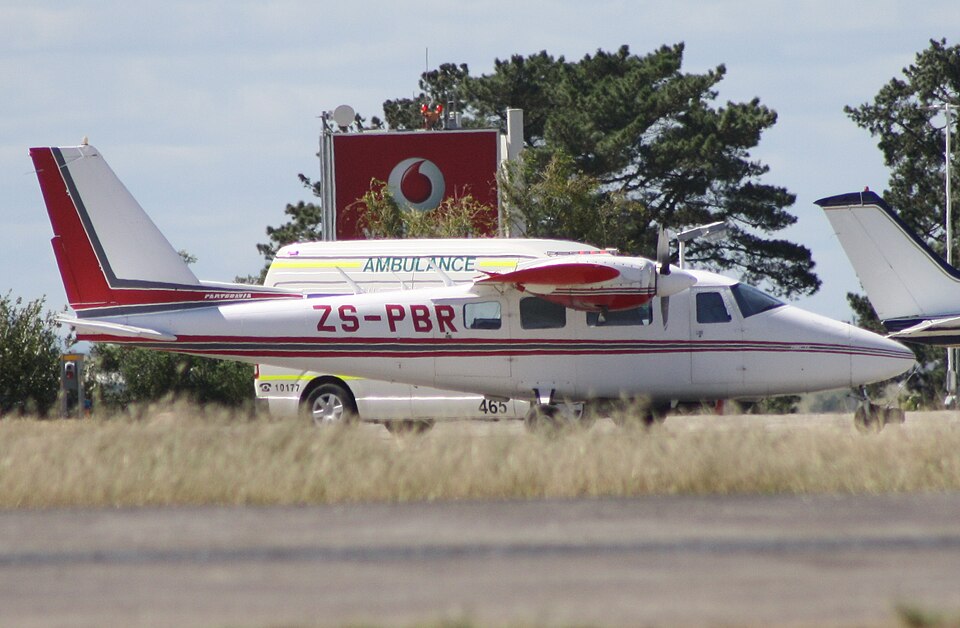
On December 22, 2006, a Partenavia P68-TC (registration ZS-PBR) was involved in an aviation accident near Private aerodrome near Alldays, ZA. Investigators recorded the probable cause as: The nose wheel of the aircraft entered into a subsurface hole on the runway while the pilot was taxiing towards the threshold of Runway 27, which caused the nose assembly of the aircraft to collapse. This summary draws on records from the South African Civil Aviation Authority (SACAA) Accident and Incident Investigations Division.
On 22 December 2006, a Partenavia P68-TC (ZS-PBR) suffered nose landing gear damage while taxiing at a private aerodrome near Alldays after the nose wheel entered a subsurface hole. The sole pilot was not injured.
Overview and Aircraft Details On the morning of 22 December 2006, a Partenavia P68-TC with registration ZS-PBR was involved in an accident while taxiing at a private aerodrome near Alldays. The aircraft was operated by a sole pilot holding a valid commercial pilot’s licence, with 3,219.0 total flying hours and 20.2 hours on type. The pilot’s medical certificate was valid until 28 February 2007 and required corrective lenses. ## Sequence of Events The pilot taxied toward the threshold of Runway 27, steering slightly to the right of the runway to initiate a left turn for take-off alignment. During this manoeuvre, the nose wheel entered a subsurface hole in soft sand on the runway. The impact caused the upper torque link to fail and the bulkhead supporting the nose landing gear to partially separate from the nose structure. The pilot was not injured. ## Runway and Site Conditions The runway was a compacted sand/gravel surface on a farm and was described as fairly new. Trees had been removed during construction, and some roots were not properly cleared. Decomposed roots had created a subsurface hole approximately 30 cm (12 inches) deep. The accident site was located at GPS position South 22°28.063’ East 029°10.460’, elevation approximately 2,900 feet AMSL. ## Meteorological and Maintenance Information Surface wind was easterly at 5 kt, temperature was 28°C, and visibility was good. The last Mandatory Periodic Inspection (MPI) was certified on 19 September 2006 at 1,609.25 airframe hours; the aircraft had flown a further 36.4 hours since that inspection. The Aircraft Maintenance Organisation (AMO No. 291) that certified the last maintenance held a valid AMO approval at the time.
Probable cause
The nose wheel of the aircraft entered into a subsurface hole on the runway while the pilot was taxiing towards the threshold of Runway 27, which caused the nose assembly of the aircraft to collapse.
A SkyWalk Join't 3 paraglider crashed into the ground near Las Vizcachas, Chile, on September 1, 2024. The pilot and passenger sustained serious spinal…
PARAPENTE (ULTRALIVIANO NO MOTORIZADO)·2024-09-01DGAC Chile
A Cessna 172N struck electrical cables while on final approach to land at Aucó Aerodrome in Chile. The pilot was uninjured, but the aircraft sustained damage…
A Bombardier DHC-8-402 suffered a tail strike during landing at Puerto Williams on September 9, 2024. All 76 occupants were unharmed, but the aircraft…
A MYD JS-MD 3 glider veered off the runway and struck a wall at Vitacura Aerodrome on January 6, 2025. The pilot was uninjured, but the aircraft sustained…
A recreational paraglider flight in Puchuncaví, Chile, ended with the pilot sustaining serious injuries after a rapid descent and impact with a hillside on…
PARAPENTE (ULTRALIVIANO NO MOTORIZADO)·2025-03-29DGAC Chile
A Tecnam P2006T landed on its belly at an aerodrome in Poland after the crew failed to confirm landing gear deployment. The incident resulted in no injuries…