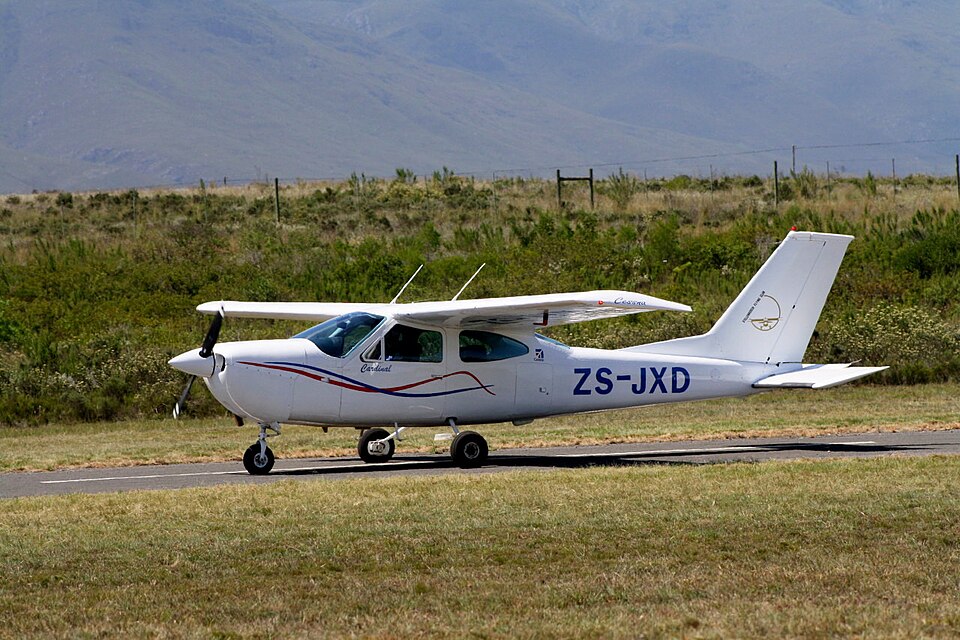
History of Flight
On 28 November 2009, at 0715Z, a pilot departed Stellenbosch Aerodrome (FASH) with three passengers for a private scenic flight. Before departure, the pilot refueled the aircraft with 6.5 US gallons of fuel into the right-hand tank. Using a dipstick found in the aircraft, the pilot measured fuel levels: the right-hand tank indicated ¾ and the left-hand tank ½. The pilot noted that the fuel gauges showed less than ½ on the right and ½ on the left but relied on the dipstick readings.
The flight proceeded at low altitude around the Cape Peninsula to Langebaan. On the return to Stellenbosch, the engine began to run rough and the fuel gauges indicated empty. The pilot, believing the gauges to be inaccurate, diverted to Fisantekraal Aerodrome (FAFK) and activated the emergency squawk 7700 on the transponder. Shortly thereafter, a complete loss of power occurred, and the pilot executed a forced landing on an open field. The aircraft landed hard; the nose wheel broke off and the right wing tip struck the ground, resulting in substantial damage.
Injuries to Persons
The pilot and two passengers were not injured. One passenger was treated for a bruised arm by the Air Mercy Services (AMS) helicopter crew.
Damage to Aircraft
The aircraft sustained substantial damage, including a broken nose wheel and damage to the right wing.
Personnel Information
The pilot, a 43-year-old male, held a valid private pilot licence with a night rating and a medical certificate valid until 31 August 2010. He had 136 total flying hours, with 35 hours on the Cessna 177 type.
Aircraft Information
The aircraft was a Cessna 177B (serial number 177-02585) manufactured in 1976. It was equipped with a Lycoming O-360-AIF6D engine (serial number L22512-36A) and a McCauley propeller. Total airframe hours at the time of the accident were 4649.3. The last maintenance inspection was performed on 22 October 2009 at 4635 hours.
Meteorological Information
Weather conditions were reported as CAVOK, with calm wind, temperature 20°C, and sky clear.
Wreckage and Impact Information
The forced landing occurred on an uneven open field. Post-accident examination showed the fuel selector set to both tanks, no evidence of fuel in either tank, and the transponder still set to code 7700.
Tests and Research
Investigation revealed that two dipsticks, both marked ZS-JXD, were present in the aircraft. The dipstick used by the pilot was incorrectly calibrated; the correct dipstick was stored behind the pilot's seat. The miscalibration resulted in an overestimate of fuel quantity. With the incorrect dipstick, total usable fuel (30.5 US gallons per tank) was miscalculated, reducing endurance from an expected 3 hours 30 minutes to approximately 2 hours 54 minutes. The flight time was about 2 hours 30 minutes, leading to fuel exhaustion.
Probable Cause
The accident was attributed to an unsuccessful forced landing after fuel exhaustion. Contributory factor: 1. Poor pre-flight planning and not ensuring that the aircraft had sufficient fuel on board. 2. The pilot used an incorrectly calibrated dipstick to measure the fuel for the flight.