History of the Flight
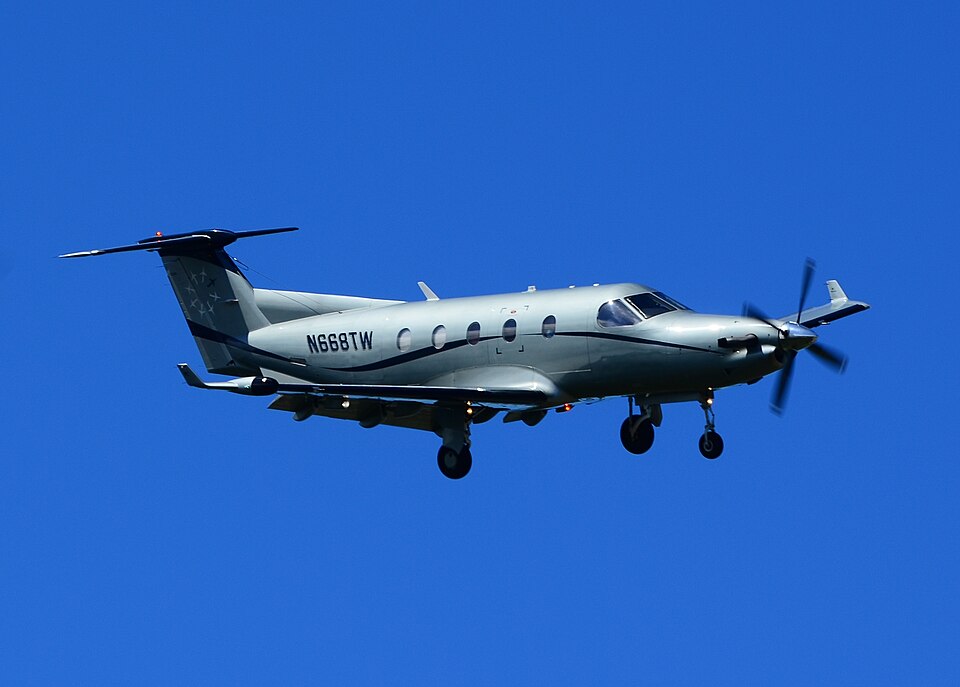
On January 16, 2024, a Pilatus PC12 (registration N668TW) operated by Tradewind Aviation was conducting a ferry flight without passengers from Luis Munoz de San Juan International Airport in Puerto Rico to Saint-Barthélemy Airport. The captain was the pilot flying (PF) and a co-pilot served as the pilot monitoring (PM). During the approach to runway 10, while overflying Col de la Tourmente less than 300 meters from the runway threshold, the aircraft encountered turbulence that induced a sudden left roll. The left wing struck and sheared branches of a tree. The pilot countered with right stick inputs, bringing the right wing to within approximately two meters of the ground. The approach was continued and the aircraft landed without further incident.
Aircraft Information
The Pilatus PC12 is a single-engine turboprop certified for single-pilot operation but was operated by two pilots in this incident. It is powered by a Pratt & Whitney Canada engine producing 1,200 hp, with a maximum takeoff weight of 4,100 kg. Approach speed with flaps at 15° is 95 kt, and landing speed is 78 kt. The incident aircraft was equipped with an angle of attack (AOA) indicator on its EFIS, which displays a pointer between 'F' (fast) and 'S' (slow) indications; the center corresponds to 1.3 times the stall speed.
Crew Information
The 22-year-old captain held a commercial pilot license with PC12 single-engine turbine and instrument ratings. He had approximately 1,660 total flight hours, including 660 hours on the PC12, and had landed 68 times at Saint-Barthélemy as PF in the three months prior. The 30-year-old co-pilot had 1,120 total hours, 550 on type, and 75 landings at Saint-Barthélemy as PM in the preceding three months.
Meteorological Information
The 12:30 METAR indicated variable wind direction between 060° and 120°, mean wind from 090° at 12 kt, visibility greater than 10 km, few clouds above 3,000 ft, and temperature 28°C. Detailed wind measurements showed a 10-minute mean direction of 090° to 100°, speed 14–15 kt with gusts of 16–21 kt.
Airport Information
Saint-Barthélemy Airport has a single paved runway 10/28, 646 m long and 18 m wide. Runway 10 threshold elevation is 49 ft; threshold 28 is 7 ft. The approach to runway 10 passes over Col de la Tourmente at an altitude of about 130 ft, located 310 m from the touchdown zone. The airport is restricted to authorized pilots and aircraft due to surrounding high ground and turbulence.
Operator Procedures
Tradewind Aviation's operations manual specifies that for runway 10, the approach must be stabilized with full flaps, landing gear down, and the AOA indicator between center and the first low-speed mark. Only captains may act as PF during landings at Saint-Barthélemy. The approach slope is between 6° and 8°. Co-pilots receive one-day theoretical and practical training; captains undergo 15–25 supervised landings before authorization.
Analysis of Collected Data
Data from the Garmin GTN 750 navigation system provided one-point-per-second flight path and ground speed. Comparison with three later approaches in similar wind conditions showed that the incident approach had a steeper descent profile and higher ground speed variability, consistent with the reported downdrafts.
Consequences and Damage
The aircraft sustained slight damage: the left wing leading edge was scratched and the AOA sensor was cracked. The stall protection system (stick-pusher) became inoperative, likely due to the AOA sensor damage.