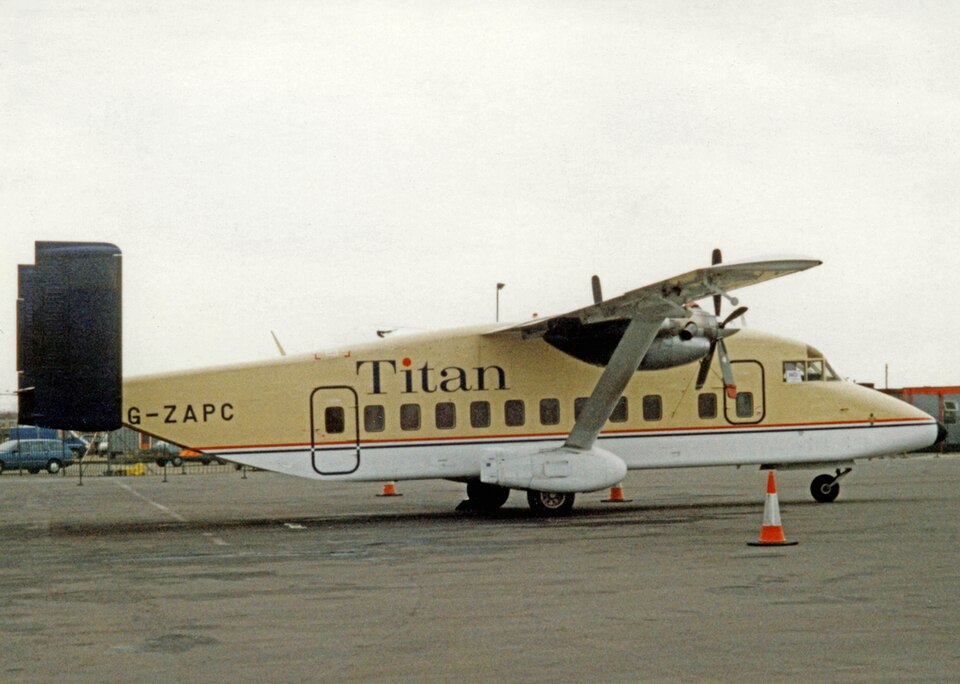
Background
The aircraft departed Exeter at 2237 hrs under fair weather with scattered cloud at 1500 feet. After climbing through cloud to FL 90, the aircraft cruised in clear, smooth air. During the cruise, the co-pilot observed a slight rate of climb on his vertical speed indicator despite level flight, and a spurious hydraulic warning occurred, but these were the only anomalies.
As the aircraft approached East Midlands Airport, the runway visual range was below approach minima, and several aircraft were holding. G-ZAPC descended to 2,500 ft and held in clear air over the Lichfield NDB for about 45 minutes until fuel state dictated a diversion to Liverpool. On diversion, the aircraft was cleared direct to the Whitegate NDB and then Wallasey VOR at FL 40. At this level, the crew could see ground features in good visibility until they entered cloud while descending through 3,500 feet during radar vectors for an approach to Liverpool Airport. The cloud was stratiform and did not appear to contain precipitation or significant turbulence. At Liverpool, the cloud base was 6/8 at 1,100 feet, visibility 12 km, temperature +1°C, and surface wind 060°/8 kt.
Approach
Runway 09 at Liverpool has an ILS localizer but no glidepath transmitter, so a LOC DME approach is normally flown. The DME range is set to zero at the runway displaced threshold. The pilot flies the localizer azimuth and adjusts height using the pressure altimeter; the 3° glidepath commences at 1,610 feet QNH from 5 nm DME with check heights at 4, 3, 2, and 1 nm DME. On the north side of the runway, 329 metres from the threshold, there are four PAPI lights set to a 3° glidepath.
During the approach, all anti-icing services were switched on except for the wing de-icing boots (the commander decided not to employ them because no ice was seen on the wings) and the ice detector (considered unreliable). The approach proceeded normally, and the aircraft descended out of cloud at about 1,100 feet after being in cloud for about 10 minutes. When the commander viewed the PAPIs at 1 DME, "all four lights had a pink tinge." Thinking he might be slightly low, he asked the co-pilot for the correct height at 1 DME, which was 410 feet. The commander's pressure altimeter (set to QNH 1019 mb) indicated the aircraft was slightly high, so he made a small correction resulting in three red and one white PAPI light. The commander decided to touch down slightly beyond the runway identifier numbers.
The aircraft was cleared to land with a wind of "Easterly at 10 kt." On short finals, the commander asked for full flap and allowed speed to bleed back from approach speed (110-120 KIAS) towards threshold speed (90 KIAS) without moving the throttles. Both crew and a passenger in the jump seat reported the aircraft crossed the runway end at 88-90 KIAS.
Accident
Some 20 to 30 feet above the runway, the commander noticed the flight controls felt "sloppy," as if speed was unusually low, but no stall warning or stick shaker activated. At much the same time, all three on board felt the aircraft sink rapidly; the commander pulled back on the control column but could not arrest the high rate of descent, and the aircraft struck the runway very hard. The right wing dropped as the right main gear collapsed, and the aircraft veered right off the runway onto grass. The ground was frozen hard, and the aircraft came to a halt without further significant damage. The crew informed ATC they were unhurt before securing the aircraft while ATC activated emergency services.
On leaving the aircraft, the commander inspected the wings for ice accretion and noticed a thin layer of clear, watery ice along the leading edges across the pneumatic de-icing boots from top to bottom. The ice layer could be wiped off with one finger and was no more than one-eighth of an inch thick. Throughout the flight, there were no visible signs of ice on the wings or windscreen wiper. Consequently, the commander had not increased the threshold speed to compensate for ice accretion.
Investigation
From the available evidence, it appears probable that the aircraft developed a high rate of descent from 20 to 30 feet above the runway without a stall warning. The following causal factors were considered: wind shear; wake turbulence; pitot-static system errors; low airspeed during the final approach; and significant ice accretion on the airframe. Wind shear was discounted because numerous wind readings showed normal variation in direction but consistent speed, and no obstacles upwind of the threshold. Wake turbulence was discounted because the preceding aircraft had landed 19 minutes before G-ZAPC. The pitot-static systems were checked and found leak-free, with all relevant instruments accurate; all pitot head, static plate, and stall warning heaters were serviceable. A comparison of the approach profile with preceding aircraft showed no evidence of static pressure errors. Calculated radar airspeeds were consistent with crew-reported speeds for the initial approach, suggesting pitot errors were unlikely, unless icing affected these systems late in the approach. The final approach was flown at about the correct airspeed, but radar data showed a trend of speed reduction toward stalling speed in the last mile, though the data was too coarse for exact speeds and the stall warning did not activate. The likelihood of significant airframe icing was discounted based on the commander's statement, post-accident photographs showing no significant ice, no ice lumps found on the runway, and the airframe being ice-free when examined by the AAIB despite overnight sub-zero temperatures. There was, therefore, no positive conclusion as to the cause, and it remains a possibility that some or all factors may have combined to produce the high rate of descent.