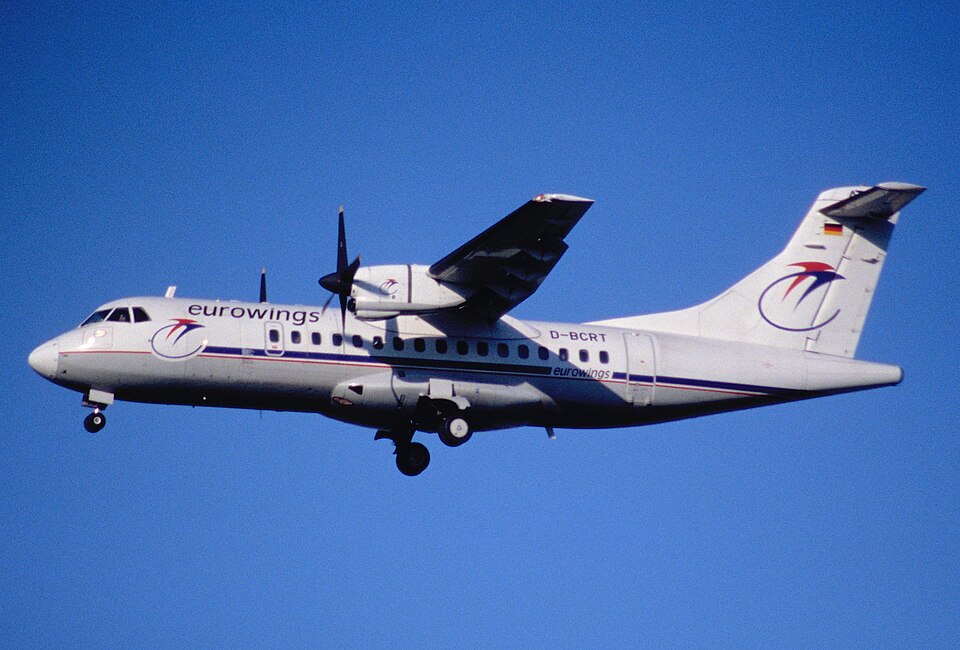
On September 19, 2000, an AVIONS DE TRANSPORT RéGIONAL ATR42-300 (registration D-BCRT) was involved in an aviation accident near 5 NM W/SW KLO DVOR/DME, CH. Investigators recorded the probable cause as: The incident was due to the controller's misjudgment of the traffic situation and passive behavior, with the unusually short departure interval of a faster aircraft behind a slower one contributing to the incident. This summary draws on records from the Swiss Transportation Safety Investigation Board (STSB / SUST).
On 19 September 2000, a Swissair MD-83 and a Eurowings ATR42-300 came within 1.7 NM and 600 ft near Kloten. The report attributed the airprox to controller error and a short departure interval.
Incident overview On 19 September 2000, an airprox occurred between SWR3962 and EWG583 approximately 5 NM west/southwest of the KLO DVOR/DME. The incident was recorded at 07:37 UTC. ## Aircraft and operations The first aircraft was SWR3962, a Boeing MD-83 registered HB-ISZ, operated by Swissair on a scheduled flight from Zürich to Basel. The second aircraft was EWG583, an ATR42-300 registered D-BCRT, operated by Eurowings on a scheduled flight from Zürich to Dortmund. ## Sequence of events EWG583 departed Zürich at 07:33:24 UTC and was cleared on the B3Y departure route. SWR3962 departed at 07:34:55 UTC on the H3Y departure route. Both aircraft were in radio contact with Zurich Departure Control on 125.950 MHz and were operating under instrument flight rules in Class C airspace. As SWR3962 climbed toward FL60, the crew received a TCAS resolution advisory and reduced their climb rate. EWG583 was not equipped with TCAS. The aircraft came within 1.7 NM horizontally and 600 ft vertically. ## Findings and cause The report found that the departure interval was 91 seconds, although the TACO system had suggested 3 minutes. The departure controller allowed the faster jet to depart behind the slower turboprop. The departure control controller initially assessed the situation as unproblematic but did not intervene. The probable cause was the controller's misjudgment of the traffic situation and passive behavior, with the unusually short departure interval contributing to the incident.
A SkyWalk Join't 3 paraglider crashed into the ground near Las Vizcachas, Chile, on September 1, 2024. The pilot and passenger sustained serious spinal…
PARAPENTE (ULTRALIVIANO NO MOTORIZADO)·2024-09-01DGAC Chile
A Cessna 172N struck electrical cables while on final approach to land at Aucó Aerodrome in Chile. The pilot was uninjured, but the aircraft sustained damage…
A Bombardier DHC-8-402 suffered a tail strike during landing at Puerto Williams on September 9, 2024. All 76 occupants were unharmed, but the aircraft…
A MYD JS-MD 3 glider veered off the runway and struck a wall at Vitacura Aerodrome on January 6, 2025. The pilot was uninjured, but the aircraft sustained…
A recreational paraglider flight in Puchuncaví, Chile, ended with the pilot sustaining serious injuries after a rapid descent and impact with a hillside on…
PARAPENTE (ULTRALIVIANO NO MOTORIZADO)·2025-03-29DGAC Chile
A Tecnam P2006T landed on its belly at an aerodrome in Poland after the crew failed to confirm landing gear deployment. The incident resulted in no injuries…