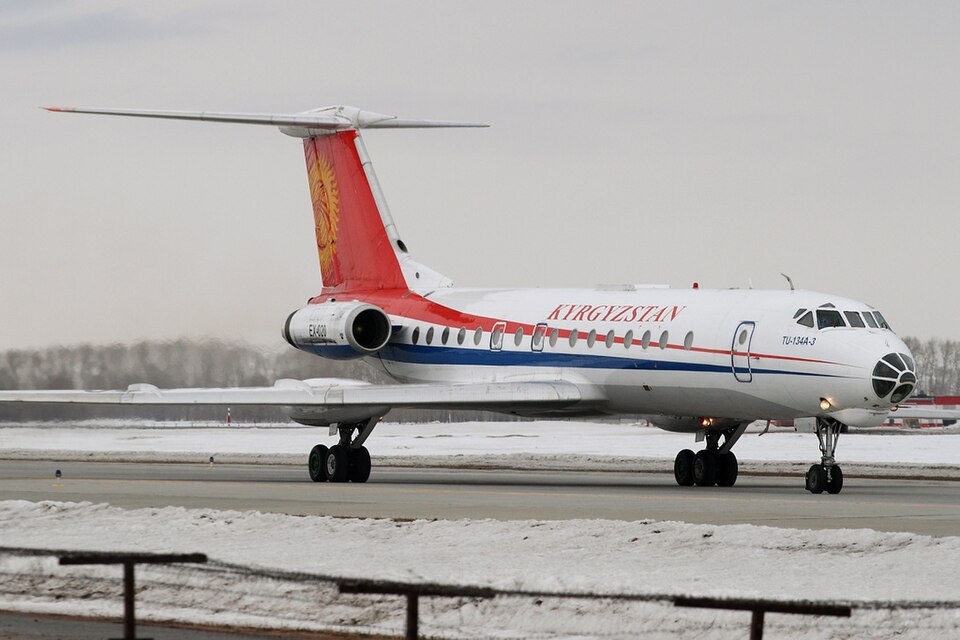
Accident Overview
An aircraft completing a flight from Bishkek initiated a descent to Osh Airport. The approach was conducted in reduced visibility due to fog. The aircraft was not properly aligned with Runway 12 when it touched down hard, experiencing vertical forces of 2.5 g. The impact did not cause a bounce but resulted in the loss of the right main landing gear. Subsequently, the aircraft became uncontrollable, veered off the runway, came to rest inverted, and burst into flames. The fire partially destroyed the aircraft.
All 88 occupants were evacuated, with 31 sustaining injuries, some serious. The main door was jammed; occupants exited through other doors and overwing exits. According to the official findings, no serious injury occurred, and six people required hospital treatment for minor injuries.
Weather and Conditions
At the time of the accident, visibility was reduced to 300 meters horizontally and 200 meters vertically. The runway visual range (RVR) for Runway 12 was 550 meters.
Investigation Findings
The official investigation revealed a series of deficiencies. A letter from Kyrgyzstan's Transport Prosecutor to Parliament, dated April 2012 and made known on April 22, 2013, indicated that Osh Airport had been approved to operate in Category I weather minima without proper equipment and should not have been certified for such conditions. As a result, the aerodrome was subsequently limited to visual flight rules (VFR) operations.
The aircraft was not properly equipped for the flight, lacking a Ground Proximity Warning System (GPWS) and passenger oxygen. The crew was not qualified to conduct the flight, and oversight by the airline's dispatch and chief pilot was insufficient. The Transport Prosecutor noted that those responsible for overseeing flight operations could not answer even basic questions. Kyrgyzstan's Civil Aviation Authority failed to oversee the airline's operations.
During the approach to Osh, the crew was informed of weather conditions permitting an approach, but the transmitted data were incorrect. The actual weather did not permit an approach. The aircraft was established on the extended centerline only about 4.02 kilometers (2.17 nautical miles) before touchdown, instead of the required 10.5 kilometers (5.6 nautical miles). It was above the glidepath, and a steep dive resulted in a touchdown with a high rate of descent and vertical forces exceeding the design limit (more than 2.5 g). The high impact forces prevented a bounce; the aircraft began to disintegrate. At 270 meters past the runway threshold, it reached 58 degrees of right roll. The tail fin separated between 270 and 550 meters past the threshold. The aircraft was completely inverted at 600 meters past the threshold and came to a stop about 1,000 meters past the threshold.
Probable Cause
The official probable cause, as stated in the investigation, encompasses multiple factors: the airport was approved for Category I operations without proper equipment and should never have been certified; the aircraft lacked GPWS and passenger oxygen; the crew was unqualified; oversight by the airline's dispatch and chief pilot was insufficient; the Civil Aviation Authority failed to oversee the airline; incorrect weather data led the crew to attempt an approach in actual conditions that did not permit one; and the crew's late alignment, above-glidepath position, and subsequent steep dive resulted in a high-rate-of-descent touchdown that exceeded the aircraft's structural limits.