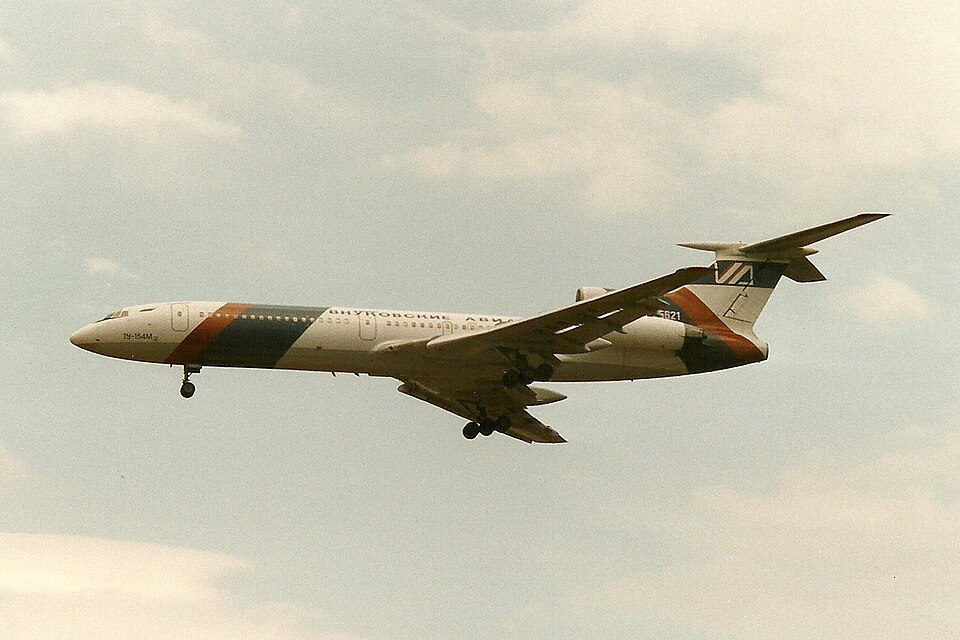
Background
Vnukovo Airlines flight VKO2801 was a chartered flight carrying workers and their families to coal mining towns on Svalbard. The aircraft departed Moscow-Vnukovo Airport at 04:44 UTC bound for Longyearbyen Airport on the Norwegian archipelago.
Flight and Descent
The flight was uneventful until descent. At 09:56, the crew received clearance to descend. Shortly after, they were given weather information: runway 28 in use, wind 230° at 16 knots, visibility over 10 km, rain showers, clouds few at 1500 ft, scattered at 2000 ft, broken at 4000 ft, temperature +5°C, dewpoint -0°C, and QNH 1005 hPa (later 1006 hPa). The crew twice attempted to request runway 10 for landing but were not understood by Longyear Information due to language difficulties.
At 10:15, the aircraft was overhead the ADV beacon. The crew began a base turn with a 22° bank angle, rolling out on magnetic heading 160° at 10:16. During the turn to base, a malfunction in the electric trimming mechanism occurred but was corrected. At 10:17, the crew initiated a turn to intercept the inbound course of 300°, as per the approach chart. At that time, the aircraft was 14 NM from the airport but deviated 2 NM left of the prescribed outbound track from ADV.
At 10:18, after two radio altimeter aural warnings, the co-pilot took controls and disengaged the autopilot pitch channel (roll channel remained engaged). The aircraft passed the localizer centerline and rolled out on heading 290°. The crew debated whether the turn was timely, leading to a corrective turn to heading 306°. The aircraft was then 14.7 NM from the airport, 2.8 km right of the centerline, at 5000 ft. Flaps were increased to 28°, airspeed reduced to approximately 180 kts.
Accident
Instead of intercepting the centerline, the crew flew parallel to the localizer with minor heading changes. At 10:20, a corrective turn brought the track near 300°, but lateral deviation increased to 3.7 km right. The aircraft began descending. Further turns followed. At 10:22:05, a left turn began when the aircraft was 8 NM from the airport. The aircraft entered strong turbulence near mountains. The GPWS activated 9 seconds before impact. The crew responded with power and pitch-up. At 10:22:23, 7.7 NM from the airport at 2975 ft, the aircraft struck the top of Mount Operafjellet, 3.7 km right of the approach centerline. All 141 occupants were killed, mostly mine employees and their families.
Official Findings
The investigation reported multiple findings: the HSI course was set to 283° instead of 300°, misleading the crew; the navigator likely set the wrong course on the GPS; the crew misunderstood the AFIS officer's authority; limited English proficiency hindered communication; the navigator was overloaded; pilots did not monitor the navigator; communication duties were improperly delegated; the co-pilot inappropriately transferred lateral control; poor crew resource management; no new approach briefing for runway 28; failure to intercept the outbound track from ADV; confusing HSI indications led to loss of situational awareness; pilots lacked approach charts during critical phases; unaware of VDF service for position check; over-reliance on GPS; descent in mountainous area without positive lateral control; and continued the approach despite uncertainty.