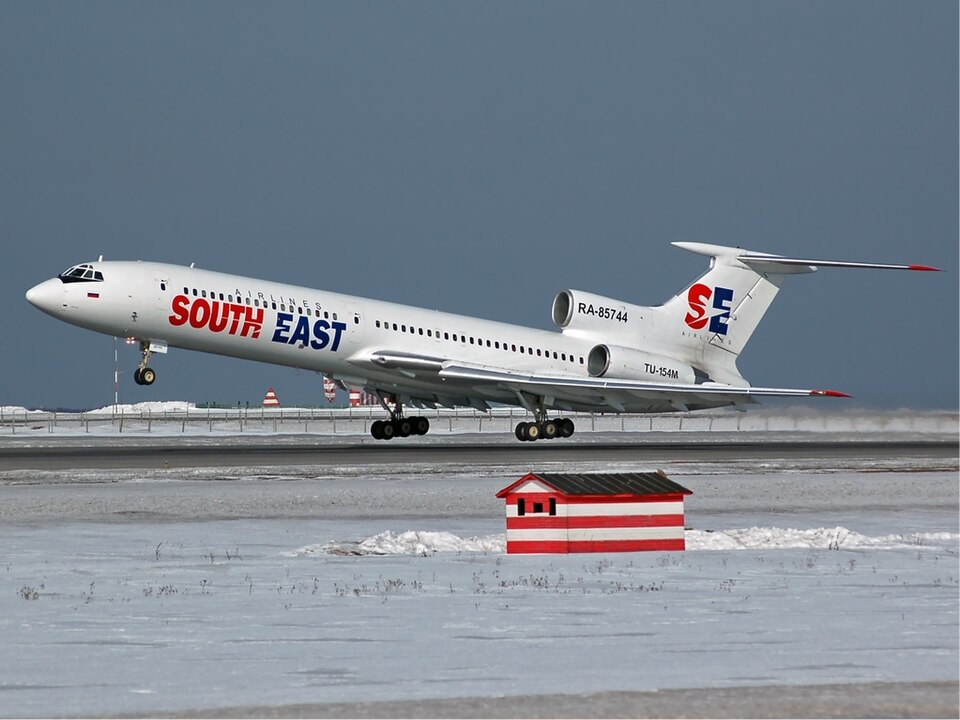
Incident Overview
Daghestan Airlines (Avialinii Dagestana) flight DAG372 departed Moscow-Vnukovo Airport at 1408 local time, bound for Makhatchkala, Daghestan. Fourteen minutes after takeoff, while cruising at an altitude of 9,000 meters approximately 80 kilometers south of Moscow, the crew informed air traffic control about the failure of engines number 1 and 3. The flight was cleared to return to Moscow-Domodedovo Airport.
Final Approach and Crash
On final approach, the aircraft descended below the clouds at a height of 500 feet but was not properly aligned with the runway centerline. It touched down hard to the right of runway 32R, went out of control, impacted an earth mound and bushed, and came to rest broken in two. Two passengers were killed, and 78 other occupants were injured.
Probable Cause
The official investigation identified the probable cause as erroneous actions by the crew, who, while landing in instrument meteorological conditions with one engine running, permitted the aircraft to touch down significantly to the right of the runway. These actions resulted from the following factors:
- The flight engineer inadvertently turned off the fuel booster pumps of the service tank while performing manual fuel transfer procedures during the climb, leading to fuel starvation, all engines spooling down, outer engines (number 1 and 3) shutting down, and loss of electrical power for 2 minutes 23 seconds due to loss of all three generators.
- Failure by the crew to use all available possibilities to restore on-board systems after generator number 2 was recovered and the auxiliary power unit (APU) spooled up and was successfully connected.
- Failure to comply with recommendations for flying with two engines inoperative and approach and landing with two engines inoperative.
- Lack of leadership and lack of management and distribution of responsibilities by the captain, leading to independent but not always accurate actions by other crew members, resulting from insufficient training in crew resource management.
- A complex wind environment varying with height, which contributed to deviation from the proper approach trajectory while the crew was flying on standby instruments rather than regular instruments.
- Insufficient training of the crew as a whole and each individual to act in emergency and complex scenarios.
- The non-implementation of safety recommendations developed in earlier investigations to prevent the flight engineer from inadvertently turning off the fuel booster pumps.