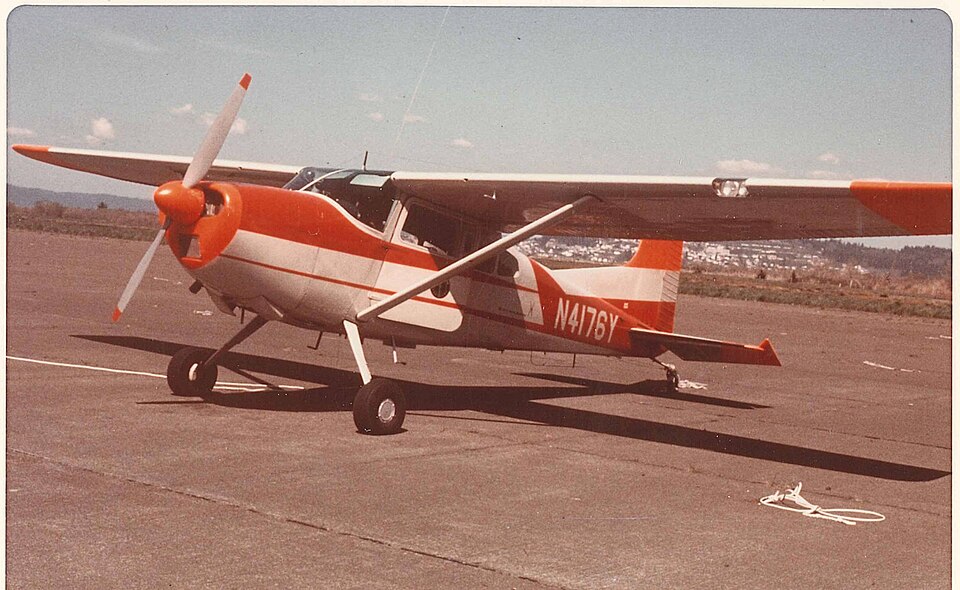
On September 22, 1993, a Cessna 185A (registration N4176Y) operated by Mcadams, John A. was involved in an aviation accident near DE Borgia, MT. Investigators recorded the probable cause as: THE PILOT'S POOR IN-FLIGHT PLANNING/DECISION AND HIS FAILURE TO MAINTAIN AIRSPEED ABOVE A STALL. This summary draws on records from the U.S. National Transportation Safety Board (NTSB) historical archive.
Aircraft registered N4176Y. Photo: R6, State & Private Forestry, Forest Health Protection / Public domain, via Wikimedia Commons
A witness observed an airplane perform a low pass over an unlit airstrip in dark night conditions, then pull up sharply and turn left before descending behind a hill, where flames became visible. Post-crash investigation revealed a nose-down, left-wing-low impact attitude with no evidence of mechanical failure.
Accident Overview
A witness reported that an airplane made a low pass over an unlit airstrip in dark night conditions. The witness initially believed the airplane was preparing to land, but noted that its airspeed was too fast for landing. Upon reaching the end of the airstrip, the airplane suddenly pulled up and executed a sharp left turn. It then descended behind a small hill, and shortly thereafter, flames were observed.
Post-Crash Findings
During the post-crash investigation, it was noted that the airplane had collided with terrain in a nose-down and left-wing-low attitude. Examination of the wreckage revealed no evidence indicating a mechanical failure or malfunction.
Witness Account
The sole witness described the sequence of events, emphasizing the airplane's excessive speed during the low pass and the abrupt maneuvers that preceded its disappearance behind the hill. The subsequent visible flames suggested an impact with the ground.