Casualties unknown

1995-05-21: North American T-6G (N2449) — Beaumont, TX

Beaumont, TX, US

On May 21, 1995, a North American T-6G (registration N2449) was involved in an aviation accident near Beaumont, TX. Investigators recorded the probable cause as: THE PILOT'S FAILURE TO PERFORM A GO-AROUND AND HIS FAILURE TO MAINTAIN AIRSPEED. FACTORS IN THE ACCIDENT WERE IMPROPER RUNWAY ALIGNMENT AND AN AFT CENTER OF GRAVITY. This summary draws on records from the U.S. National Transportation Safety Board (NTSB) historical archive.

Sourcesthe U.S. National Transportation Safety Board (NTSB) historical archivePrimary reportUpdated 1781061362Data APIEditorial standards
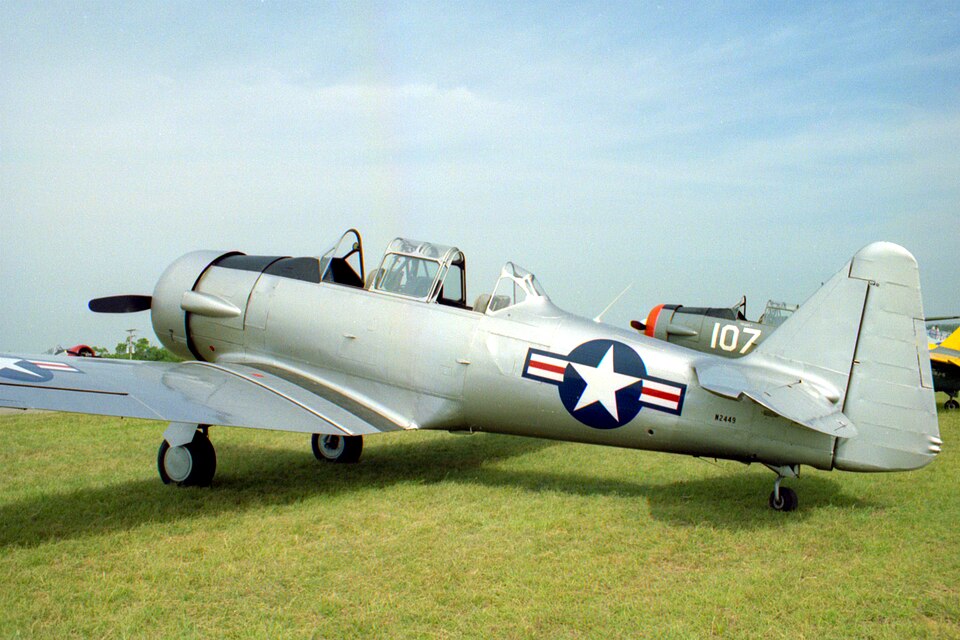
Aircraft registered N2449
Aircraft registered N2449. Photo: André Gerwing / CC BY-SA 4.0, via Wikimedia Commons

During a formation overhead approach, the lead T-6 aircraft, N2449, executed a sharp break and later experienced a loss of control on final, with the center of gravity calculated outside the allowable range.

Flight Description

A flight of seven T-6 aircraft formed in a right echelon for a 360-degree overhead approach for landing. The lead aircraft, bearing registration N2449, overflew a portion of Runway 16 at approximately 1,000 feet above ground level (AGL) before initiating its break for the overhead approach.

Sequence of Events

The lead aircraft executed a 'sharp' left break, achieving approximately 80 to 90 degrees of bank. The bank angle then decreased, and the landing gear and flaps were extended. During the base-to-final turn, the aircraft overshot the final approach course to the right of the runway. Subsequently, the aircraft banked back to the left of the centerline, with the bank angle increasing to 60 to 65 degrees. The left wing dropped, and the aircraft's nose pitched down. Just prior to impact, the aircraft made a left roll of less than one-quarter of a full rotation.

Weight and Balance Considerations

The calculated center of gravity (CG) for the aircraft at the time of the event was 34.7 inches. According to the weight and balance data, the maximum gross weight CG range is 27.5 inches to 32.5 inches. The calculated CG fell outside this allowable range.

Investigation report by the U.S. National Transportation Safety Board (NTSB) historical archive. Original record: https://carol.ntsb.gov/event/20001207X03442. This page is a structured re-presentation; facts and quotes are in the National Transportation Safety Board (NTSB), United States.