Incident Overview
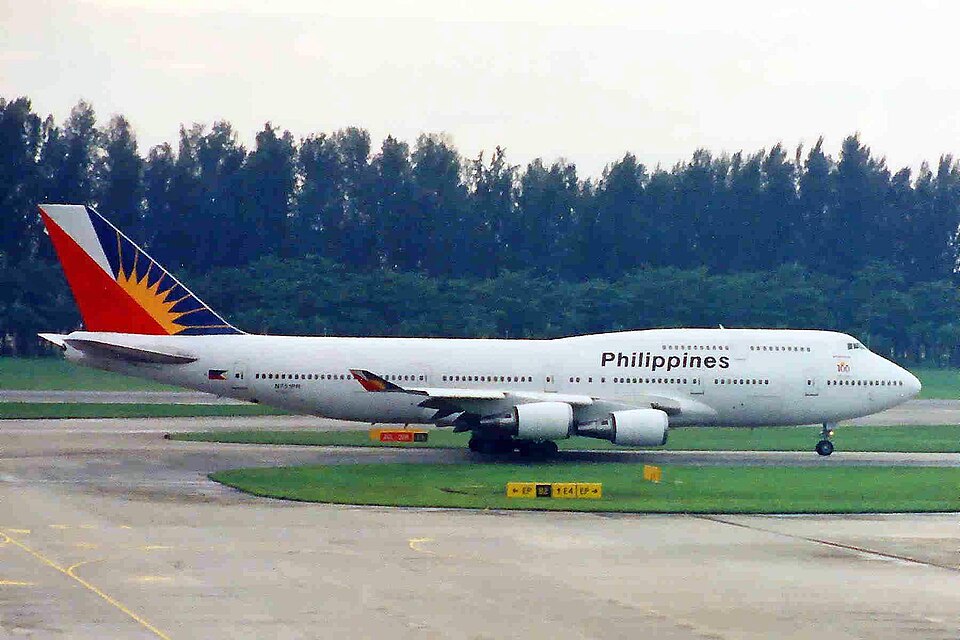
At night, a Boeing 747-4F6B, registration N751PR, taxied into a Boeing 747 SP-44, registration F-GTOM, during ground operations at Los Angeles International Airport (LAX). N751PR was proceeding westbound on taxilane "C" for its planned departure to Manila. F-GTOM had landed from France and was standing short of its assigned gate 101, oriented in a northwesterly direction with its left wing extending onto taxilane "C." Six ground service personnel were in proximity to F-GTOM, awaiting the connection of a tow tractor to pull it into the gate at the Tom Bradley International Terminal (TBIT). The collision occurred when N751PR impacted the aft portion of F-GTOM's left wing. N751PR's right wing's winglet was severed off, and F-GTOM's left wing was substantially damaged.
Sequence of Events
Air traffic control (ATC) had cleared N751PR to taxi past the stationary F-GTOM and make a 90-degree turn onto a nearby taxiway. The ground crew's wing walkers for the standing airplane were aware that its left wing was partially blocking taxilane "C." One of the wing walkers issued its company-authorized "engine operating" signal, which was observed by N751PR's crew. This nonstandard signal was interpreted by the departing airplane's crew as an "all clear to taxi" signal in accordance with the standard hand signals published in the FAA's Aeronautical Information Manual and by its airline.
The collision occurred as N751PR commenced a sharp left turn from the centerline of taxilane "C" toward a perpendicular taxiway. During the turn, the effective length of the airplane's wing increased. The right wing tip was not visible to the captain; he relied upon his first officer and crewmembers to monitor its proximity to the standing airplane. However, after passing abeam the standing airplane's empennage and observing the wing walker's "all clear signal," the first officer redirected his attention toward their new course and away from the standing airplane's left wing.
Airport Layout and Previous Incidents
Due to a lack of available ground area and to accommodate the airport's need for additional airplane movement areas, the FAA had approved a reduction in clearance between the terminal gates and the adjacent taxiway/taxilane. Airport management was aware of the collision hazard related to the proximity between taxilane "C" and adjacent terminal gates. During the previous five-year period, three other collisions had occurred between Boeing 747 airplanes on the taxilane.
Regulatory and Procedural Issues
TBIT airport management personnel were responsible for enforcing published airport rules that required the arriving Boeing 747 SP-44 (F-GTOM) to power into gate 101, which was equipped with an operative docking light guidance system. However, this guidance system had not been used by the contract ground service company for several years. The TBIT management personnel failed to enforce the policy and allowed the ground service personnel to stop the arriving F-GTOM short of gate 101, thus partially blocking taxilane "C." The ground personnel, using their outdated airport rules manual (that directed a tow-in procedure), planned to utilize a tow tractor to pull the airplane the remaining distance to the gate. This was contrary to the revised manual, which required a power-in procedure. Airport management had failed to ensure that all manual holders were using updated versions of the manual.