Preflight and Flight Details
A student pilot, under the supervision of a flight instructor, conducted a preflight inspection for a dual instructional flight using the checklist. The student checked the fuel gauges and visually inspected the tanks, but did not use a dipstick to confirm the exact fuel quantity. He estimated that each tank was about three-quarters full. Fuel samples taken from the wings and the fuel strainer were free of water and debris. The student performed the engine start, run-up, and before-takeoff checks, and all indications were normal.
Maneuvers and Power Loss
The flight proceeded to the local training area, where the student executed steep turns. The instructor noted minor deficiencies in the student's technique and demonstrated the use of pitch and power to smooth the maneuver. They then transitioned to minimum-controllable-airspeed maneuvers before practicing power-off stalls. During a stall recovery, the instructor observed a reduction in engine power. He adjusted the throttle, mixture, and carburetor heat controls, but the engine stopped producing power and the propeller ceased rotating.
Emergency Descent and Landing
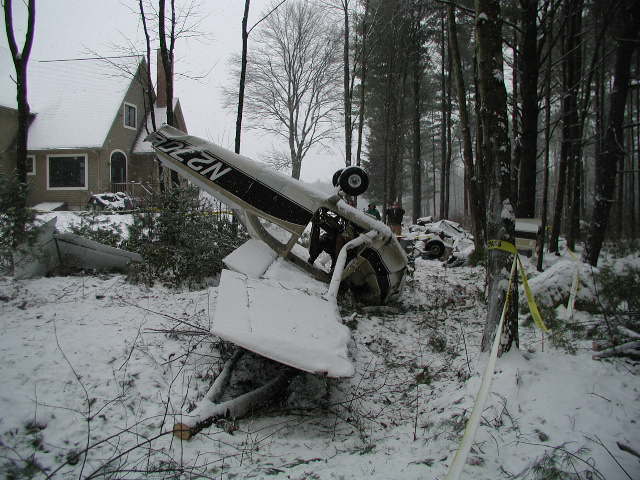
During the subsequent descent, the instructor contacted air traffic control, declared an emergency, and selected a field for a night forced landing. The airplane struck trees before reaching the field, descended to the ground, nosed over, and came to rest inverted.
Post-Accident Examination
At the accident scene, there was only a faint odor of fuel and no evidence of fuel spillage. No fuel was found in either fuel tank. An examination of the engine revealed no anomalies.