Background
The accident involved a Part 135 on-demand charter flight returning two passengers to the base airport. The multi-destination flight had originated from the accident airport approximately 16 hours prior. The crew consisted of a captain and a first officer.
Incident Sequence
On the final leg, the flight encountered stronger than anticipated headwinds. The first officer expressed concern several times about the remaining fuel. Approaching the destination, the captain became concerned about an extended downwind leg and informed the air traffic control tower (ATCT) specialist that the flight was low on fuel. The ATCT specialist cleared the aircraft for a priority landing.
According to cockpit voice recorder (CVR) data, when the crew attempted to lower the wing flaps, they discovered the flaps would not extend beyond 8 degrees. After lowering the landing gear, the captain stated to the first officer, "The gear doors are stuck down.... no hydraulics." He also said, "Okay, so we're gonna do, this is gonna be a ref and twenty...All right, probably not going to have any brakes..."
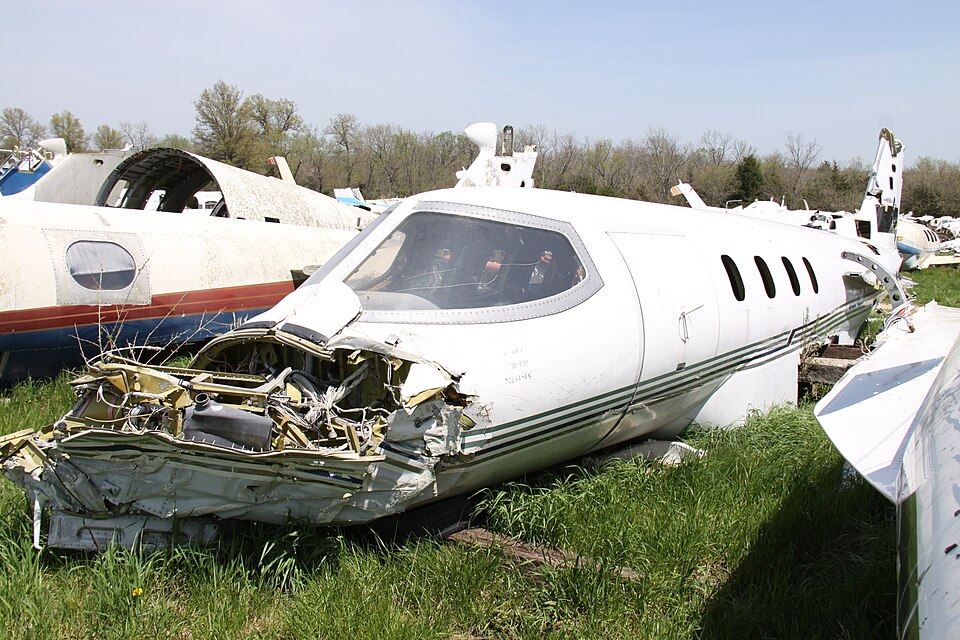
An ATCT specialist reported that the aircraft touched down about midway on the 6,001-foot-long dry runway. It continued to the end of the runway, entered the overrun area, struck a chain link fence, crossed a road, and struck a building.
Postaccident Findings
During a postaccident interview, the captain stated that during the landing roll, the first officer was unable to deploy the emergency drag chute. The captain also said that neither he nor the first officer attempted to activate the nitrogen-charged emergency brake system. The aircraft was not equipped with thrust reversers.
An examination of the hydraulic pressure relief valve and pressure regulator assembly revealed numerous indentations and small gouges on their exterior portions, consistent with being repeatedly struck with a tool. Testing and disassembly of the hydraulic pressure relief valve showed that the valve piston was stuck open.
The emergency drag chute release handle was designed with two safety latches that must be depressed simultaneously to activate the parachute. Inspection of the emergency drag chute system and release handle disclosed no preaccident mechanical anomalies.