Incident Overview
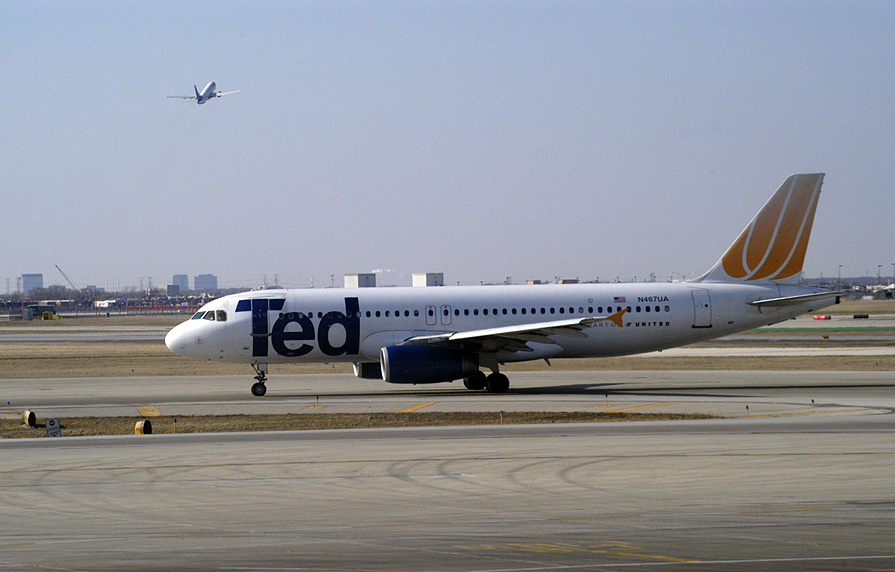
During pushback at Denver International Airport's Gates A46 and A48, two Airbus A320 aircraft—one operated by United Airlines and one by TED—experienced a wingtip collision, resulting in minor damage to both airplanes. The incident occurred when the United A320 was taxiing after pushback while the TED A320 remained connected to its tug.
Sequence of Events
The captain of the United A320 reported that during pushback, the TED A320 was being pushed back at an angle toward their position. He relayed his concern to the ground crew but did not receive a clear response. As the TED A320 approached, two persons from the push crew ran out, apparently to get a better view. Both airplanes were finally stopped in close proximity, with the United aircraft positioned east of its push line, toward the other aircraft.
The captain requested that his tug remain in place in case they needed to return to the gate for a sick passenger. When it was determined that the passenger could fly, they started engines and released the pushback crew. The crew disconnected and received a salute and release from guidance for a left turn out.
At that time, the TED A320 was still connected to its tug. One of its ground crew was standing to the left front of the airplane, facing aft, looking toward the United aircraft and holding his right hand overhead with his left arm out and slightly raised, indicating wingtip clearance distance. The United captain taxied slowly forward at idle thrust and eased toward the left. After a short distance, the wingtips collided.
The United first officer noted that both he and the captain looked at a ground crew member standing in front and between the two airplanes, holding a wand raised and other arm extended horizontally to indicate wing clearance. After receiving taxi clearance for a left turn out, the first officer provided a visual check and cleared the captain on the right. As they began moving, the first officer glanced forward and then looked back to the right, where the wing walker had disappeared, and the wingtips made contact.
One ground crew member on the TED A320 stated he was wing walking on the first officer's side. Another ground crew member was on the captain's side. The first ground crew member said the other crew member stopped the pushback. He went around to see what was happening and observed the wings of the two airplanes about 20 to 30 feet apart. He then looked at the United first officer and gave him a hold sign. He subsequently went to the tug operator to discuss the aircraft's position. As he talked with the tug operator, the United A320 proceeded to move and clipped the wing of the TED A320.
Procedures Cited
United Airlines pushback procedures for Gates A46 and A48 at Denver International Airport state: "The coordination of the pushback must include ... verbal agreement between gate crews ... on which aircraft is being moved first, [and] continual visual observance of the clearance between aircraft."