History of Flight
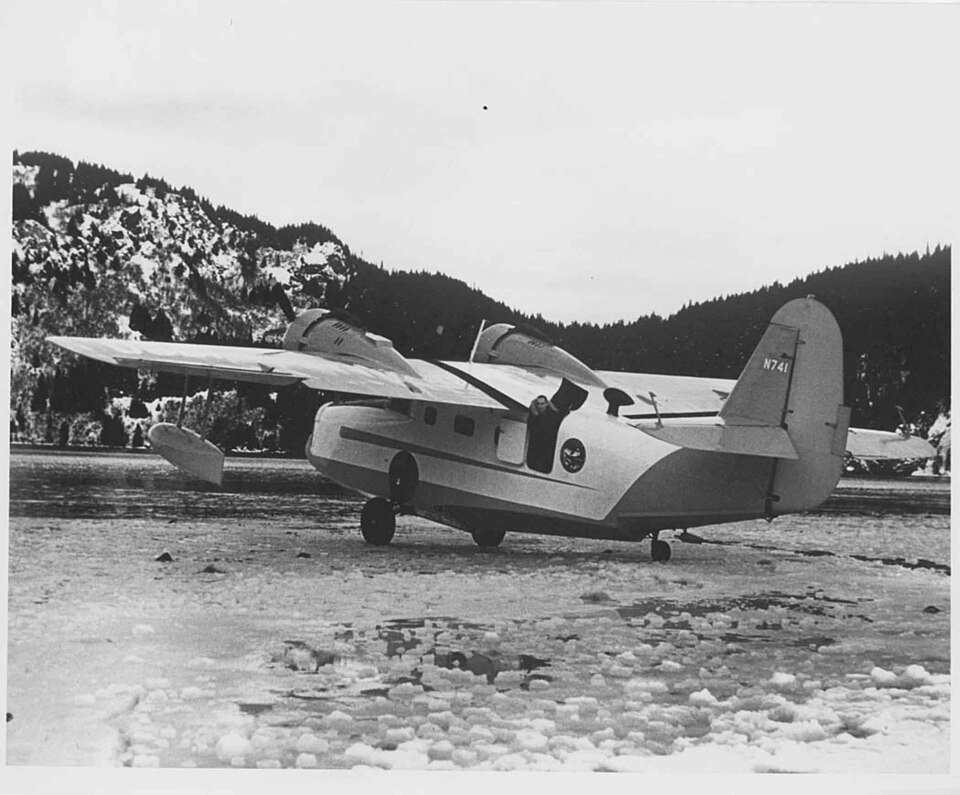
On April 9, 2008, about 1630 Alaska daylight time, an amphibious Grumman G-21A airplane (registration N741) operated by Peninsula Airways, Inc., as scheduled commuter Flight 325 under 14 CFR Part 135, was on approach to Runway 30 at Unalaska Airport, Alaska. The flight originated at Akutan Sea Plane Base about 1615. Of the nine people on board, the airline transport pilot and seven passengers sustained minor injuries, and one passenger sustained serious injuries. The airplane received substantial damage after colliding with a trailer van.
Ballyhoo Road, which provides access between Unalaska and the city dock facility, crosses the approach path of Runway 30. Two remotely controlled gates with warning lights are designed to block vehicle traffic during landings on Runway 30; when activated, runway end identifier lights (REIL) also activate. Prior to landing, pilots are instructed to activate the gate and warning light system.
The truck driver reported that he was transporting a 45-foot-long by 13-foot-tall trailer van from the Horizon Lines trailer yard to the city dock facility. As he approached the road crossing, he saw the warning lights flashing but the gates were not closed. He stopped for about 45 seconds, then, not seeing any landing traffic, drove forward. Shortly after passing the flashing lights, he heard a loud bang and the truck rocked left; he then saw the airplane collide with the runway on the left side of his truck. The driver stated that during his four months in Unalaska, the gates had never worked, and the flashing lights would activate with no arriving traffic and remain on, blocking traffic for long periods.
The accident pilot reported that during initial approach, he activated the remotely controlled traffic warning devices as required. He saw the REIL strobe lights and observed a large truck and trailer rig stopped adjacent to the southern gate. He configured the airplane for landing and continued to watch the truck. As the airplane neared the threshold, he realized the truck was moving onto the road. He applied full engine power for a go-around, but the aft section of the airplane's belly and empennage struck the top of the trailer van. Immediately after the collision, the pilot had no elevator control, and the airplane descended nose-down, colliding with the runway and sliding several hundred feet. The pilot stated no preaccident mechanical anomalies existed.
Personnel Information
The pilot held an airline transport pilot certificate with airplane multiengine land and sea ratings, and commercial privileges with single-engine land and sea ratings. His most recent first-class medical certificate (issued November 28, 2008) required corrective lenses. According to the NTSB Pilot/Operator Aircraft Accident Report, his total flight time was 7,040 hours, with 320 hours in the accident aircraft make and model. In the 30 days before the accident, he flew about 9 hours; in the preceding 90 days, about 22 hours. His most recent proficiency check (CFR Part 135.293) occurred on May 30, 2007, administered by a company check airman in the same make and model.
Aircraft Information
The airplane was a Grumman G-21A equipped with two Pratt & Whitney R985-AN-14B radial engines (450 horsepower each). Maximum gross weight was 9,200 pounds; estimated weight at accident was 8,833 pounds. It was not equipped with a cockpit voice recorder or flight data recorder. The aircraft was maintained under an Approved Aircraft Inspection Program with inspections every 50 and 100 flight hours. At the time of the accident, the airframe had accumulated 12,228 hours, with 10.2 hours since the most recent "A" check.
Meteorological Information
At 1616, the Unalaska Airport METAR reported wind from 30 degrees (true) at 9 knots gusting to 15 knots; visibility 10 statute miles; overcast ceiling at 2,200 feet; temperature 30°F; dew point 21°F; altimeter 29.98 inHg.
Communications
About three minutes before the accident, the pilot announced intentions to land on Runway 30 over the airport's Common Traffic Advisory Frequency (122.6). He then keyed his microphone seven times to activate the remotely controlled gate and warning light system. No further radio communications were recorded.
Aerodrome and Ground Facilities
The Unalaska Airport is owned by the State of Alaska and certified under 14 CFR Part 139. It has a single runway (3,900 ft long, 100 ft wide) with displaced thresholds of 100 feet at both ends. Runway 30 has high intensity runway lights, REIL, and a VASI. Near the threshold, two remotely controlled gates with warning lights are designed to block vehicle traffic during landings. The Airport Facility Directory (AFD) Alaska Supplement states: "Stop light for vehicle traffic crossing Runway 30 threshold must be activated and deactivated for each aircraft operation over the threshold" and recommends aircraft cross the threshold at a minimum height of 25 feet.
The gate system was originally installed in 1994. The State of Alaska's Regional Safety and Security Officer reported the gates had been out of service for more than a year due to budgetary constraints and pending equipment upgrades. The airport conducted daily inspections, but archived condition reports from the past 10 years showed no mention of the inoperative gates. No NOTAMs or advisories warned pilots that the gate system was inoperative. On April 25, 2008, FAA inspectors noted discrepancies concerning the inoperable gate system, including inadequate fencing and no formal procedures for gate operation.
Wreckage and Impact Information
The accident site was documented by the Unalaska Police Department. After colliding with the trailer van, the airplane descended uncontrollably nose-down and struck the runway about 322 feet from the van. The main landing gear collapsed, and the wreckage slid 560 feet on the paved, dry runway, coming to rest on the right side oriented on a 70-degree heading. Debris included plexiglas, aluminum, a door frame, and landing gear components. Both wings remained attached; the right wing sustained outboard damage, the left wing minor damage. The fuselage was extensively crushed and distorted, with the primary crush zone in the cockpit and front passenger area. The underside of the amphibious hull was crushed upward and inward, exposing crushed elevator control push-pull tubes. No preaccident mechanical anomalies were discovered.
Additional Information
On November 9, 2008, construction of a new gate system was completed and fully operational. Effective March 12, 2009, the FAA published updated AFD procedures for Unalaska Airport, including note: "***DANGER*** There is a road crossing the approach of RWY 30. Warning System and Gates must be activated. The gates are controlled by Pilot Controlled Lighting (PCL) on frequency 122.6 (CTAF). This frequency controls the REILS, MIRLS, and the gates."
The accident truck driver did not have a valid driver's license, and his commercial driver's license was suspended, according to the Unalaska police officer assigned to the case.
The Safety Board released the wreckage to the owner's representatives on April 23, 2008.