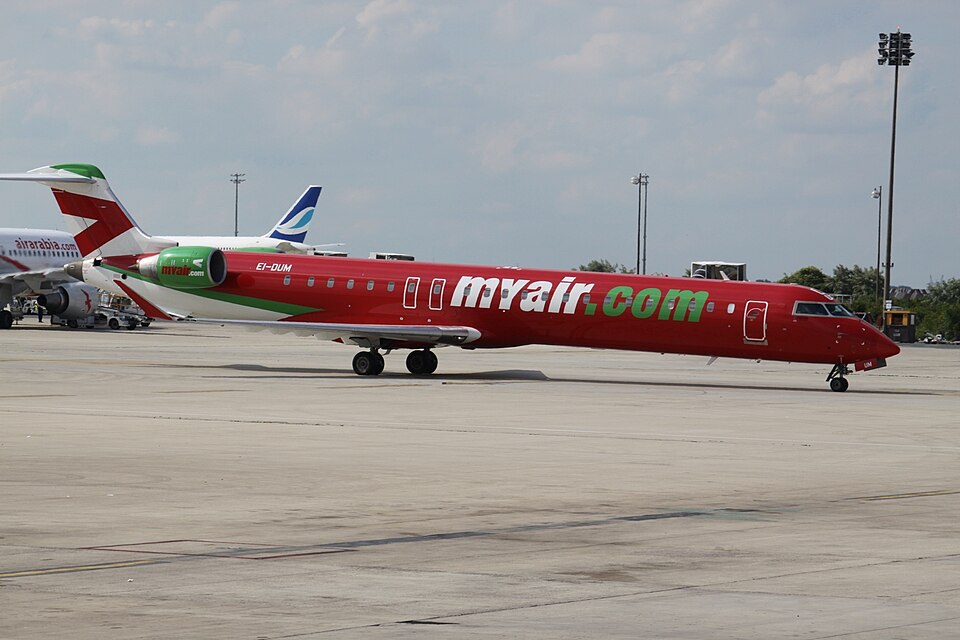
Incident Overview
On the evening of 26 May 2008, at 21:50 local time, a baggage tug operated by Romanian Airport Services SA struck the left wing of a CRJ 900 aircraft (registration EI-DUM, operator My Air) at Bucharest Baneasa International Airport (LRBS). The tug had just completed loading baggage into the aircraft's hold and was moving away when the collision occurred, resulting in damage that removed the aircraft from service.
Damage Assessment
The aircraft sustained damage to the trailing edge upper wing closure panel (heavily damaged), the lower wing closure panel (heavily damaged), the trailing edge ribs (heavily deformed), the lower metal support band (heavily deformed), and the static dischargers on the trailing edge panel (lightly damaged). The baggage tug also suffered damage, including a broken windshield and deformed cabin structure.
Investigation Findings
The investigation revealed several deficiencies in the movement area regulations at Bucharest Baneasa Airport:
- The traffic regulations were incomplete and permissive, allowing vehicles to operate without requiring drivers to possess an airport-issued driving license obtained through examination by an airport-appointed committee.
- The regulation lacked an internal and external distribution list, making it impossible to ensure that all authorized operators used the current version for staff training.
- No explicit responsibility was assigned to the ground control unit for managing traffic on the aircraft parking apron.
- Vehicles operating on the movement area were not required to have communication equipment for radio contact between operator and traffic director in the aircraft safety zone.
- Oversight of compliance with traffic regulations on the movement area was ineffective.
- Markings for vehicle traffic on the movement area were incorrect, not clearly explained or highlighted in the regulations, and not observed.
- On certain directions, the movement area lighting system may have disturbed operators while maneuvering.
Conclusions: Causes
Determining Cause: Error by the tug operator while maneuvering the vehicle during aircraft servicing, and error by the person responsible for directing the approach or removal of the technical equipment from the aircraft.
Contributing Cause: Lack of coordination in the activity of removing servicing equipment from the aircraft safety zone.
Safety Recommendations
The investigation commission issued three safety recommendations: 1. Revise the traffic regulations for Bucharest Baneasa Airport to comply with Romanian Civil Aviation Regulations (RACR-PETA, Edition 01/2008). 2. Implement a Vehicle Tracking System (VTS) to monitor vehicle and equipment movements on the maneuvering areas. 3. Reevaluate the lighting system of the technical area at Bucharest Baneasa Airport.