History of Flight
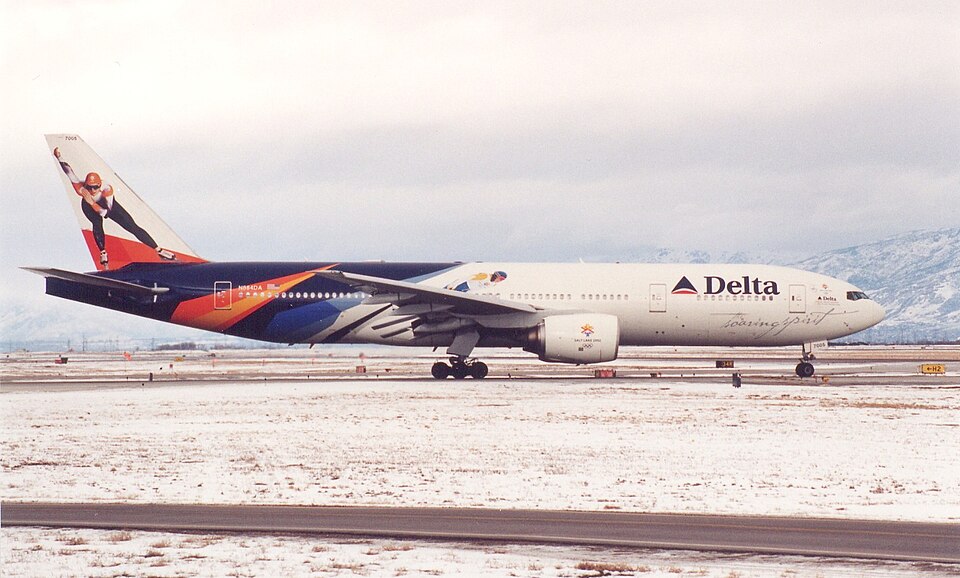
On January 2, 2009, about 1028 eastern standard time, a Boeing 777-232ER, N864DA, operating as Delta Air Lines flight 55, experienced a contained fan blade separation in the No. 2 (right) engine during takeoff roll at Hartsfield-Jackson Atlanta International Airport, Atlanta, Georgia. During the takeoff roll at about the 80-knots callout, the pilots felt the airplane shudder and observed the No. 2 engine’s exhaust gas temperature (EGT) go to redline. They rejected the takeoff and taxied clear of the runway, stopping on an adjacent taxiway where they shut down the No. 2 engine. Airport fire department personnel checked for fire but found none. The airplane taxied back to the gate under its own power; passengers and crew deplaned normally. No injuries were reported among the 4 pilots, 11 flight attendants, and 242 passengers. The flight was operating under 14 CFR Part 121 as an international flight from Atlanta to Narita International Airport, Tokyo, Japan.
Damage to Engine and Airplane
Examination of the No. 2 engine revealed one fan blade fractured transversely across the root shank adjacent to the dove tail bedding flank. A 7-inch long piece of the root remained in the fan disc slot. The fracture surface showed an elliptical pattern radiating from the convex side. A broken piece recovered from the runway matched that pattern. All remaining fan blades had nicks and tears; several had missing outer portions with delamination. No evidence of bird strike was found. The fractured blade was contained within the fan case and Kevlar wrap, which bulged but had no through-holes. The fan case had cuts and gouges but no through-holes. The engine inlet duct had through-holes in the upper part; trajectory analysis indicated debris would not have struck the airplane. The fuselage had a dent with gouges above the window belt between doors 1R and 2R; trajectory analysis showed debris came from the engine inlet. The right wing underside and flap jackscrew fairings had gouges and dents but no holes.
Engine Information
The airplane was equipped with two Rolls-Royce RB211-Trent 895-17 turbofans. The No. 2 engine, serial number 51191, had accumulated 35,206.3 hours and 4,867 cycles since new. It had 18,036.8 hours and 1,914 cycles since last overhaul in May 2005, and 7,050 hours and 591 cycles since installation in September 2007. Originally a Trent 892-17, it was upgraded to the 895-17 thrust rating at last overhaul.
Fan Blade History
The fractured fan blade, part number FW22129 ASSY, serial RGG16701, had accumulated 33,499 hours and 4,657 cycles since new, with a published life limit of 10,000 cycles. Originally manufactured as PN FK30842ASSY, it was reworked per Rolls-Royce Service Bulletin RB.211-72-D672 at 2,742 cycles, involving grit blasting, laser shock peening (LSP), shot peening, and plasma spraying.
Flight Recorders
Flight data recorder (FDR) data showed both engines started at about 0949. After start, N1 and N3 were matched except around 0954 when No. 2 engine rpm increased temporarily; pilots stated they shut down No. 2 during taxi due to air traffic delays. No. 2 was restarted at 1021. At 1027:52, both engines N1 increased together, stabilizing at 95% at 1028:04. At 1028:20, No. 2 engine N1 and N3 dropped to zero. Concurrently, No. 1 engine vibration levels increased then dropped. FDR showed momentary warnings for No. 2 EGT exceedance and failure. Cockpit voice recorder audition did not reveal issues with crew performance.
Research and Testing
Metallurgical examination of the fractured fan blade root revealed an elliptical fatigue crack originating on the convex side aft corner shear key slot corner radius. The crack progressed 1.4 inches across the shank and 5.2 inches rearward. Titanium alloy conformed to material requirements; no material anomalies or preexisting defects were found at the origin. CAT scans confirmed geometry per engineering drawings. LSP and shot peening were confirmed. The metal spray coating on the blade root was significantly worn. According to Rolls-Royce, prior to this incident, the spray coating had a soft life limit of 4,000 cycles and dry film lubricant (DFL) should be reapplied every 1,200 cycles. Delta’s records showed coating reapplied at 1,915 cycles before the incident and DFL at 250, 390, 680, and 1,480 cycles. After the incident, Rolls-Royce revised and reduced these intervals. A review of operational data found Delta made more high thrust takeoffs than other Trent 895 operators, though within limits. Rolls-Royce analysis stated that higher stress levels from Delta’s operations contributed to deterioration of the plasma spray coating and loss of DFL, but were insufficient to initiate the crack. They indicated that residual fatigue life usage in the bedding flanks, in conjunction with high stress, worn coating, and loss of DFL, caused the crack and subsequent fracture.
Other
The Rolls-Royce RB211 Trent 895-17 engine is certificated in the United Kingdom. The Air Accidents Investigation Branch (AAIB) was notified and appointed an accredited representative.