Event History
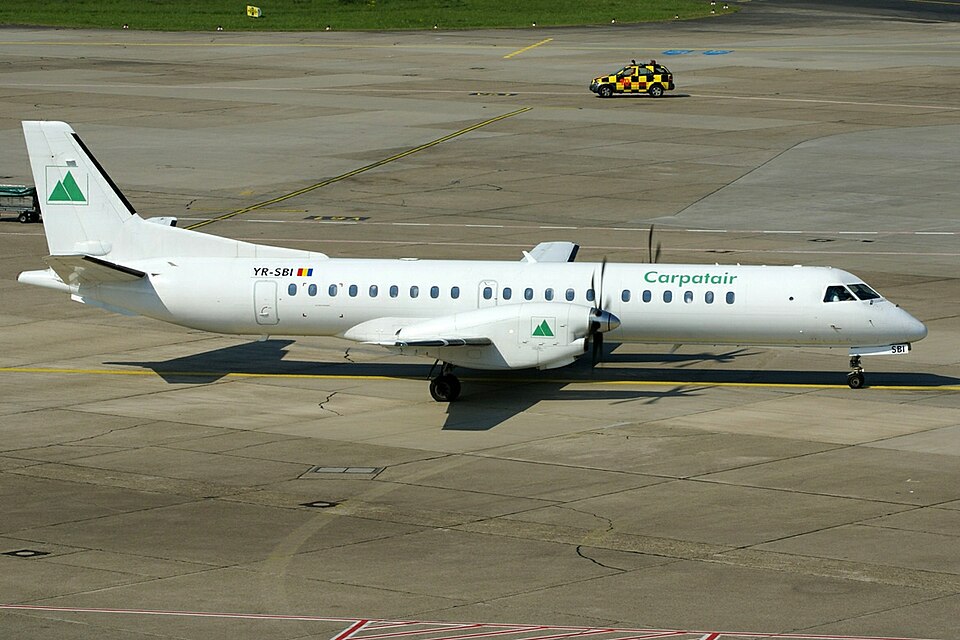
On 28 February 2009, at 08:05 local time (06:05 UTC), a SAAB 2000 aircraft with registration YR-SBI, operated by Carpatair, was on a flight from Chișinău to Timișoara. During the final approach, after the landing gear extension procedure, the nose landing gear remained in an intermediate position instead of fully extending and locking. The crew entered a holding pattern near the TSR NDB and repeatedly cycled the gear and performed the emergency extension procedure. They then conducted a low pass over Timișoara Airport for ground personnel to visually confirm the nose gear position. Upon confirmation that the nose gear was not extended, the crew executed positive-load maneuvers to try to free the gear, all unsuccessful. The crew declared an emergency and decided to perform a forced landing.
Landing and Evacuation
The airport administration, in coordination with the emergency services, prepared the runway by applying firefighting foam. The aircraft made contact with the runway on the main landing gear, then the crew controlled the descent of the nose until it contacted the foam-covered runway. After the aircraft stopped, all 4 crew members and 48 passengers were evacuated through the main door. No injuries were reported.
Damage
Externally, the aircraft showed no major damage. During subsequent examination, damage was found to the propeller assemblies and the nose gear doors. After disassembling the nose gear system, it was found that the lock pin of the piston was damaged, with fragments found at the bottom of the piston chamber, outside it, and in contact with the self-centering cam. The migration of these fragments had damaged the nose wheel centering system.
Investigation Findings
After the aircraft was jacked in the hangar, multiple gear extension and retraction cycles were performed, and the control system functioned correctly. It was determined that the nose gear had not extended because the left tire had made direct contact with the edge of the gear door, jamming the movement. This occurred because the nose wheel assembly was not aligned with the aircraft centerline; the wheels were rotated 10 degrees to the right. This misalignment persisted even after the gear was down and unloaded.
The investigation commended the crew's actions, particularly the controlled descent of the nose after main gear contact, which prevented a hard impact and likely avoided major structural damage.