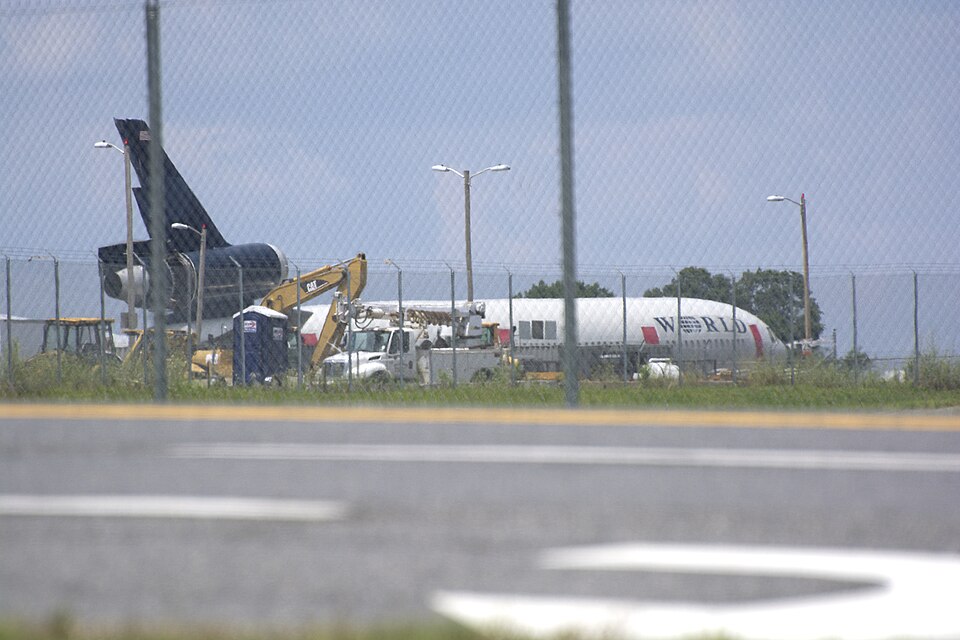
Accident Overview
On May 6, 2009, at approximately 1302 Eastern Daylight Time, World Airways flight 8535, a Boeing DC-10-30 (registration N139WA), experienced a hard landing on runway 10 at Baltimore/Washington-Thurgood Marshall International Airport (BWI) in Baltimore, Maryland. The flight crew executed a go-around and subsequently landed on runway 33L. The flight was a non-scheduled international passenger operation under 14 CFR Part 121, transporting troops returning from Iraq under contract with the U.S. Department of Defense Air Mobility Command. It had departed Leipzig, Germany at 0700 central European time.
Sequence of Events
The approach to BWI was routine, with visual flight rules weather and light traffic. The aircraft was established on the ILS runway 10 approach, descending through 1,500 feet at 150 knots. The captain, who was the pilot flying, reported the approach was stable. At approximately 500 feet, the landing gear was down and flaps set to 35 degrees. The crew noted a departing aircraft on a crossing runway, and the autopilot was disengaged. Power briefly increased at about 100 feet, then decreased until touchdown.
The aircraft began a pitch-up flare at about 45 feet above the runway threshold. The main landing gear touched down first with a nose-up attitude of about 5.5 degrees and a peak vertical acceleration of 1.6G, described by the crew as a "firm" touchdown. The airplane bounced slightly, extending the main struts and possibly becoming airborne momentarily. The captain perceived the bounce and nose pitch-up, and attempted to re-establish a normal landing attitude. Recorded data showed the control column shifted from pull to push for two seconds, causing a rapid decrease in pitch attitude. As the nose-down pitch rate increased, the column returned to pull, and the nose landing gear struck the runway at a pitch attitude below zero with a recorded vertical acceleration spike of 2.8G. The captain reported feeling no elevator authority to arrest the derotation.
The cockpit voice recorder captured a sound consistent with spoiler handle activation, but shortly after, the flight engineer called "no spoilers." Spoiler and handle position were not recorded parameters; Boeing performance analysts suggested that the spoilers might have been knocked down due to throttle advance.
The pitch attitude rebounded, reaching 10 degrees nose-up in less than two seconds. Both pilots reported a rapid pitch rise. The control column again switched to push, and engines 1 and 2 began spooling up. Pitch dropped rapidly, and the nose landing gear impacted the runway a second time with a peak vertical acceleration exceeding 3.2G. Some flight data recorder dropouts occurred at this point. Engines 1 and 2 were accelerating through approximately 85% N1, and engine 3 through about 50%. The pitch attitude rebounded again, and a go-around was initiated with all three engines at climb power.
During the climb-out, smoke appeared in the cockpit, diagnosed by the crew as an overheating air conditioning pack. Some attitude instrumentation was lost, inertial reference units were damaged and dislodged, and the #1 hydraulic system failed. The captain declared an emergency. The controller advised the crew that they appeared to have damaged the nose gear and left debris on the runway.
The controller-in-charge activated the crash phone and called an "Alert II," notifying airport rescue and firefighting equipment and the airport authority. The flight was vectored for a visual approach to runway 33L, remaining in visual conditions and using standby instruments due to instrumentation failures. The flight deck crew prepared for a landing with blown nose tires and communicated with the cabin crew twice for an emergency landing. The landing and rollout on runway 33L were successful, with ARFF vehicles standing by and responding immediately as the aircraft stopped.
Injuries and Damage
The first officer experienced a serious neck injury. The captain, flight engineer, and nine flight attendants reported minor injuries. No additional injuries were reported among the 168 passengers.
The aircraft sustained substantial damage. The nose landing gear right tire and wheel were damaged. There was extensive skin damage, buckling, and cracking in the forward fuselage area. The right-hand portion of the forward pressure bulkhead was severely buckled and fractured. The left nosewheel tire burst and shredded the carcass, requiring the right tire to be discarded due to overstress. Numerous components in the electronics equipment bay were dislodged and damaged, and the #1 hydraulic system failed.
Personnel and Aircraft Information
The captain, age 40, had worked for World Airways since June 2001, holding an Airline Transport Pilot certificate with type ratings in the DC-10, MD-11, and SF-34. He had 6,500 total flight hours, including 193 hours on the DC-10. He reported feeling ill on the accident flight, experiencing digestive system discomfort. The first officer, age 37, had worked for World Airways since April 2008, with an ATP certificate and type ratings in the DC-10, CE560, and Lear, and reported 6,300 total flight hours (373 on DC-10). The flight engineer had 3,580 total hours, with 621 as flight engineer on the DC-10.
The aircraft, N139WA, was a Boeing McDonnell-Douglas DC-10-30 (serial number 46583) equipped with General Electric CF6-50C2 engines, with approximately 107,814 total airframe hours. No relevant maintenance issues were noted.
Additional Findings
Meteorological conditions at the time included calm wind, 10 miles visibility, few clouds at 2,100 feet, temperature 17°C, and no precipitation. The ILS runway 10 showed no anomalies. The runway was dry. The digital flight data recorder was a Lockheed LAS 209 mylar tape unit recording 22 parameters, but pressure altitude was not recorded properly, and elevator position parameters could not be converted with valid data. The cockpit voice recorder functioned normally. Toxicological samples from the flight crew were negative. No fire occurred; smoke was from an overheated air conditioning pack. An aircraft damage and performance study was conducted by Boeing with NTSB oversight.