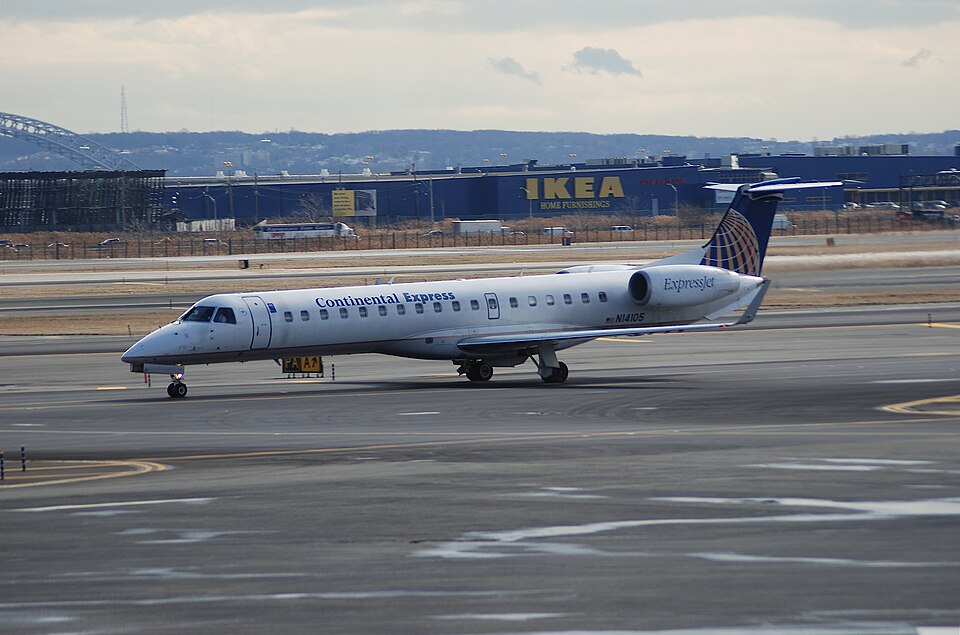
10 Aug 2010: EMBRAER EMB-145XR — Express Jet Airlines

10 Aug 2010: EMBRAER EMB-145XR (N14105) — Express Jet Airlines

No fatalities • Salt Lake City, UT, United States

Probable cause

An in-flight collision with a bird while on the downwind leg of the traffic pattern during a visual approach.

— NTSB Determination

Accident narrative

On August 10, 2010, about 1340 mountain daylight time, an Embraer EMB-145XR, N14105, collided with a large bird while on a downwind for a visual approach to Salt Lake City International Airport, Salt Lake City, Utah. The two flight crew members, the two cabin crew members, and the 46 passengers were not injured, but the airplane, which was owned and operated by Express Jet Airlines, sustained substantial damage. The 14 Code of Federal Regulations Part 121 scheduled passenger flight, which departed Houston-Bush Airport at 1136 central daylight time, was being operated in visual meteorological conditions (VMC). The airplane was on an Instrument Flight Rules (IFR) flight plan.

According to the pilot, while the airplane was about five miles north of the airport, on a downwind for a visual approach in visual meteorological conditions, it flew through a flock of large birds about 6,900 feet above ground level (agl). A few seconds prior to the impact, as the airplane was being slowed from 280 knots to 190 knots, the Captain, who was the pilot doing the flying, looked at the instrument panel to check his instruments. When he looked back up he saw what he thought was at least six seagulls directly in front of the airplane. Neither he nor the First Officer had seen the birds prior to that moment in time. Because of their close proximity, there was no time to make control inputs to avoid them, and therefore one of the birds impacted the airplane forward of its windscreen. Because the bird penetrated into the forward avionics department, the Captain lost a number of his primary instruments, so he transferred control of the airplane to the First Officer, who completed an uneventful visual approach. When the airplane was inspected by emergency personnel on the taxiway, it was determined that a section of skin about three feet long had been folded back between the nose cone and the Captain's windscreen. Maintenance personnel who made an initial examination of the bird remains identified it as a White Pelican. A review of the data published by the Utah Water Science Center revealed that the Great Salt Lake is home to one of the three largest colonies of White Pelicans in North America, and that the adult birds can weigh as much as 20 pounds.

Contributing factors

  • cause Contributed to outcome
  • Flight crew

Conditions

Weather
VMC, wind 200/16kt, vis 10sm

Loading the flight search…

What you can do on Flight Finder

  • Search flights between any two airports with live fares.
  • By aircraft — pick a plane model (e.g. Boeing 787, Airbus A350) and see every route it flies from your origin.
  • Route map — click any airport worldwide to explore its destinations, or draw a radius to find nearby airports.
  • Global aviation safety — aviation accident database, 5,200+ records since 1980, with map and rankings by aircraft and operator.
  • NTSB safety feed — recent U.S. aviation accidents and incidents from the official NTSB CAROL database, updated daily.

Frequently asked questions

How do I search flights by aircraft type on FlightFinder?

Pick an aircraft model — Boeing 737, Airbus A320, A380, Boeing 787 Dreamliner and more — enter your origin airport, and FlightFinder shows every route that plane flies from there with live fares.

Which aircraft types can I filter by?

We support Boeing 737/747/757/767/777/787, the full Airbus A220/A319/A320/A321/A330/A340/A350/A380 family, Embraer E170/E175/E190/E195, Bombardier CRJ and Dash 8, and the ATR 42/72 turboprops.

Is FlightFinder free to use?

Search and schedules are free. Pro ($4.99/month, $39/year, or $99 one-time lifetime) unlocks the enriched flight card — on-time stats, CO₂ per passenger, amenities, live gate & weather — plus My Trips with push alerts.

Where does the route data come from?

Live schedules come from Amadeus, AeroDataBox and Travelpayouts. Observed routes (which aircraft actually flew a given city pair) are crowdsourced from adsb.lol ADS-B data under the Open Database License.