Accident Overview
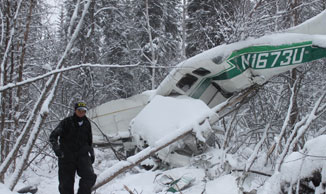
On November 29, 2011, at approximately 1925 Alaska Standard Time, a Cessna 207 airplane with registration N1673U collided with terrain roughly two miles southwest of Chuathbaluk Airport in Alaska. The commercial pilot sustained fatal injuries, and the aircraft sustained substantial damage. Inland Aviation, based in Aniak, was operating the flight as a visual flight rules (VFR) positioning flight under 14 Code of Federal Regulations Part 91. Marginal visual meteorological conditions prevailed at departure from Aniak Airport.
Personnel and Medical Findings
The pilot, age 61, served as the owner and director of operations for the carrier. He held a commercial pilot certificate with instrument ratings and reported 10,000 flight hours at his last medical exam in August 2011. He had documented medical conditions including deficient vision in the left eye, exotropia of the right eye, early cataracts, hypertension, and a below-the-knee amputation of the right leg, all managed via Statements of Demonstrated Ability (SODA). A postmortem examination attributed his death to multiple blunt force injuries. Toxicological tests were negative for alcohol but showed 15 percent carbon monoxide, consistent with heavy smoking.
Meteorological Conditions
Weather reports from Aniak Airport, located eight miles west of the accident site, indicated deteriorating conditions. Nine minutes before the crash, visibility was four statute miles with an overcast ceiling at 3,600 feet. Eleven minutes later, visibility dropped to 2.5 miles, and by 1956, it was reduced to 1.25 miles with a broken ceiling at 900 feet. The area forecast called for light snow, blowing snow, and mist.
Aircraft and Wreckage Analysis
The aircraft had 16,888.9 total flight hours, and a 100-hour inspection was completed the morning of the accident. It was powered by a Continental IO-520-F engine with 300 horsepower. The wreckage path began at a spruce tree approximately 70 feet tall, 180 feet from the main debris field. The airplane came to rest suspended on collapsed birch trees, with the nose on the ground and empennage ten feet above. Extensive impact damage was noted on the firewall, instrument panel, and wings. The engine separated from the airframe and rested 15 feet beyond the main wreckage. Propeller blades exhibited impact damage, but no pre-accident mechanical anomalies were found during subsequent examinations of the engine and gyroscopic instruments.