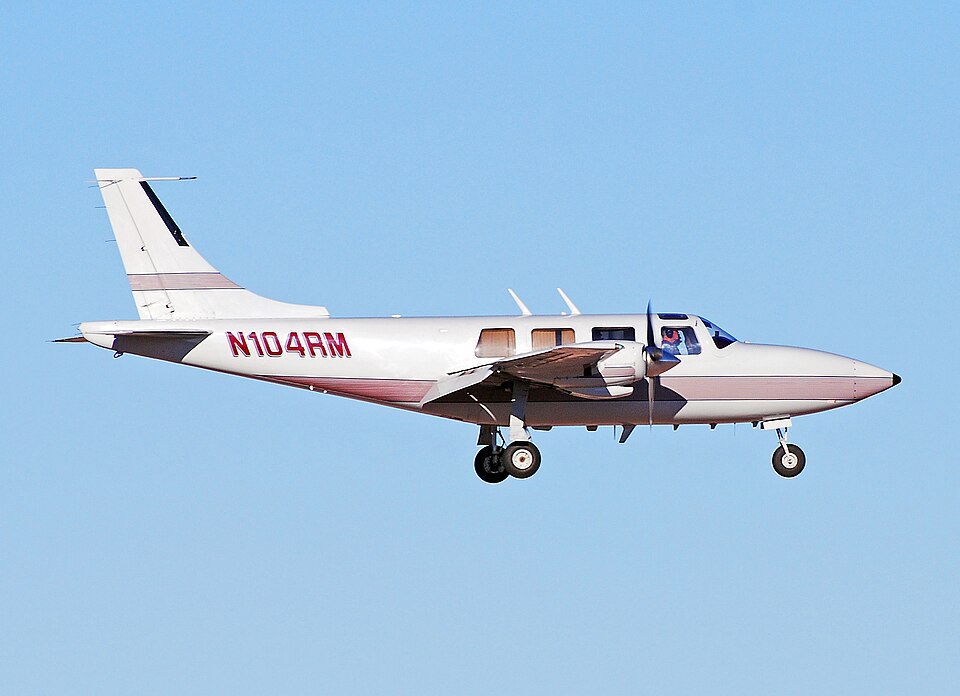
Accident Details
On January 5, 2012, at 1539 Pacific standard time, a Piper Aerostar 601P, registration N104RM, sustained substantial damage during a landing at North Las Vegas Airport (VGT), Las Vegas, Nevada. The private pilot, the sole occupant, was not injured. The owner/pilot was operating under 14 CFR Part 91 for a personal local flight that originated approximately 39 minutes before the accident. Visual meteorological conditions prevailed, and no flight plan was filed.
The pilot stated the flight's purpose was to practice instrument landing approaches. On the third approach, he requested to sidestep from runway 12 left to 12 right for a full stop landing. The tower controller approved and cleared him to land. The pilot reported that almost immediately after touchdown, the airplane began “wavering” and moments later veered left. He applied “full right rudder” to regain directional control, and subsequently the airplane departed the right side of the runway. The pilot attributed the loss of control to a main landing gear malfunction.
Witness Observations
A witness described the airplane’s touchdown as “firm” but not abnormal. Several witnesses observed the airplane “fishtail” almost immediately after touchdown and drift left. As it neared the left side of the runway, it “yawed” right and went “skidding” down the runway while facing right. The left engine propeller blades began contacting the runway. One witness reported hearing the right engine increase to near full power as the airplane moved right. When the airplane entered the dirt on the right side, it spun left, coming to rest facing opposite its landing direction.
Postaccident Examination
A Federal Aviation Administration (FAA) inspector found both wings bent up, the wing flaps bent, the left wing’s fuel tank compromised, and the fuselage with several holes. On January 25, 2012, the inspector and a licensed mechanic examined the airplane. The left propeller assembly was feathered, and the right propeller blades were bent forward. Cockpit examination revealed both throttle levers in the aft/closed position, propeller control levers full forward, and mixture controls full rich. The throttle levers operated normally with normal friction, but both propeller control levers exhibited little friction and could be moved with one finger’s pressure. The pilot had not reported any engine or propeller malfunctions.
A police video showed that moments after the accident, an officer suggested the pilot turn off electrical power; the pilot was observed reentering the airplane.
The mechanic noted that forward bending of the right propeller blades indicated the right engine was at high power when it contacted the ground, and the airplane was sliding backward. The right wing flaps bent forward indicated aft movement during terrain contact. The nose and main landing gears showed no preimpact anomalies.