History of Flight
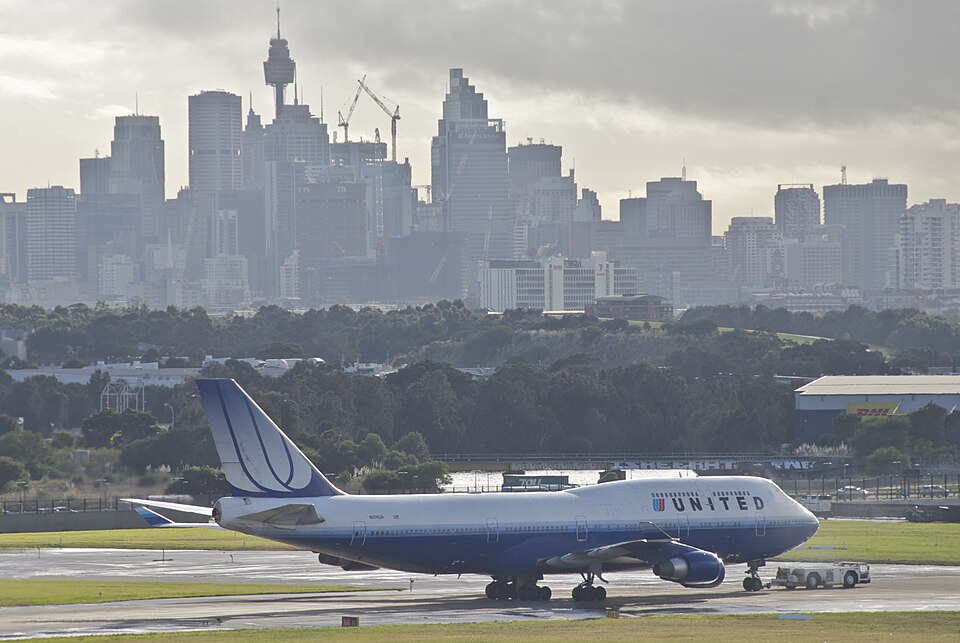
On February 19, 2013, at about 1500 UTC, N174UA, a Boeing 747-422 operated by United Airlines as an international scheduled passenger flight under 14 CFR Part 121, encountered turbulence during cruise over the Pacific Ocean while en route to San Francisco International Airport (SFO), California. The flight had departed Sydney Airport (YSSY) at about 0540 UTC on an instrument flight rules (IFR) flight plan. The airplane experienced light to moderate turbulence from about 1330 UTC until 1530 UTC. The seatbelt sign was illuminated, passengers remained seated, and flight attendants sat on the floor or used jump seats for safety. Around 1500 UTC, near the BALKS intersection at flight level 390 (39,000 feet), one flight attendant fell while walking from her bunk to the aft lavatory and sustained a serious injury. A passenger who was a nurse attended to her, suspecting a broken wrist. The flight crew declared an emergency with air traffic control, and the airplane continued to its destination for an uneventful landing. After landing, the flight attendant was transported to a hospital, where doctors confirmed a broken wrist. The airplane did not sustain any damage.
Personnel and Crew Statements
The first officer flying, age 58, held an airline transport pilot (ATP) certificate with type ratings in the B747-400 and B777, and a first-class medical certificate issued October 16, 2012. He reported 15,500 total flight hours. The second-in-command first officer (International Relief Pilot, IRO), also age 58, held an ATP certificate with type ratings in the B747, B757, B767, and B777, and a first-class medical certificate issued October 25, 2012. He reported 17,094 total flight hours. The captain was on rest break during the turbulence encounter.
The IRO reported that preflight planning included discussion of expected turbulence during the first half of the flight, which occurred as briefed. An area of light turbulence east of Hawaii between FL300 and FL440 was noted in association with a 120- to 140-knot jet stream. The IRO stated the weather encountered was expected for the first half, but moderate turbulence during the second half was not anticipated based on preflight information. They received a convective SIGMET from dispatch concerning embedded cumulonimbus clouds, implying potential for severe or greater turbulence, severe icing, and low-level wind shear. After discussing a possible deviation of 600 to 1,000 nautical miles, the decision was made to continue on course with functioning weather radar. The seatbelt sign was turned on before entering the SIGMET area, and the airplane experienced light to moderate turbulence for about 3 hours. The injury occurred near BALKS.
The injured flight attendant reported that while on break in the bunk room, the airplane had been encountering moderate turbulence for hours. She stated the turbulence stopped briefly and she thought she heard a faint ding from the seatbelt sign. From the crew bunk, they cannot hear public address announcements or always detect when the seatbelt sign is activated. She waited 10 to 15 minutes to ensure it was safe before climbing down. After descending, the airplane 'dropped and picked her up throwing her 6 to 10 feet,' and she landed on her right arm.
Meteorological Information
The National Weather Service (NWS) Pacific Surface Analysis Chart for 1200Z on February 19 depicted a high pressure system north of Hawaii with central pressure 1035 hPa, and a ridge extending southeastward. No significant surface boundaries were near the turbulence location. NWS High Level Significant Weather Prognostic Charts valid for 0600Z, 1200Z, and 1800Z showed a subtropical jet stream near FL410 with winds up to 160 knots, and the accident site was near a jet stream with 140-knot winds. An area of clear air turbulence (CAT) was expected along and poleward of the jet stream from FL270 to FL430. No organized convective activity was depicted near the accident site, but isolated embedded cumulonimbus clouds were shown west and south between 39,000 and 42,000 feet. All charts depicted an area of moderate turbulence associated with the jet stream, and the flight route crossed the jet stream near the event. No oceanic SIGMETs were issued for the Oakland Oceanic area because the severe turbulence was not widespread enough. Satellite imagery showed a comma cloud pattern, a baroclinic leaf, and transverse cloud bands perpendicular to upper-level winds, features associated with CAT. A Weather Research and Forecasting (WRF) simulation indicated Richardson numbers values associated with moderate and greater turbulence from breaking transverse waves.
Flight Data Recorder
Flight Data Recorder (FDR) data showed vertical acceleration variations between 1.3 g and 0.65 g from approximately 14:16:00 UTC to 17:13:30 UTC. During this period, pressure altitude started at about 37,000 feet, increased to 39,000 feet about 8 minutes later, and remained at 39,000 feet for 2 hours 18 minutes. Over the next 31 minutes 50 seconds, altitude decreased to 37,575 feet, then increased to 41,000 feet before decreasing to about 33,000 feet. The airplane landed at 18:31:07 UTC.