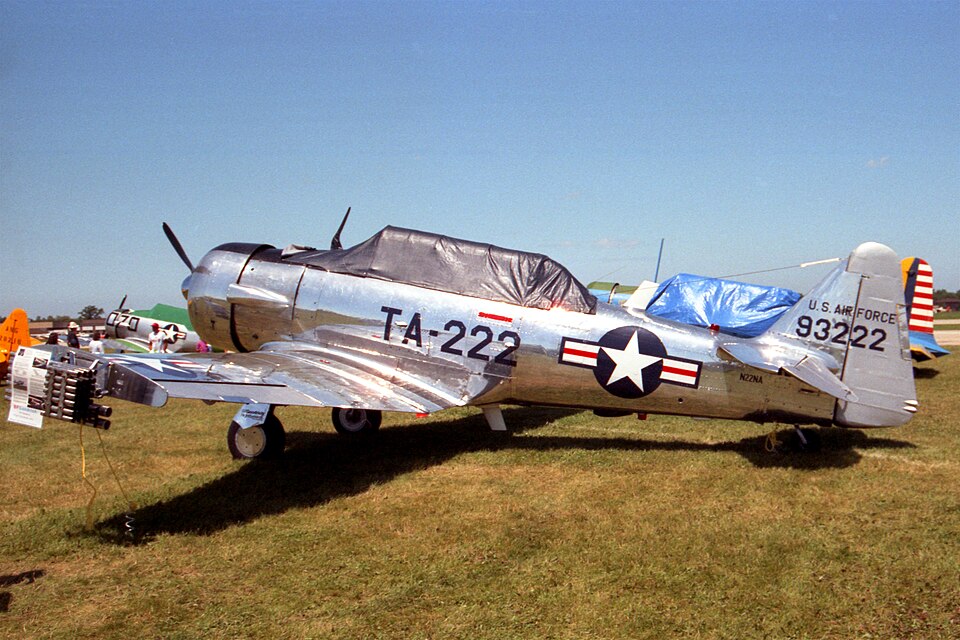
Accident Overview
On October 23, 2014, at approximately 1235 eastern daylight time, a North American T-6G, registration N22NA, was forced to land following a total loss of engine power during initial climb at Naples Municipal Airport (APF) in Naples, Florida. The airline transport pilot was not injured, and the airplane sustained substantial damage. The aircraft was registered to Bill Leff Airshows LLC and was operated under 14 CFR Part 91 as a personal flight. Visual meteorological conditions prevailed, and an instrument flight rules flight plan had been filed. The flight was destined for Leesburg, Florida (LEE).
Investigation Findings
The pilot reported that during initial climb, with the right fuel tank selected, and between 150 to 250 feet above ground, the engine lost all power. He lowered the landing gear, maintained flying airspeed, and landed the airplane in the grass to the right of the runway. The airplane collided with a runway distance remaining sign and came to a stop. The pilot turned off the magnetos and electrical master switch, and exited through the cockpit canopy. He later stated that there were 113 gallons of fuel on board at takeoff.
An FAA inspector examined the wreckage. Structural damage was noted to the fuselage, left wing, and right wing root. The propeller was bent aft, and the engine remained attached at the firewall. The engine crankshaft turned freely when the propeller was rotated manually. The fuel tanks contained an adequate supply of fuel.
The aircraft was moved to a hangar at APF for further examination. The left main landing gear strut was fractured at the trunnion, and damage to the upper wing skin above the right main landing gear strut was consistent with upward displacement of the landing gear. The left wing spar was fractured about 3 feet outboard of the landing gear light. Throttle, mixture, and propeller control continuity was confirmed from cockpit to engine.
Inspection of the front and rear seat fuel selector handles revealed both were positioned to the left tank position. The fuel selector shaft from the front seat was separated from the handle, with fractured rivets. With the forward fuel selector in the left tank position, the fractured rivets/shaft aligned. The fuel selector transmission for the front/rear seats was displaced slightly from its normal position.
Engine and Fuel System Examination
Movement of the propeller confirmed continuity to both magnetos. The oil tank contained oil. No fuel was noted at the inlet fitting of the auxiliary fuel pump, and about 11 ounces of blue-colored fuel (consistent with 100LL) were drained from the fuel strainer. Approximately 3 ounces of similar fuel were drained from the line from the fuel strainer outlet to the mechanical fuel pump inlet. No fuel was found in the line from the mechanical fuel pump outlet to the fuel flow transducer, and none was found at the carburetor inlet fitting.
Powertrain continuity was confirmed to the engine-driven fuel pump drive pad. The engine-driven fuel pump was removed; the drive gear appeared normal with no damage to gear teeth, and the pump turned freely. The auxiliary fuel pump was removed and separated from the electric motor; the drive splines were normal. Both pumps were retained for testing.
All forward spark plugs were removed and exhibited normal wear, gap, and color; no damage to center electrodes was noted.
Inspection of the forward seat fuel selector valve revealed it was between detents and the handle moved freely. Continuity of the front seat fuel selector to the transmission was confirmed from the separation point near the handle, and for the rear seat from the selector to the transmission. The shaft from the transmission outlet to the fuel selector valve in the left wing was separated at the transmission and was found bent. Marker marks indicated the fuel selector shaft position was slightly out of the detent near the right tank position.
Further examination of the fuel selector valve showed it was near the right tank detent. Air blown from the right port to the outlet in the as-found position showed no obstructions. When positioned to the right tank detent, air moved through the valve. The valve could not be flow tested due to thread issues. Marks were made on the valve housing and cover for alignment. Disassembly in the as-found position revealed the hole from the right tank position nearly aligned with the tank port. The conical seal was a white hard material with no obvious slippage relative to the valve shaft.
Fuel Pump Testing
The auxiliary and engine-driven fuel pumps were tested at a FAA-certified repair station using PD680 Type II fluid. The engine-driven pump at 2,000 rpm produced 57.8 gph and at 2,500 rpm produced 59.7 gph with 4.37 psi pressure; leakage of 9 drops in 30 seconds was noted from the drain fitting. The auxiliary pump at 2,000 rpm produced 89.5 gph and at 2,500 rpm produced 91.3 gph with 8 psi pressure; leakage of 1 drop per second was noted from the outlet fitting due to a damaged thread. No leakage from the drain fitting was observed.
According to the Pratt and Whitney Handbook for the R-1340-AN1 engine, normal fuel consumption at climb and high speed (2,200 rpm) is approximately 55 gph.
Data Analysis
The aircraft was equipped with a JP Instruments EDM 700 engine monitoring system. The unit was examined by the NTSB Vehicle Recorders Division. The recording contained about 15.6 hours of data over 20 power cycles from September 19 to October 23, 2014. The accident flight lasted about 13 minutes and was the last recorded. Recorded parameters included device time/date, exhaust gas temperature (EGT) and cylinder head temperature (CHT) for cylinders 1-9, peak EGT delta, CHT cooling rate, and battery voltage. No other parameters were recorded.
Cylinder 7 EGT did not record valid data during the accident flight. A grouping of EGT and CHT was observed, except for cylinder 6, which was a low outlier. After engine start and warm-up, cylinder 6 EGT was 255°C and CHT 82°C, about 325°C and 70°C less than the mean of other cylinders. Other cylinders' EGT ranged from 551 to 678°C and CHT from 129 to 173°C. EGT and CHT then increased in all cylinders consistent with increased power. Cylinder 6 EGT jumped to 747-804°C and CHT converged with others. Subsequently, all parameters decreased until the end of the recording, consistent with power reduction.
Following inspection, the owner was advised of a cursory inspection of the accident site and the damaged sign. The owner expressed that the sign was not frangible based on left wing damage. Examination of the hardware by the manufacturer revealed that the parts failed as expected; the frangible couplings were fractured at the base.