History of Flight
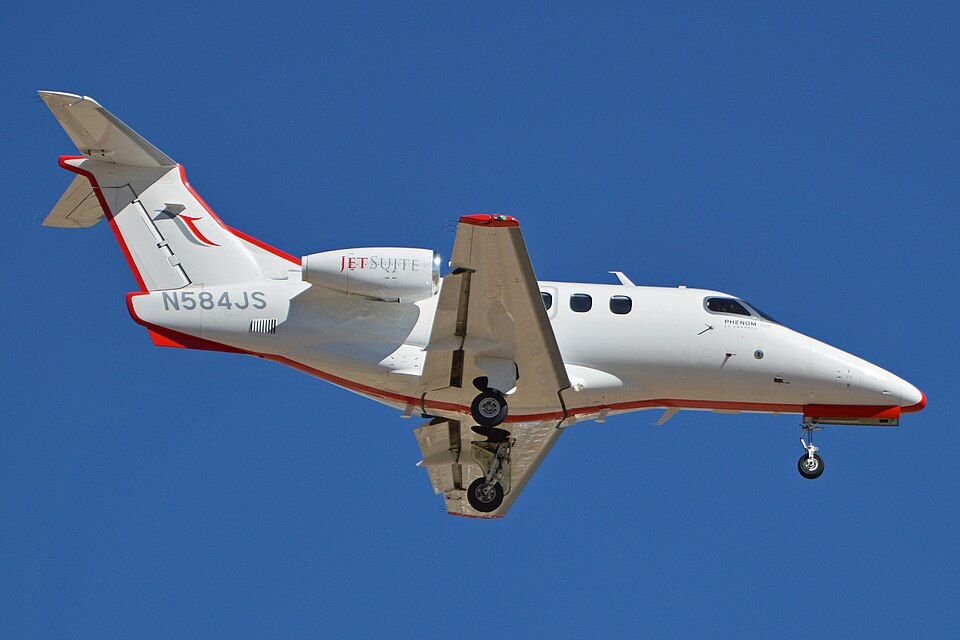
On November 21, 2014, about 1010 central standard time, an Embraer EMB-500 (Phenom 100) airplane, registration N584JS, overran the runway after landing at Sugar Land Regional Airport (SGR) in Sugar Land, Texas. The two airline transport-rated pilots were not injured, and the airplane was substantially damaged. The airplane was operated by Superior Air Charter, LLC (doing business as JetSuite Air) as a 14 CFR Part 91 positioning flight. Instrument meteorological conditions existed at the airport, and the flight operated on an instrument flight rules flight plan. The flight originated from William P. Hobby Airport in Houston, Texas.
According to the pilots, the flight aimed to reposition the airplane from HOU to SGR. During the approach, the tower controller provided vectors and cleared the flight to land on runway 35 via the instrument landing system (ILS) approach. The copilot reported no standing water on the runway and a tailwind of 15 knots decreasing to 9 knots at touchdown.
After landing, the pilot flying applied brakes but noted no appreciable deceleration. She pulled the emergency brakes twice, but the airplane continued off the runway, across a service road, and came to rest in a drainage ditch facing opposite the direction of travel, with the empennage partially submerged.
Flight data recorder (FDR) and cockpit voice recorder (CVR) data showed the approach: the airplane slowed to 120 knots and maintained that speed until about 155 ft mean sea level, then to 118 knots. The airplane stayed on glideslope until about 380 ft msl when the autopilot disconnected, after which it descended below the glideslope. It crossed the displaced threshold at about 100 ft msl and 112 knots indicated airspeed, touching down at 1010:37 about 1,040 ft from the threshold at 104 knots. During the landing roll, the pilots expressed concern about lack of deceleration.
About 1.6 seconds after touchdown, the nose gear touched down and the pilot's brake pedal increased with oscillations over 7.5 seconds to full deflection. About 4 seconds later, the emergency/parking brake (EPB) was applied, causing wheel speed to drop from 70 to 0 knots, consistent with a locked-wheel skid. The airplane departed the runway at 1011:15 at about 30 knots groundspeed.
Pilot Information
The pilot held an airline transport pilot certificate with single-engine, multi-engine, and instrument ratings, plus instructor certificates. She reported 6,311 total flight hours and 1,110 hours in the accident airplane make and model. She held a first-class medical certificate issued July 29, 2014.
The copilot held an airline transport pilot certificate with similar ratings. He reported 4,232 total flight hours and 814 hours in the accident airplane make and model. He held a first-class medical certificate issued July 26, 2014, with the restriction "must wear corrective lenses."
Aircraft Information
The Embraer EMB-500 Phenom 100 is a very light jet. It can seat four passengers normally, up to seven. It is equipped with two Pratt & Whitney Canada PW617-F turbofan engines. The accident airplane, serial number 50000140, was not equipped with spoilers (spoilered were introduced from serial 50000325). It had no thrust reversers.
The brake system is hydraulic, brake-by-wire with antiskid. The EPB is a T-handle mechanically linked to the emergency brake valve, without antiskid protection.
Meteorological Information
At 1012, the SGR automated weather observation system reported wind from 130° at 8 knots, visibility 6 miles in light rain and mist, broken clouds at 3,300 ft and overcast at 4,200 ft. At 1025, conditions improved: wind 130° at 8 knots, visibility 10 miles, few clouds at 600 ft, broken at 1,800 ft, overcast at 4,400 ft.
Airport Information
SGR is a public-use, towered airport 17 miles southwest of Houston. It has a single concrete runway 35/17, 8,000 ft long and 100 ft wide. Runway 35 has a 1,984 ft displaced threshold; runway 17 has a 380 ft displaced threshold. Touchdown zone elevation for runway 35 is 78 ft.
Flight Recorders
The CVR and FDR were examined by the NTSB. The FDR data was downloaded by the operator; the CVR was removed and analyzed.
Wreckage and Impact Information
The airplane came to rest about 100 ft beyond the end of runway 35 in a drainage creek. It had turned about 148° opposite the direction of travel, with the front on the embankment and the aft section submerged. The tail cone was partly broken and separated. The right main landing gear collapsed, and the right wing tip and aileron were damaged.
Tests and Research
The brake control unit (BCU) was functionally tested and operated normally; no abnormalities were found. The NTSB conducted a performance study.
The performance study indicated that the approach complied with the operator's stabilized approach criteria initially, but the copilot called "1000 … stable" when speed was 147 knots, 27 knots above approach speed. The airplane slowed to 120 knots below 800 ft msl, remained on glideslope until 380 ft, then autopilot disconnected and it descended below glideslope. Speed at 50 ft above touchdown zone elevation was about 118 knots, exceeding the go-around limit of 111 knots.
The landing distance available was 6,016 ft. The AFM landing distances assume reference speed at 50 ft; the actual speed was 17 knots above reference. Despite this, the available runway met the operator's wet-runway planning requirement.
After touchdown, the braking coefficient remained low (around 0.03) even as brake pedals were depressed, then jumped to 0.13-0.14 when the EPB was applied. The reason for the low braking coefficient early in the roll could not be determined. The antiskid system, which is a wheel deceleration control algorithm, may not have achieved maximum efficiency due to pedal input variations below 90% deflection. The locked-wheel skid after EPB application reduced braking friction, consistent with reverted-rubber hydroplaning found on the tires.
The investigation could not determine why the antiskid system maintained a low slip ratio even as braking command increased. The actual braking coefficient on the wet runway was lower than predicted by manufacturer's published wet-runway landing distances. The AFM's standing-water landing distances may be more indicative. The pilots received a report of no visible standing water, which may have influenced assumptions.