Accident Details
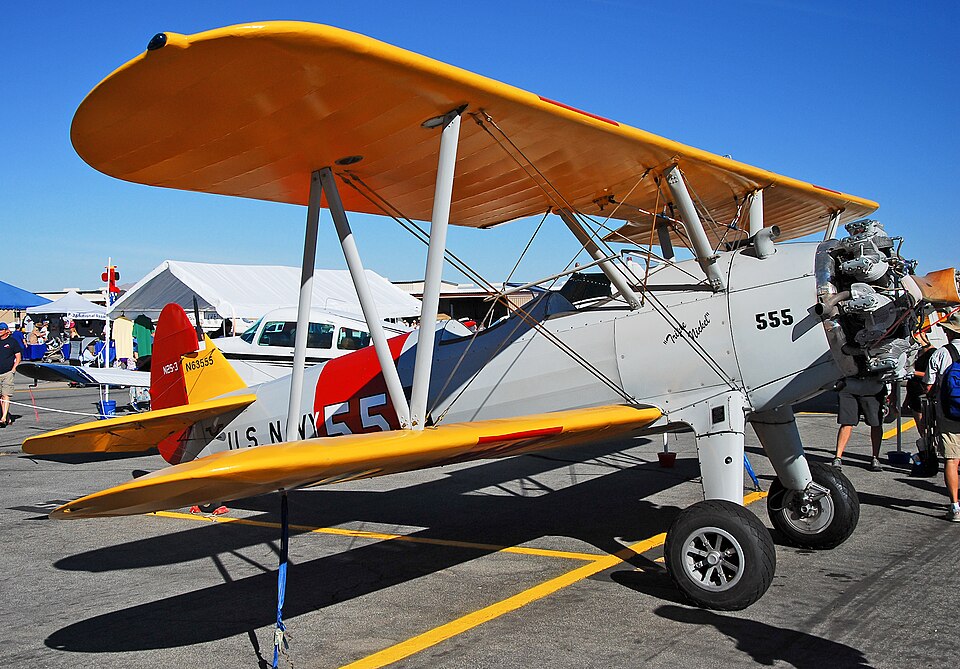
On March 2, 2016, at about 1300 Pacific standard time, a Boeing A75N1 (PT17), registration N63555, touched down hard during a forced landing at Palm Springs International Airport, Palm Springs, California. The airline transport pilot sustained minor injuries, and the passenger was seriously injured. The airplane was substantially damaged. Palm Springs Air Museum Inc. operated the airplane under 14 Code of Federal Regulations Part 91 for a local sightseeing flight that was originating at the time. Visual meteorological conditions prevailed, and no flight plan had been filed.
The pilot reported that the engine lost power passing through 400 ft after takeoff from runway 31L. Seeing houses and other obstacles straight ahead, the pilot decided to turn around and land on runway 13R. The airplane landed hard on the runway centerline but came to rest aligned about 30° left of the runway heading.
Examination Findings
During the initial examination, the forward end of the fuselage sustained crush damage around the front cockpit. The throttle lever and mixture lever in the cockpit would not move due to the damage; all linkages were connected from the cockpit to the carburetor. Flight control continuity was established for all flight controls. Portions of the bottom cylinders, numbers four and five, fractured and separated. A clear blue fluid, consistent with Avgas, was drained from the gascolator, and a water paste test had no reaction, indicating no water contamination. All fittings were tight. A black fluid consistent with motor oil was evident on the dipstick. There was no external evidence of catastrophic mechanical malfunction.
A follow-up examination revealed light brown exhaust tube coloration. The air filter was clean, with no discoloration in the intake tube. The crankshaft rotated freely with no metallic sounds or binding. All valves except for the two damaged bottom cylinders moved approximately the same lift in firing order. Thumb compression was obtained on all cylinders except the damaged ones.
The carburetor was removed and disassembled. The floats were metal, and the bowl contained no fluid. The accelerator pump operated without resistance. The throttle lever would not move due to a crushed housing; the butterfly valve was almost vertical (fully open). The mixture lever moved freely. The carburetor heat arm was crushed at the box, and the rod end at the bellcrank fractured and separated along a jagged, angular plane.
The fuel line from the gascolator to the carburetor was removed; nothing drained out. The line was reconnected to the gascolator and the fuel selector valve turned on; blue fluid came out. Upon removal again, an obstruction was visible near one end of the line. The firesleeve was removed, revealing the hose entering the fitting at a slight angle not visible with the firesleeve in place. The line was cut near the obstruction; the inner surface of the hose appeared cut and curled into the hose at the fitting.
Maintenance History
An entry in the maintenance logbooks dated October 20, 1967, recorded that all new gas lines were made. There were no entries after that to indicate any work was performed on the gas line hoses.