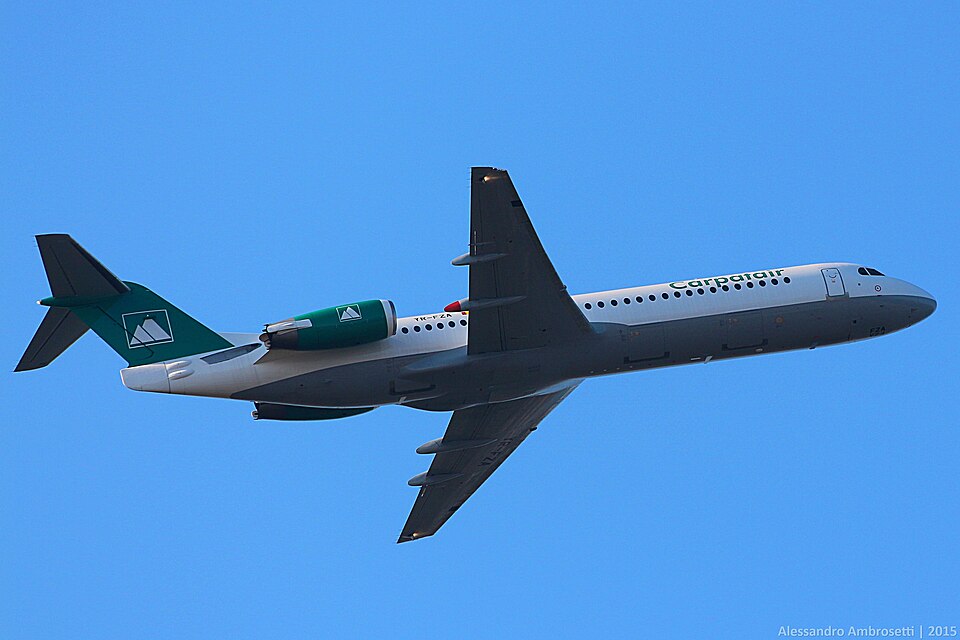
What happened
On April 6, 2016, a Fokker F28 Mark 0100 aircraft registered YR-FZA, operated by Romanian carrier Carpatair on behalf of Swedish airline Nextjet, was conducting a scheduled commercial flight from Arvidsjaur to Gällivare Airport in northern Sweden. The approach to runway 30 took place at night under instrument meteorological conditions, with snow and rain reducing visibility to 1,500 meters.
During the final phase of the approach, the aircraft crossed the runway threshold at an altitude of approximately 50 feet with a speed of 134 knots, which was higher than optimal for the conditions. Upon touchdown in the designated zone, the aircraft experienced a hard landing followed by a bounce and a displacement in yaw. Despite the crew's report that maximum reverse thrust and wheel brakes were applied immediately, flight data recorder (DFDR) evidence indicated a significant delay in deceleration efforts.
The DFDR showed that engine reverse power did not increase from low idle until 20 seconds after touchdown, when the aircraft had slowed to approximately 50 knots. At that point, the reverse thrust only reached 75% and 65% of the maximum possible N1 rpm for the left and right engines, respectively, rather than the full emergency reverse capability of 95.5%. Additionally, longitudinal acceleration data suggested that wheel brakes were not effectively applied during this initial period. The aircraft continued down the runway, overrunning the paved surface and coming to a stop on the runway strip. There were no injuries among the 51 passengers and 4 crew members, and the aircraft sustained only slight damage.
The investigation
The Swedish Accident Investigation Authority (SHK) led the investigation, with accredited representatives from Romania and the Netherlands. The inquiry analyzed data from the Digital Flight Data Recorder (DFDR), Cockpit Voice Recorder (CVR), and airport communications. Interviews were conducted with the flight crew, cabin crew, and airport personnel.
The investigation established that the approach briefing did not adequately address runway conditions, final approach speeds, or the specific use of reverse thrust and brakes for the contaminated surface. Meteorological reports indicated a reported friction coefficient between 0.34 and 0.36 with 1 mm of slush on the runway; however, the SHK noted that such reported coefficients in winter conditions can be unreliable and may not correlate accurately with actual aircraft braking performance.
Technical analysis revealed that the thrust reduction to idle occurred late, contributing to the high touchdown speed. The yaw displacement upon landing likely distracted the pilot in command, leading to the delayed application of reverse thrust. The crew stated they initiated braking immediately, but DFDR data and low brake temperature readings post-landing suggested the brakes had little effect initially.
Findings
The serious incident was caused by the gradual decrease of conditions for a safe landing, which was not perceived in due time by the flight crew. Contributing factors included:
- The airspeed did not decrease from 50 feet height to touchdown, resulting in a high-speed landing.
- The reported friction coefficients were likely unreliable indicators of actual braking performance on the contaminated runway.
- Wheel brakes were probably not fully applied effectively due to the initial yaw disturbance and lack of immediate monitoring.
- Reverse thrust rpm increased only 20 seconds after touchdown, significantly delaying deceleration.
The investigation also highlighted a lack of standard procedures for cockpit cooperation regarding the monitoring of deceleration and reverse rpm after landing. The absence of callouts or cross-checks for these parameters contributed to the delayed reaction.
Safety action
The SHK issued safety recommendations urging ICAO, EASA, and the Swedish Transport Agency to work toward the introduction of a generic "Safe Landing" concept. This concept would cover the flight phase from the runway threshold until full stop, including criteria for appropriate speed at threshold crossing, monitoring speed reduction, and ensuring proper use of retardation devices like speed brakes, lift dumpers, reverse thrust, and wheel brakes. The recommendations emphasized that operators and regulators should establish improved procedures for planning and execution, as well as enhanced training for flight crews operating in winter conditions on short and contaminated runways.