History of Flight
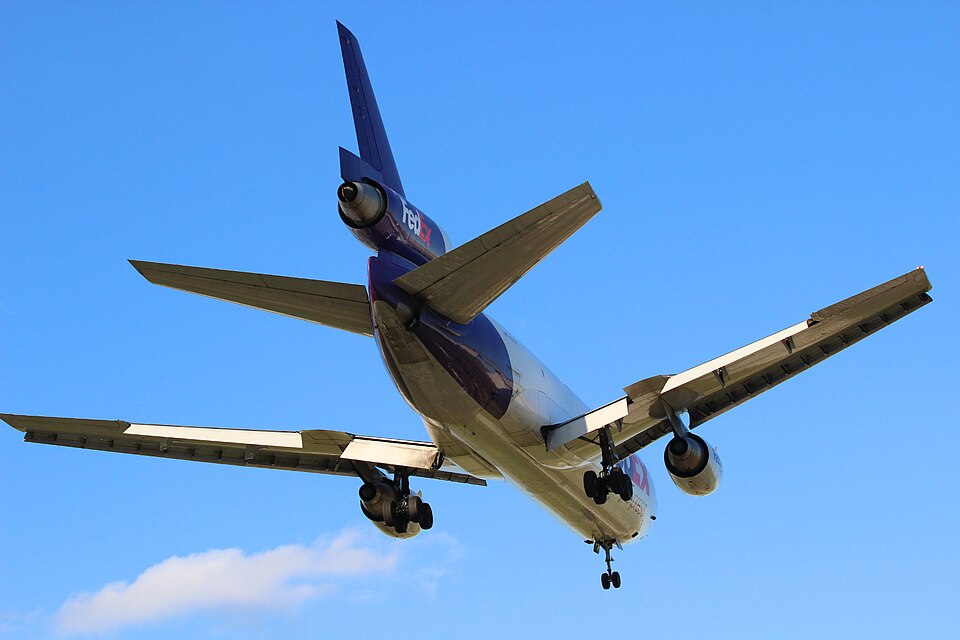
On October 28, 2016, about 1751 eastern daylight time, FedEx Express flight 910, a McDonnell Douglas MD-10-10F (registration N370FE), experienced a left main landing gear (MLG) collapse after landing on runway 10L at Fort Lauderdale–Hollywood International Airport (KFLL), Fort Lauderdale, Florida. The left wing subsequently caught fire. The airplane came to rest off the left side of the runway. The two flight crewmembers evacuated the airplane. The captain reported a minor cut and abrasions from the evacuation, and the first officer was not injured. The airplane sustained substantial damage. The cargo flight was operating under 14 CFR Part 121 and originated at Memphis International Airport (KMEM), Memphis, Tennessee.
The first officer was the pilot flying, and the captain was the pilot monitoring. Both flight crewmembers stated in postaccident interviews that the departure from Memphis and the en route portion of the flight were normal. About 1745, air traffic control cleared the flight for an instrument landing system approach to runway 10L at KFLL. Recorder data indicate that the first officer set the flaps at 35º about 1746 when the airplane was 3,000 ft above ground level (agl). The first officer disconnected the autopilot about 1749 when the airplane was 1,000 ft agl. Both flight crewmembers reported that the approach was stable at 500 ft agl. At 200 ft agl, the first officer began making airspeed corrections to compensate for the crosswind. About 1750, the first officer disconnected the autothrottles at 100 ft agl as briefed.
At 50 ft agl, the first officer initiated the flare. The left MLG touched down about 1750:31 in the touchdown zone and left of the runway centerline. The first officer deployed the spoilers at 1750:34, and the nose gear touched down 3 seconds later. The thrust reversers were deployed at 1750:40. According to the cockpit voice recorder, the captain instructed the first officer to begin braking about 1750:39 (the airplane was not equipped with autobrakes). Flight data recorder data indicate an increase in brake pedal position angle and longitudinal deceleration about 1750:41. In postaccident interviews, the flight crewmembers reported hearing a "bang" as the first officer applied the brakes, and the airplane yawed left. The CVR recorded multiple thuds consistent with a gear collapse.
About 1750:48, the captain stated, "I have the airplane," and the first officer replied, "you got the airplane." The captain applied full right rudder without effect while the first officer continued braking. About 1750:53, the captain instructed the first officer to call the tower about the emergency.
An airport video of the landing showed that the No. 1 engine initially supported the airplane after the left MLG collapse when a fire began near the left wing tip. The airplane eventually stopped off the left side of the runway, about 30º to 40º off the runway heading. About 1751, the flight crew began executing the evacuation checklist. The pilots reported hearing an explosion as they prepared to evacuate. The airport video showed a fireball at the No. 1 engine. The captain attempted to discharge a fire bottle in the No. 1 engine, but it did not discharge. They evacuated through the right cockpit window.
Personnel Information
The two crewmembers had flown together previously and reported a good rapport. The captain, age 55, was hired by FedEx in 2000 and had about 10,000 total flight hours (estimated) with about 1,500 hours in the MD-11. He held a multiengine airline transport pilot certificate with type ratings in the LR-Jet, Boeing 727, and MD-11. The first officer, age 47, was hired in 2004 and estimated 6,000 to 6,300 total flight hours with about 400 to 500 hours in the MD-11. He held a multiengine airline transport pilot certificate with a type rating in the MD-11. Both held FAA first-class medical certificates.
Aircraft Information
The accident airplane, a McDonnell Douglas MD-10-10F (serial number 46608, registration N370FE), was manufactured in 1972 and had 84,589 total flight hours and 35,606 total cycles at the time of the accident. FedEx purchased it on August 21, 1997. It was converted from a DC10-10 to a DC10-10F on July 3, 1999, and to an MD-10-10F on November 2, 2003. It was powered by three General Electric CF6-6D turbofan engines. The last "C" check was on September 21, 2016; the last inspection was on October 25, 2016 (service check, "A" check, and "B" check).
The most recent overhaul of the left MLG occurred on February 28, 2008, by Hawker Pacific Aerospace (HPA) Repair Station in Sun Valley, California. It was installed on the accident airplane on March 31, 2008. Time since installation was 10,249.03 flight hours, 5,653 cycles, and 3,133 days (8.58 years). At the time of the accident, the FedEx MLG overhaul limit was 9 years or 30,000 flight hours, and the left MLG had 152 days remaining. The Boeing maintenance planning document recommends overhaul every 8 years or 7,500 flight cycles. The most recent service of the MLG shock strut was performed at the last "C" check in September 2016.
A pilot report dated February 6, 2014, indicated a hard landing at Newark Liberty International Airport. Maintenance personnel downloaded FDR data and performed structural inspections; no defects were noted.
Maintenance records showed that during the left MLG's last overhaul, work associated with Alert Service Bulletin DC10-32A259 was accomplished. The overhaul included inspection and repair of the air filler valve bore. All dimensions were within manufacturer limits except the inner diameter wall radius, which was recorded as 0.090 inch (allowable 0.015 to 0.030 inch). No additional records addressed the exception; a Boeing representative indicated that larger radius findings had been approved for continued service.
Wreckage and Impact Information
The airplane came to rest off the left side of runway 10L near the A4 taxiway. The outer cylinder of the left MLG fractured midway through the air filler valve bore on the aft side. The fracture was circumferential; the upper portion remained attached to the airplane. On-scene examination identified features consistent with fatigue on the fracture surface at the air filler valve bore. Three pieces of the cylinder were found on the runway, including a piece with fatigue features. The fill valve was not found.
The left wing sustained fire damage from inboard of the No. 1 engine pylon outboard to the wingtip and chordwise from leading-edge to trailing-edge spars. The wing trailing edge panels, flaps, and ailerons were damaged. Slats and the left-wing fuel tank bottom sustained structural damage. The No. 1 engine had scraped areas on its bottom; the pylon fuel tube was torn and partially consumed by fire. An airport surveillance camera captured a fireball and debris after the airplane stopped.
Meteorological Information
At 1653, the KFLL METAR reported wind from 050° at 15 knots gusting to 25 knots, 10 miles visibility, few clouds at 2,400 ft agl, scattered clouds at 3,300 ft agl, broken ceiling at 4,100 ft agl. At 1753, about 2 minutes after the accident, wind from 050° at 15 knots gusting to 24 knots, visibility 10 miles, few clouds at 2,600 ft agl, broken ceiling at 5,000 ft agl. Peak wind at 1732 was 060° at 26 knots.
Additional Information
In 2007, Boeing revised maintenance instructions for inspection and repair of the MLG shock strut cylinder air filler valve bore, prompted by preliminary findings from a July 28, 2006 accident involving FedEx flight 630 (a similar MD-10-10F left MLG failure at Memphis). Boeing issued revisions to CMM 32-11-04 and Alert Service Bulletin DC10-32A259, and FAA AD 2008-09-17 required inspections.
An eddy current inspection demonstration indicated that surface roughness and edge effects could produce false positives and that the inner diameter radius was difficult to inspect. Magnetic particle inspection would require complete disassembly.
Two previous gear collapse events involving FedEx MD-10 aircraft were noted: one on July 28, 2006 (left MLG) and one on December 18, 2003 (right MLG).