History of the Flight
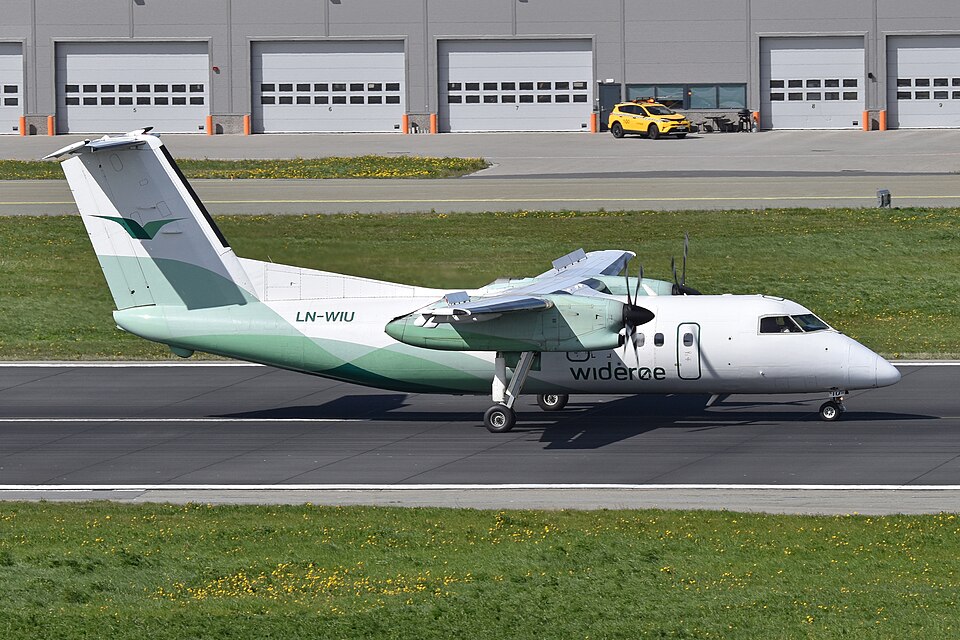
Widerøe flight WIF814 was en route from Bodø to Svolvær with three crew members and 35 passengers on board. It was dark, with cumulonimbus clouds, rain and hail showers in the area. There were gale force winds with strong gusts at Svolvær Airport.
The commander (the captain), who was Pilot Flying, was about to perform a visual circling over the sea in order to land towards the south. Just before turning into the final approach, the airplane began to buffet and lose altitude, and there was a significant loss of airspeed. Despite full power being applied, the airplane continued to lose both airspeed and altitude. The stall warning (stick shaker) activated. The nose of the aircraft was lowered and stalling was prevented, or a stall recovery performed, but the altitude above the terrain became very low (25 m) before the aircraft began to climb, and the situation was resolved. The first officer further increased engine power, to the maximum available, and at some point took over the flight controls on his own initiative.
After the incident, which transpired over the course of approx. 10 seconds, the crew interrupted the approach and continued to Leknes where they landed normally.
Injuries and Damage
There were no injuries and no aircraft damage.
Crew Actions and Perceptions
The crew perceived the incident differently. The commander described that he had brought the situation under control and that he therefore could hand the controls over to the first officer. The first officer asserted that he had to intervene to prevent the aircraft from going into the sea. The facts are insufficient for the AIBN to determine with certainty which pilot did what during the seconds in question. Nor has it been possible to determine the specific time and sequence of actions, and what effect each action had in isolation. Consequently, it is not possible to draw any definite conclusions regarding whether the first officer's intervention had impact on the outcome. However, it is indisputable that the joint actions of the crew resulted in the aircraft starting to climb in time to avoid collision with the sea.
Investigation Findings
The Accident Investigation Board Norway (AIBN) concluded that the airplane was exposed to severe wind shear from a cumulonimbus cloud. The manoeuvring to regain control took place with sparse visual references and with no visible horizon. The investigation showed that the conditions were right for the commander to possibly have experienced a somatogravic illusion. However, the AIBN found no basis to conclude that sensory illusion had any impact on the way the wind shear was handled.
In this investigation, AIBN paid particular attention to assessing risk management and safety margins in connection with circling in darkness. No obvious system faults or other defects that could have had an impact on the sequence of events or causal relations were uncovered. The incident is an important reminder of the vulnerability associated with manoeuvring at low altitude above terrain with few visual references, in darkness and turbulent air. It also serves as a reminder that operators, and pilots, with thorough local knowledge, experience and training beyond current government requirements are better equipped to handle critical situations such as this one in a safe manner.
Several relevant safety barriers have been strengthened since 2010. Double PLASI, circling lights, turbulence warning, etc. were put in place as a result of the continuous preventive air safety cooperation between operators and Avinor. Goal-oriented simulator training to raise awareness concerning sensory illusions was also planned by Widerøe, independently of this incident.
No safety recommendations were proposed.