Accident Sequence
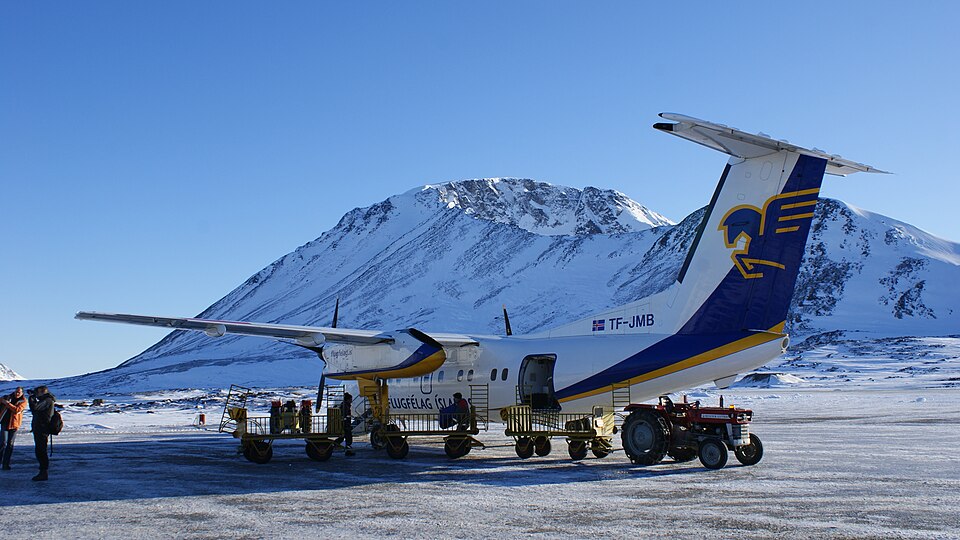
The flight crew established visual contact with the runway at BGGH and elected to deviate to the right (west) of the offset localizer for Runway 23. The approach continued from a position right of the extended runway centerline. As the aircraft neared Runway 23, it was still completing a right turn over the landing threshold. The aircraft touched down on Runway 23 between the runway threshold and the touchdown zone, landing to the left of the runway centerline. Upon touchdown, the right main landing gear (MLG) shock strut fuse pin sheared, resulting in a collapse of the right MLG. The aircraft then skidded down the runway and departed the runway to the right. Neither passengers nor crew suffered any injuries. The aircraft sustained substantial damage. The accident occurred in daylight under visual meteorological conditions (VMC).
Investigation Findings
According to the official investigation, the licenses and qualifications of the flight crew, flight and duty times, the documented technical status of the aircraft, and the aircraft mass and balance had no influence on the sequence of events. The flight crew had planned the flight with a destination alternate. The latest terminal aerodrome forecast (TAF) before departure indicated marginal weather conditions for a successful approach and landing at BGGH, with strong winds, low visibility, and low cloud base. The forecasted weather at the expected approach time was below preplanning minima. The actual weather conditions and enroute briefings were equivalent to the forecast. With reference to the operator’s aerodrome and procedure briefing and the latest reported wind conditions from Nuuk AFIS before landing, a landing was prohibited. Strong winds and moderate to severe orographic turbulence from the surrounding mountainous terrain increased the flight crew load. On approach, the flight crew had difficulties maintaining stabilized approach parameters. The flight crew most likely suffered from task saturation and information overload. No flight crew callouts on divergence from the operator’s stabilized approach policy were made. Optimal crew resource management was not present. Important low-altitude stabilized approach parameters such as airspeed, bank angle, and runway alignment were not sufficiently corrected. The flight crew was solely focused on landing, and task saturation mentally blocked a decision to go around.
Probable Cause
The official probable cause states that a divergence from the operator’s stabilized approach policy caused an unstabilized approach and a hard landing, leading to an excess load on the right main landing gear at touchdown. The right MLG fuse pin sheared as a result of stress.