History of Occurrence
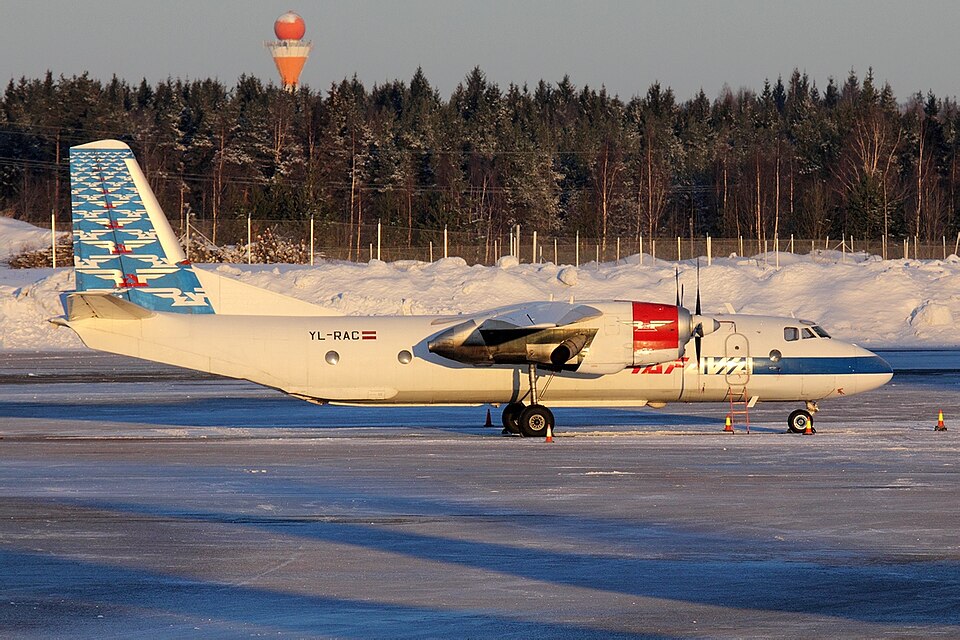
On 17 July 2017, the Antonov AN-26B, registration YL-RAC, operated by RAF Avia, was scheduled for a cargo flight from Timișoara International Airport, Romania, to Budapest International Airport, Hungary. At 20:32 LT (17:32 UTC), the aircraft began taxiing from its parking position to the holding point for runway 11. Timișoara Tower cleared the aircraft for take-off at 20:35 LT (17:35 UTC). Shortly after initiating the take-off run, engine no. 2 stopped without any preceding abnormal indications. The crew captain performed directional control inputs, but after traveling approximately 200 meters from the runway 11 threshold, the aircraft turned right and exited onto the grass surface of the runway safety area, coming to a stop about 30 meters onto the grass.
In radio contact with Timișoara Tower and following instructions, the captain confirmed the aircraft could return to the runway using its own power. After maneuvering back onto the runway, the aircraft taxied to parking position 13. Subsequently, it was repositioned to position 9 for functional engine tests. No crew members sustained bodily injury, and no damage to the aircraft was reported.
Additional Information
Meteorological Information
The METAR for Timișoara International Airport at 17:30 UTC (20:30 LT) reported: wind from north at 6 knots (3 m/s), visibility greater than 10 km, temperature 27°C, and atmospheric pressure 1019 hPa.
Airport Information
Timișoara – Traian Vuia International Airport (ICAO: LRTR) is an airport meeting international aeronautical safety standards with no operating restrictions for regular flights and open to irregular operations of any aircraft type.
Aircraft Information
The aircraft involved was an Antonov AN-26B, configured for cargo commercial air transport. It was equipped with two AI-24VT turbo-prop engines manufactured by Ivcenko Progress and a turbo-reactive auxiliary engine RU19. The wingspan is 29.2 meters, and the nose landing gear wheel orientation angle is a maximum of 45° on each side. Engine no. 2, serial number H4811BT061, was installed on 24 May 2016 and had accumulated 2199 operating hours and 1973 cycles as of 17 July 2017. The last maintenance (check F-15) was certified on 3 May 2017 per CRS No. 349, performed by RAF Avia's Part 145 approved maintenance organization. The fuel flow regulator ND-24T (No. 02449365) was installed on engine no. 2 on 25 May 2016; during the F-15 check, its filters were replaced as per Work Order No. 349.
The aircraft was equipped with a digital flight data recorder (DFDR) type БУР4-1. Data decoding showed that during the take-off run, power levers were set to 100 degrees, torque on engine 1 was 94 kg/sq.cm, on engine 2 dropped from 15 to 0 kg/sq.cm, and aircraft heading initially 106 degrees. At 00:08.11, engine 2 propeller automatically feathered; power levers were subsequently reduced. At 00:08.30, aircraft heading was 170 degrees, and the aircraft had exited the runway.
After returning to the platform, the crew inspected the aircraft and found no damage. Engine tests were conducted: engine no. 2 started and ran normally at idle but stopped without control when higher power was demanded. To identify the malfunction, components of the engine automation systems were replaced one by one: PRT Block (exhaust gas temperature control), URT Block (speed control), governor R-68DК-24 (propeller control), automatic fuel regulator ADT-24T, and fuel pump regulator ND-24T. After replacing the fuel pump regulator (ND-24T, No. 02449365), the engine operated normally and the initial defect did not recur.
Conclusions
Findings
- The crew held valid licenses and medical certificates.
- The aircraft had a valid airworthiness certificate and maintenance was performed per the approved schedule.
- During take-off run, engine no. 2 stopped without control, and the propeller automatically feathered. No other abnormal indications were observed.
- The crew did not report any external events (birdstrike, FOD, etc.) that could have caused the failure.
- The malfunction was resolved after replacing the fuel pump regulator (ND-24T, No. 02449365). No faults in the operation of this component were noted in the maintenance records prior to the incident.
Cause of the Occurrence
The engine uncontrolled shutdown occurred as a consequence of a technical failure of the fuel pump regulator (ND-24T).
Safety Recommendations
The investigation commission issued no safety recommendations.