Accident Overview
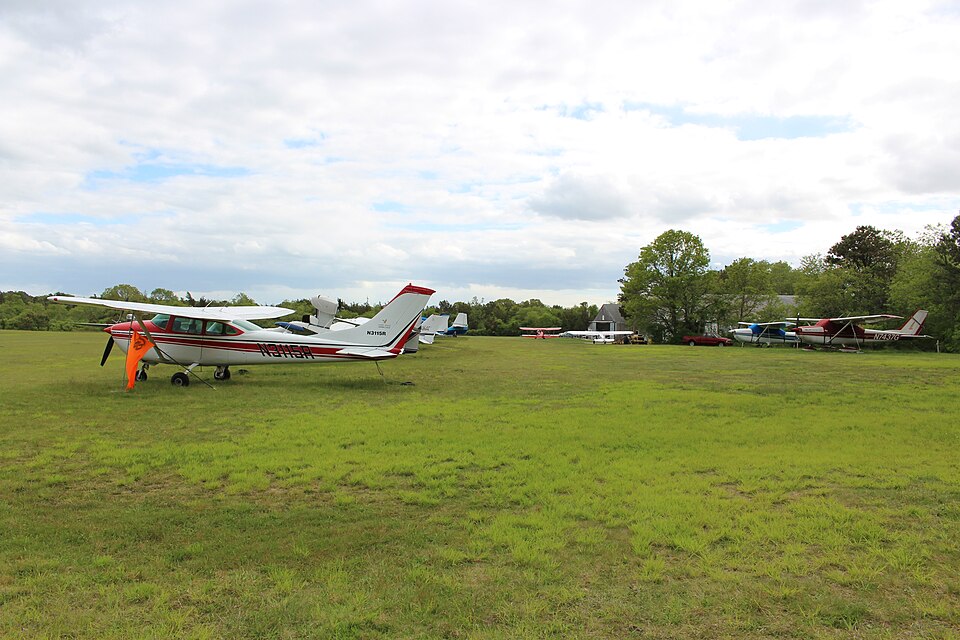
On August 27, 2018, about 1250 eastern daylight time, a Cessna 182L, registration N3115R, nosed over following a landing overrun at Cranland Airport (28M) in Hanson, Massachusetts. The commercial pilot was not injured. Visual meteorological conditions prevailed, and no flight plan was filed for the local skydiving flight, which originated at 28M and was operated under 14 Code of Federal Regulations Part 91.
Pilot's Account
The pilot reported completing a thorough preflight inspection and runup before the accident flight, noting no mechanical malfunctions or failures that would have precluded normal operation. He observed no abnormal indications or battery discharge during the runup. A witness stated that the airplane was jump-started by a vehicle just prior to the flight.
About 2,000 ft during the initial climb, the airplane experienced a radio failure and the pilot noted a slight change in engine sound. He consulted with the jumpmaster and continued climbing to 7,500 ft to allow two pairs of skydivers to jump. After the jumpers departed, the pilot reported engine roughness. He considered diverting to a nearby airport about 8 miles southeast with longer runways but opted against it due to unfamiliarity. Instead, he circled down over the airport, keeping his approach "a little faster and higher than normal" to ensure he could still reach the runway if the engine lost total power. After extending full flaps, he tried to "bleed off speed" and lose altitude quickly. He landed longer than usual and chose not to execute a go-around because of the rough-running engine. Despite maximum braking, the airplane overran the departure end of runway 18, encountered a ditch, nosed over, and came to rest inverted.
Witness Observations
According to the jumpmaster, he noted no engine problems or other anomalies besides the radio failure before jumping. After landing, he observed the left main tire smoking from the pilot "locking up the brakes." A second jumpmaster saw the airplane "arriving fast" and heard braking before the overrun.
Airport and Weather
Review of airport video showed that the airplane touched down near the midpoint of the 1,760-ft-long runway. A Federal Aviation Administration responder noted a quartering tailwind for the landing direction. The recorded wind at an airport 8 miles southeast, near the accident time, was variable at 5 knots.
Wreckage Examination
The airplane came to rest inverted 183 ft beyond the departure end of runway 18. The airframe sustained substantial damage to the fuselage, both wings, rudder, and vertical stabilizer. The flaps were extended. The main landing gear tires showed significant tread wear on one side with visible holes. Tire skid marks consistent with the accident airplane extended 537 ft, with rim marks evident 158 ft after the first contiguous skid marks.
Examination revealed the alternator belt was off the pulleys and on the lower right side of the engine firewall; no anomalies were noted. The battery was disconnected during the accident sequence, with the left post separated at impact. A replacement battery enabled normal flap operation. The accident battery indicated 12.3 volts. The engine showed no evidence of preimpact mechanical malfunctions. Brake testing revealed no preimpact anomalies.