History of Flight
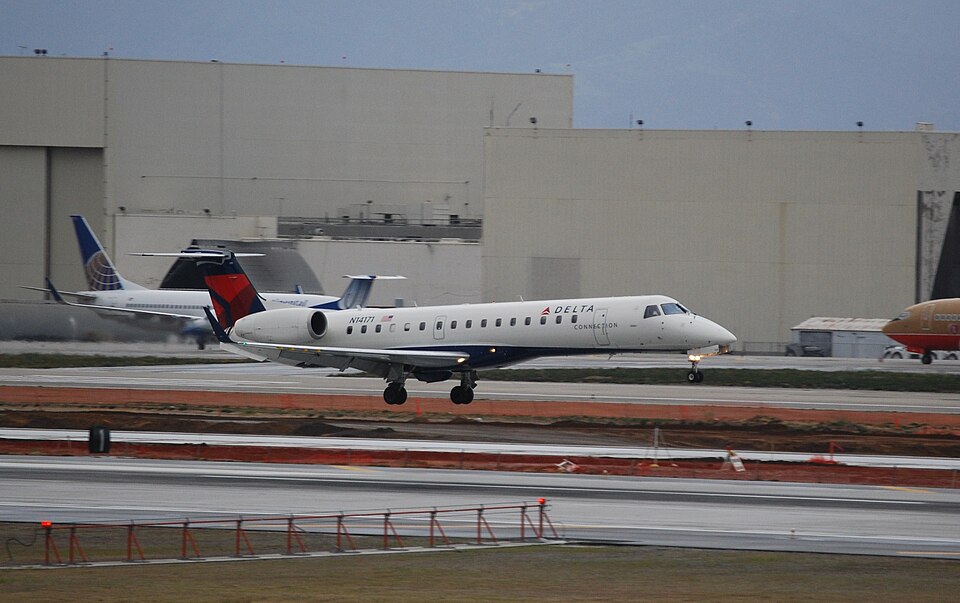
On March 4, 2019, about 1129 eastern standard time, CommutAir flight 4933, an Embraer EMB145XR (registration N14171), was attempting to land on runway 1 at Presque Isle International Airport (PQI), Presque Isle, Maine. The airplane impacted terrain to the right of the runway. The first officer and two of the 28 passengers sustained minor injuries; the captain, the flight attendant, and 26 passengers were not injured. The airplane was substantially damaged. The scheduled passenger flight operated under Part 121, and instrument meteorological conditions prevailed.
The first officer mentioned during a predeparture briefing that during a previous flight to PQI on February 27, 2019, the instrument landing system (ILS) localizer for runway 1 appeared offset when the airplane was aligned with the runway on a visual approach.
The accident flight departed Newark Liberty International Airport about 1004. The captain was pilot monitoring and the first officer pilot flying. While en route, the crew received a special weather observation at 1031 indicating wind from 090° at 5 knots, visibility 1/2 mile in moderate snow and freezing fog, and broken ceiling at 1,100 ft, overcast at 1,800 ft.
At 1101:42, Boston ARTCC cleared the flight for an ILS approach to runway 1. At 1105:35, radar services were terminated and the crew switched to CTAF. A maintenance staff member at PQI confirmed the runway was clear of snow removal vehicles. The first approach was flown but a go-around was executed after the crew reported not seeing the runway clearly. During the missed approach, the captain and first officer discussed issues with the localizer and snow cover.
For the second approach, the crew coordinated so the first officer would remain on instruments until minimums. The crew contacted PQI maintenance to ensure runway lights were on high intensity. At 1123:41, the controller cleared the flight for the ILS approach. The crew reported established on the localizer. During the final descent, the commander made callouts. At about 200 ft, the autopilot was disengaged. At minimums, the captain called runway in sight, but the first officer reported seeing "white on white" and blowing snow. The airplane touched down and came to rest in the snow-covered grassy area between runway 1 and a parallel taxiway, about 305 ft to the right of the runway centerline and about 3,600 ft beyond the threshold. Airport personnel estimated visibility about 1/2 mile.
Personnel Information
The captain began working for CommutAir in March 2013 as a DHC-8 first officer. She left in November 2015, returned in May 2016, and received a disciplinary letter in 2016. She received an EMB145 type rating in October 2017 and upgraded to captain shortly after. She had training failures in September 2017 and received remedial training in March 2018. On March 1, 2019, she flew three legs and finished at 2044, commuted home arriving about 0000, was off duty March 2-3, and commuted to EWR arriving at a hotel about 2200 on March 3, sleeping about 2330-0700. She reported feeling rested.
The first officer began at CommutAir in May 2018, received his ATP and EMB145 type rating in July 2018. He called in sick after a flight on February 28, was diagnosed with flu, felt much better by March 3. He commuted to EWR on March 3, arriving at a hotel about 0000, slept about 0100-0600, reported feeling normal but still coughing. He had moderate obstructive sleep apnea and used a CPAP machine; download showed he used it less than 1 hour on February 26 and not at all February 27-March 2; on March 3-4 he used it about 1 hour 30 minutes. He stated he did not think he used it during the early morning of March 4.
Meteorological Information
PQI's automated weather system reported at 1118: wind 060° at 4 knots, visibility 1/2 mile in moderate snow and freezing fog, temperature -3°C, dew point -4°C, altimeter 29.68 inHg. At 1143: wind 070° at 5 knots, visibility 3/4 mile in light snow, scattered clouds at 800 ft, overcast at 1,300 ft, temperature -1°C, dew point -4°C, altimeter 29.67 inHg.
Wreckage and Impact Information
Postaccident examination found the nose damaged through the first bulkhead at the top and missing or damaged through the nose gear position at the bottom. The nose cone, radar, glideslope antenna, and nose gear doors were missing. The left main gear was lodged between the left engine nacelle and fuselage; the landing gear trunnion penetrated the left engine gear box. The left-wing inboard flap shifted aft; the right-wing outboard flap appeared extended. Both engine inlets had rotational scoring, and about half the fan blades on each engine had leading-edge damage. The aft fuselage was undamaged. Two small penetration holes were found on a cabin wall. Five passenger seats had broken recline actuator hinges. The lightning arrester atop the wind sensor pole was bent; the pole was replaced on March 13, 2019.
Additional Information
Confirmation bias, an unconscious tendency to seek information supporting a belief, can affect aeronautical decision-making. FAA Advisory Circular 150/5200-30D provided guidance for winter operations; a revision on October 29, 2020, added snow clearance guidance around localizers, noting that snow accumulation of 2 feet or more may affect the radiated signal.