History of Flight
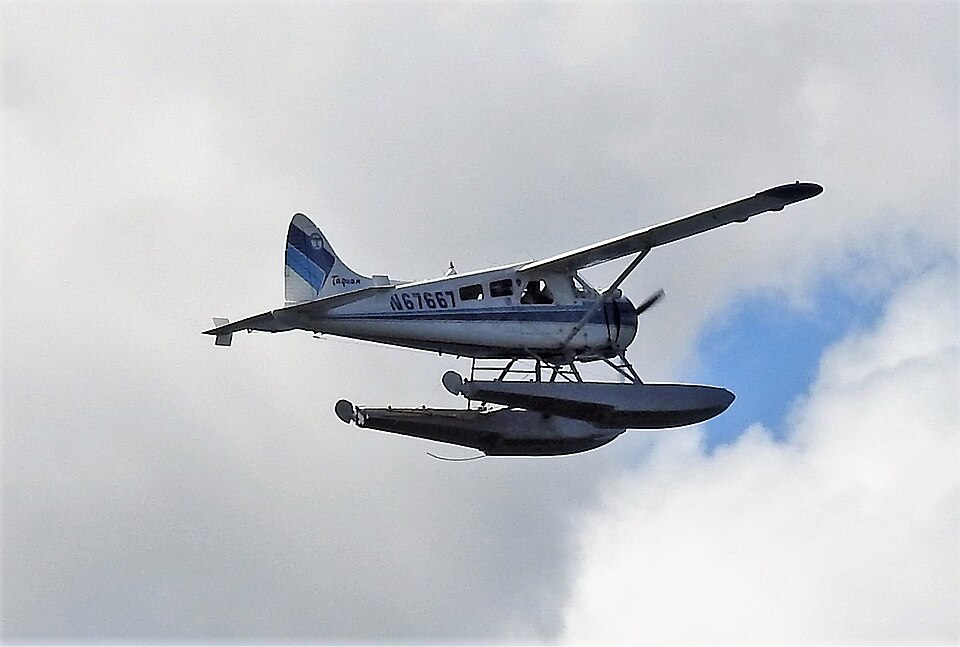
On May 20, 2019, about 1556 Alaska daylight time, a float-equipped de Havilland DHC-2 (Beaver) airplane, N67667, sustained substantial damage when it was involved in an accident near Metlakatla, Alaska. The pilot and passenger were fatally injured. The airplane was operated as a Title 14 Code of Federal Regulations (CFR) Part 135 commuter flight.
According to company dispatch documents, the flight was a scheduled commuter flight with one passenger and cargo onboard, departing from Ketchikan Harbor Seaplane Base (5KE), Ketchikan, Alaska, destined for Metlakatla Seaplane Base (MTM), Metlakatla, Alaska, about 16 miles southeast.
A review of GPS track data showed that the airplane departed 5KE about 1543 and traveled southeast over the Tongass Narrows, then south to Metlakatla Harbor at an altitude of about 800 ft. The airplane made a right turn to a 240° (magnetic) heading in the southern portion of the harbor, after which the data ended.
Three witnesses observed the airplane's approach and landing. One witness, taking photographs near the pier, reported that the wind appeared to push the airplane right during touchdown and that it was drifting right as the floats contacted the water. After skipping once or twice, the left wing dipped, then the right wing dipped and dug into the water, causing the airplane to nose over and the right wing to separate.
Another witness, in a boat, stated the airplane hit the water hard and saw the right float dig into the water before the airplane turned over as it pivoted. The third witness reported the airplane teetering back and forth; a gust of wind appeared to push the tail upward as the right wing dropped and the airplane nosed over. She noted wind from the southeast with gusts of 13 mph and the water less than choppy. The inverted airplane partially sank with the front fuselage and cockpit under water.
Two boats responded immediately, followed by a Metlakatla Police vessel with volunteer emergency medical technicians. First responders reported debris including boxes, mail, and ATV tires obscuring their view and inhibiting cockpit access. After debris was removed through the left cargo door, the passenger in the front right seat was removed after her shoulder harness was cut; the pilot was removed about 20 minutes later.
Personnel Information
According to the operator's training records, the pilot was hired with 1,606 total hours of flight experience, including 5 hours of previous seaplane experience and no experience in Alaska. He began initial company training on April 22, 2019, and completed a competency check flight in a float-equipped DHC-2 on May 3, 2019, after 4 flights and 5.4 training hours. The pilot completed initial operating experience (IOE) flight requirements on May 11, 2019, with 6.9 hours and 11 landings, allowing assignment to commuter flights per 14 CFR 135.244. His last IOE flight was to MTM. At the time of the accident, the pilot had accumulated about 22 hours in the accident airplane make and model, and flew 6.5 hours as pilot-in-command on tour flights in the preceding weeks.
A review of the pilot's personal flight logbook revealed that before flying for the operator, he gained most of his flight experience as a Cessna 208 and Cessna 182 pilot in skydiving operations.
Aircraft Information
The airplane was equipped with Edo model 679-4930 floats and two Chelton Integrated Display Units (IDU) operating as a primary flight display (PFD) and multi-function display (MFD). The PFD displayed altitude, airspeed, vertical speed, and heading. The MFD displayed navigational information on a moving map, including wind information in the upper left corner. During normal operation, wind was calculated during periods of relatively wings-level flight (bank < 6°), considering true airspeed, heading, ground speed, and track.
Company dispatch documents indicated the airplane's takeoff weight was 4,915 lbs and center of gravity was -1.6 inches, both within operating limitations. The Viking DHC-2 Flight Manual states a maximum crosswind component of 10 mph for takeoff and landing, with no stipulated maximum tailwind component, though company pilots stated 10 mph is generally accepted as the limit.
Meteorological Information
Calculated wind velocity from one of the airplane's IDUs indicated wind from 090° at 15 knots during takeoff. As the airplane climbed through about 750 ft, wind shifted to 290° at 9 knots and remained westerly throughout the en route portion and initial visual approach segment. As the airplane descended and turned onto final approach (about 242°), wind shifted from 253° at 6 knots to southerly at 2 knots, then from 083° at 8 knots over the 30 seconds before landing—a shift of 170° and 14 knots, resulting in a change from a 6-knot headwind to a 7-knot tailwind, and from a 2-knot right crosswind to a 3-knot left crosswind. According to the manufacturer, the values can contain errors and wind peaks and gusts are not calculated.
Company pilots stated that winds at MTM can be challenging and unpredictable due to surrounding high terrain. Company check airmen noted that MTM is known for downdrafts on the water when wind is from the east and southeast, where the highest mountains are located.
Wreckage and Impact Information
The airplane came to rest inverted on an easterly heading, with the right wing separated and floating about 15 ft west. The passenger's seat was removed during rescue and sank. Postaccident examination revealed all other major components attached. Floats, float struts, spreader bars, and control cables were intact. Right and left sea rudders were fractured at lower welds with minor bending.
The right wing forward fuselage attachment lug was fractured with dull, dimpled surfaces; the rear attachment was fractured and deformed rearward. The right flap was attached by the inboard bracket with a fractured control rod; an indentation on the right fuselage was consistent with the right flap in the land position during impact. Left wing, aileron, and flap were intact and attached, with the left flap extended to the land position. The cockpit flap position indicator was slightly above land position. Flight control continuity was established from the pilot's control wheel to left aileron, right wing aileron pulley, and elevator. Rudder and elevator trim cable continuity was established to aft trim tabs, but cables could not be moved due to airframe deformation and constriction.
Forward fuselage above the cockpit was fractured at the upper center windshield brace; forward upper skin was deformed inward and downward into the left cockpit side. The left forward door was secure with minor deformation; the right forward door was secure with mild deformation and worked properly. The right cabin door was open and partially attached. Exit placards were in place.
Aft fuselage and empennage exhibited crushing deformation consistent with rescue and recovery damage. Elevator and rudder were attached with full control movement.
The propeller was attached to the engine, which exhibited no damage. Full engine control continuity was observed. The three propeller blades were secure; one blade had mild aft bending and scrapes.
No pre-impact anomalies were discovered during airframe and engine examination that would have resulted in a loss of control during landing.
Organizational and Management Information
Taquan Air, a 14 CFR Part 135 air carrier, operated 14 airplanes including 10 DHC-2 Beavers, employing about 23 pilots (mostly seasonal) and 4 check airmen. The company conducted tour flights, lodge support, scheduled commuter flights, and charter flights.
The chief pilot (CP) was responsible for hiring and training. He stated that attracting new pilots had become difficult due to a pilot shortage in Alaska. The company usually hired pilots with a minimum of 100 hours of seaplane time. He hired the accident pilot due to good attitude and willingness to learn, despite few hours and no operational seaplane experience.
The company training program included practice and evaluation of crosswind landings. Company check airmen stated tailwind landings were not taught or practiced due to elevated risks of higher ground speed.
The CP stated new seasonal pilots were typically assigned to tour flights for 4-6 weeks after training. Tour flights were released in groups in good weather, and new pilots had few decisions. Usually by mid-June, pilots were assigned to commuter flights on easy routes (such as MTM) and then progressed at the CP's discretion. Information about pilot readiness was communicated through "tribal knowledge" without formal meetings. The company station manager and senior flight coordinator (FC) assigned pilots based on a qualification list, but no list was provided for the current year. The station manager understood that once a pilot completed IOE, he could be assigned to commuter flights, conflicting with the CP's policy.
The company used a flight risk assessment (FRA) process requiring the FC to calculate a risk number based on weather, equipment, landing area, and manpower. Both pilot and FC signed the FRA; if in the caution area, management was notified. The FRA for the accident flight totaled 12, in the caution area, based on factors such as the pilot having less than 500 hours in type, less than 1 year with the company, lack of area familiarity, and distraction. The FC on duty did not notify the CP because he previously approved a tour flight with the same value for the accident pilot earlier that day under the same conditions, though the flight type differed.
The company General Operating Manual indicated the director of operations routinely delegated operational control to the FC on duty.
The CP stated the company usually held an all-pilot pre-season safety meeting each year, but had not scheduled one this year. Important information was disseminated through an all-read board posted in the pilot ready room, yet the posted board did not include the new seasonal pilots.