History of Flight
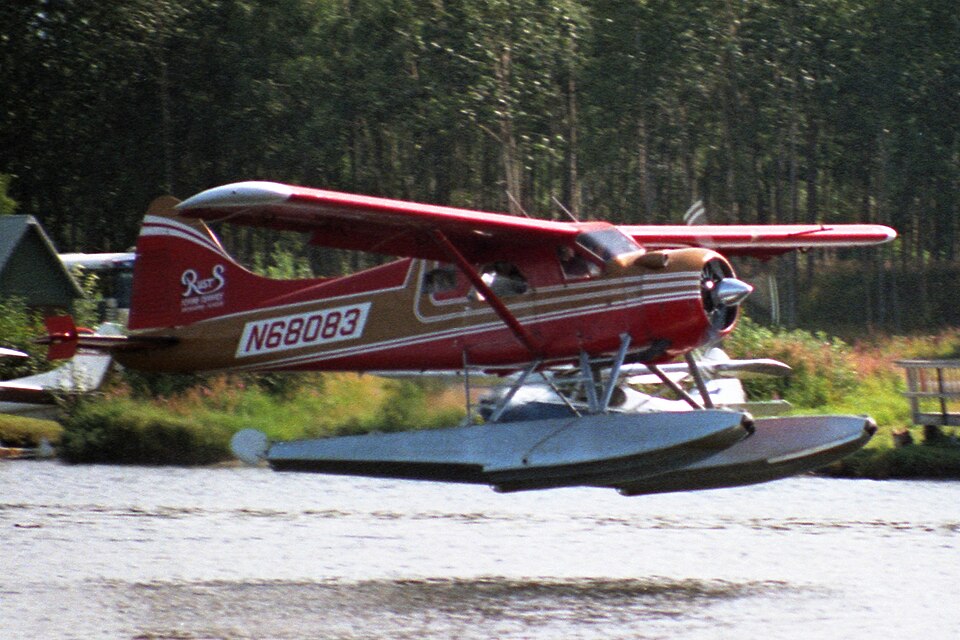
On July 19, 2019, at about 1010 Alaska daylight time, a float-equipped de Havilland DHC-2 Beaver airplane, registration N68083, was substantially damaged in an accident near Seldovia, Alaska. The airplane was operating as a Title 14 Code of Federal Regulations Part 135 on-demand commercial flight, carrying passengers from a remote lodge at Tutka Bay to Lake Hood Seaplane Base in Anchorage.
The pilot reported that after loading passengers and baggage, he started the engine, conducted a passenger safety briefing, and taxied for takeoff. During acceleration on the step, he observed the left float moving into his peripheral vision from the left cockpit window. The airplane felt as if it had lost rigidity on the floats and began to yaw left. Despite applying right aileron, the left wing struck the water, and the airplane nosed over, separating the right wing from the fuselage. The pilot stated that the cabin rapidly filled with water as he exited the submerged wreckage.
Passengers interviewed at the hospital consistently reported that after engine start, the pilot asked them to remove headsets for the safety briefing, which they described as rushed and difficult to hear over engine noise. They noted choppy water conditions, with one passenger observing whitecaps in the distance. Passengers stated that during takeoff, the airplane hit a swell or wave and nosed over abruptly, with the cabin flooding quickly. One passenger indicated the airplane briefly became airborne before impact.
A witness near the accident site reported that the airplane appeared to accelerate slowly and struggled to become airborne. The witness stated that the airplane climbed to about 50 to 100 feet, leveled off briefly, then began a gradual descent until its left float nose struck the water. The aircraft then cartwheeled and came to rest inverted. The witness alerted emergency services and used his boat to assist in rescue.
An Alaska State Trooper reported seas of less than 1 foot with long wavelength and winds under 10 knots at the accident site. The trooper also recalled the pilot stating at the hospital that he was taking off parallel to the swells when the airplane impacted a swell, became airborne, the left float broke, and the airplane cartwheeled.
Aircraft and Float Information
The airplane was equipped with Aerocet 5850 seaplane floats under Supplemental Type Certificate No. SA01722SE.
Wreckage and Impact Information
The airplane nosed over and came to rest inverted in ocean waters. All major components were recovered except the right wing, right aileron, and right lift strut. Flight control continuity was verified from the control yoke to the right fuselage bellcrank push/pull tube, left aileron and elevators, and from rudder pedals to the rudder.
Examination of the floats and attachment rigging revealed that the front left flying wire attachment fitting attached to the left float had fractured, and the associated flying wire exhibited compression buckling near the upper attachment point. The right rear flying wire attachment strap attached to the fuselage had fractured, with compression buckling near the lower attach point. No significant deformation was found on the underside or nose of either float.
The NTSB Materials Laboratory examined left float struts and flying wire attachment components. The left float struts had fracture surfaces with rough matte-gray features and deformation consistent with ductile overstress from bending or torsion loads. Bolts attaching the two left flying wire attachment fittings to the left float were bent, and the attachment hole in the intact left rear attachment fitting was elongated. Fractures in the left front attachment fitting and right rear attachment strap were consistent with ductile overstress fracture. Small areas of corrosion were present on the fractured left forward flying wire attachment fitting, but the total corroded area was a small percentage of the cross-section. Small amounts of corrosion were also observed on the three intact flying wire attachment fittings.
A postaccident examination of the airframe and engine found no evidence of mechanical malfunction or failures that would have precluded normal operation.
Additional Information
On October 8, 2012, Aerocet issued Service Letter SL05-56-15145 concerning Aerocet Model 5850 twin seaplane floats on de Havilland DHC-2 Beaver aircraft. The service letter reported corrosion of aluminum fittings beneath the flying wire clevis in parts with extensive marine service and prolonged inspection intervals. It recommended that during regular inspections, partial disassembly of the lower ends of the flying wires be performed to inspect for corrosion beneath the clevises and replace corroded parts. The original part (56-15145) was painted aluminum, while a replacement part (56-15145-2) was made from corrosion-resistant stainless steel. The service letter stated that it reflected FAA-approved design changes and current recommended inspections but did not require FAA approval; corrective action was suggested only.
Aerocet Test Report A-33162 indicated that the flying wire attachment design limit load was 3,453 pounds of force. Testing showed that buckling of flying wires occurred only at strap and fitting failure loads above 9,000 pounds of force.