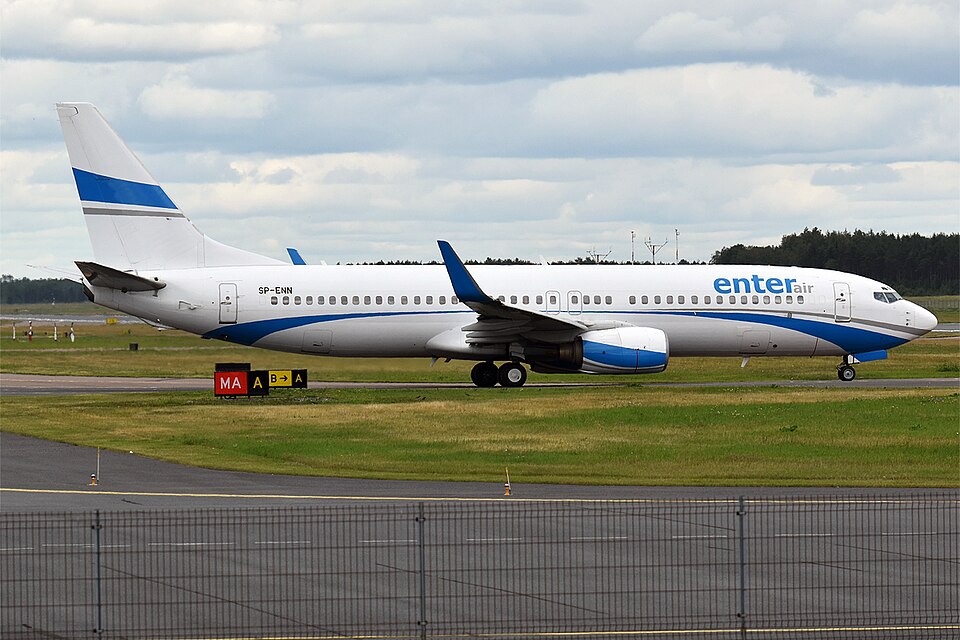
Incident Description
On March 15, 2019, a Boeing 737-800 (registration SP-ENN) experienced a hydraulic system anomaly en route from Fuerteventura Airport (GCFV) to Katowice-Pyrzowice Airport (EPKT). Approximately 80–90 minutes after departure, the Master Caution alarm activated. The flight crew inspected the overhead panel and observed a transient "Low Pressure" indication on the engine-driven pump for hydraulic system A. A gradual fluid loss in system A was noted, while system B remained stable at 96% capacity. Pressure in both systems was approximately 3100 PSI. The crew initiated the HYDRAULIC PUMP LOW PRESSURE procedure. During its execution, system A fluid level dropped to zero, and system B remained at 96%. Pressure in system A began to decrease rapidly, triggering a "Low Pressure in EMDP SYS A" warning. The crew performed the Loss Pressure of SYS A procedure and decided to land with flaps 40° at EPKT. Shortly after, a "STANDBY HYDRAULIC LOW PRESSURE" warning activated, prompting the crew to execute the corresponding non-normal checklist.
While descending, approximately 40 nautical miles from EPKT, the commander decided to proceed with vectored approach to the Final Approach Point without holding. An urgency situation was declared with a "PAN PAN" message. At that point, system B fluid level began decreasing rapidly, dropping to 60% within 2–3 minutes. The crew manually extended the landing gear and flaps (to 40°). The landing was completed without further events.
Causes
The investigation determined two causes for the incident: 1) Failure of the shimmy damper on the right landing gear, which led to a hydraulic fluid leak. 2) Improper installation of the standby emergency electric motor-driven pump (EMDP) case filter.
Preventive Actions
The operator implemented the following preventive measures: 1) Verification of correct installation of the EMDP case filter on all Boeing 737-800 aircraft in the operator's fleet. 2) Performance of a General Visual Inspection (GVI) of the landing gear selector valve on aircraft SP-ENN.
No additional safety recommendations were formulated.