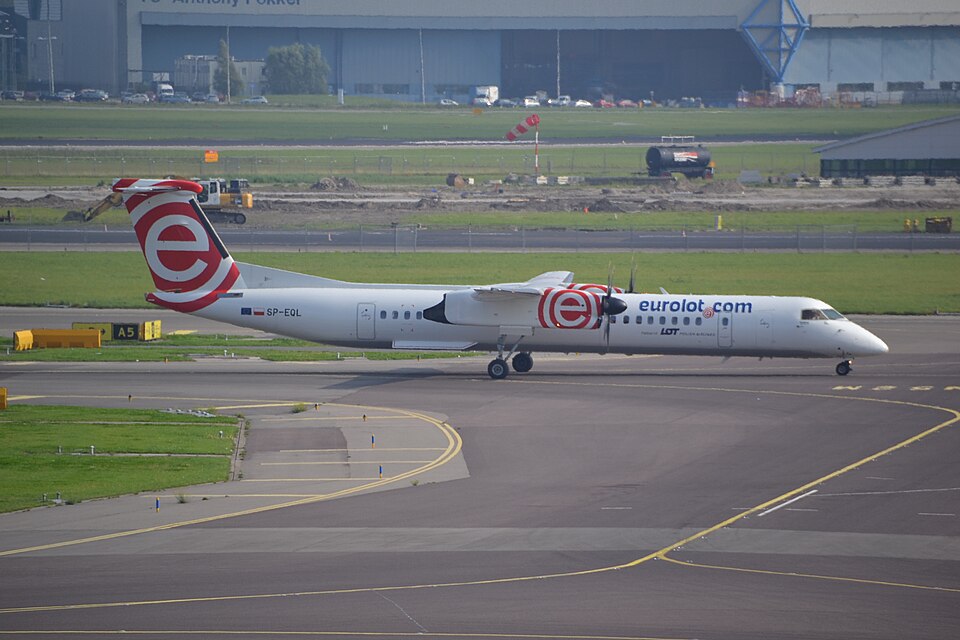
Incident Overview
On 13 August 2021, a Bombardier DHC8-400-2 aircraft, registration SP-EQL, operated a scheduled flight from Gdańsk (EPGD) to Kraków (EPKK). The crew started the engines and performed the initial turn without anomalies. During climb at approximately 4,500–5,000 feet, the crew set the propeller speed to 850 RPM and selected Max Climb (MCL) power. Shortly after, they observed a discrepancy: engine 1 indicated MCL, while engine 2 indicated Max Cruise (MCR). The pilot pressed the MCL button again, but engine 2 power did not change, and a gradual decrease in propeller RPM was noted.
Crew Actions
The crew executed the engine failure checklist and shut down engine 2 at 16:14 UTC. They broadcast a MAYDAY message, informing ATC of their intention to land back at Gdańsk in approximately 15 minutes. They also reported the number of persons on board, fuel quantity, absence of dangerous materials, and requested emergency services standby. The captain instructed cabin crew to prepare passengers for an emergency landing.
The aircraft performed an approach on one engine and landed without further incident at 16:36 UTC. After landing, the crew advised the tower that there was no danger and taxied to the parking position. Passengers disembarked via stairs.
Investigation Findings
Analysis of flight data recorder parameters indicated a potential contribution from a malfunction of the Propeller Electronic Control (PEC) module. The suspect PEC was sent to Ontic – Engineering in the United Kingdom for repair. Bench tests revealed two fault codes indicating erroneous operation after receiving a signal from the Condition Lever (CL). However, these faults could not be replicated during subsequent tests.
Flight data showed that shortly after the CL lever was set to 55° (850 RPM) and MCL was selected, the CL sent a signal to the PEC indicating a lever position below that setting. This caused a gradual, then abrupt, feathering of the propeller.
The CL lever was examined at Collins Aerospace in France. The report identified issues with lever play but concluded that these should not have caused such a large propeller movement. Tests did not reproduce the anomalies recorded during the incident. Wiring between the CL and PEC was checked and found to be in good condition.
A similar event had occurred on the same aircraft on 31 July 2021, involving a transient CL value drop. In that case, the CL lever was replaced with one from a serviceable aircraft.
Actions Taken
Because the exact cause could not be confirmed, both the PEC and the CL lever were replaced. After installation, the propeller control system was tested and functioned correctly.
No contributing circumstances were identified, and no additional safety recommendations were issued.