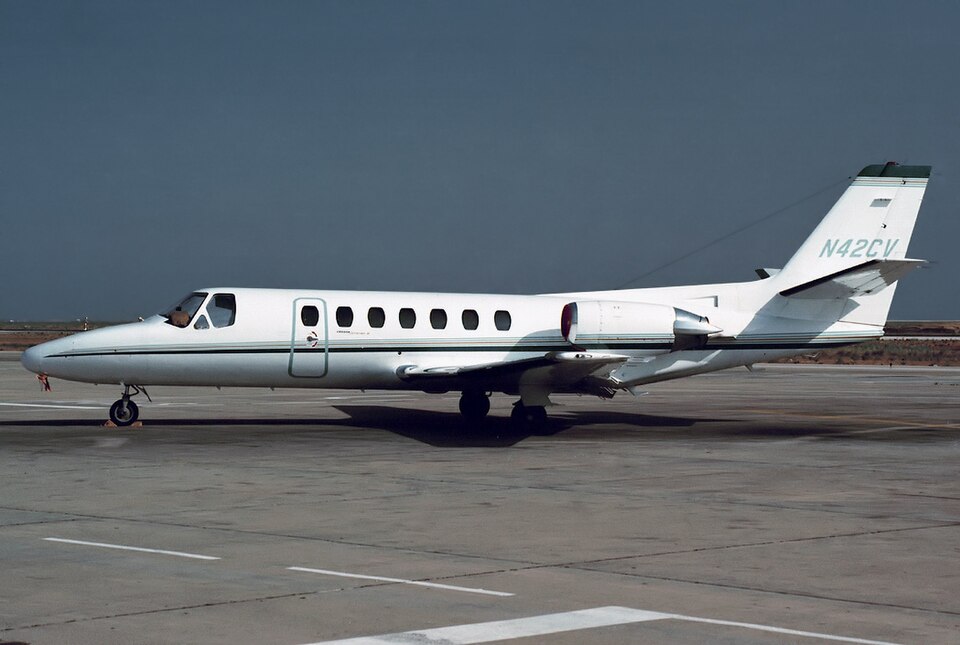
History of Flight
On December 28, 2019, about 0921 central standard time, a Piper PA-31T airplane, registration N42CV, impacted terrain shortly after takeoff from Lafayette Regional Airport/Paul Fournet Field (LFT), Lafayette, Louisiana. The commercial pilot and four passengers were fatally injured, and one passenger was seriously injured. One person in a nearby car sustained serious injuries, and two people in a nearby building sustained minor injuries. The airplane was destroyed by impact forces and a postimpact fire. The personal flight was conducted under Title 14 Code of Federal Regulations Part 91. Instrument meteorological conditions prevailed at the time of the accident.
At 0913:16, the pilot contacted the local controller and requested an instrument flight rules clearance to Dekalb-Peachtree Airport (PDK), Atlanta, Georgia. The controller issued the clearance and instructed the pilot to climb to 2,000 ft mean sea level after departure. The controller then instructed the pilot to taxi to runway 22L. At 0918:26, the pilot advised readiness for takeoff, and the controller cleared the airplane to depart with a right turn to a heading of 240°. After takeoff, the controller provided a frequency change. At 0920:26, the pilot established communications with the departure controller, stating the airplane was at 700 ft. The controller instructed a climb to 10,000 ft and a right turn to 330°. At 0920:36, the pilot acknowledged. No further transmissions were received.
ADS-B data showed the airplane climbing through 150 ft at 0920:05, then a slight right turn. It reached a peak altitude of 925 ft between 0920:37 and 0920:40, then began a continuous descent. At 0920:58, the controller issued a low altitude alert, but the pilot did not respond. The last ADS-B data point, at 0920:59, showed the airplane at 230 ft.
Multiple witnesses heard the airplane at low altitude; some described the engines at full throttle. Several saw the airplane descending through low clouds in a steep left turn. One witness stated the airplane was in a very steep left diving turn before rolling wings level and striking trees and power lines. A surviving passenger told a police officer that "the plane went straight up and then straight down."
Personnel Information
The pilot held a commercial pilot certificate with an airplane multiengine land rating and a second-class medical certificate dated November 14, 2019, with a corrective lenses limitation. On his most recent medical application (November 4, 2019), he reported 1,531 hours total flight experience, with 46 hours in the preceding 6 months, and about 730 hours in the accident airplane make and model. His most recent logbook was not located; the previous logbook showed 1,194 hours total and 910 hours multiengine as of July 25, 2017.
The company owner stated the pilot and he generally hand-flew the airplane up to at least 2,000 ft and that the accident pilot was "proficient." The airplane owner (also a pilot) described the accident pilot as having "a lot of involvement" with the airplane and being "very meticulous" about understanding flight instruments.
The pilot's most recent recurrent training occurred on April 22, 2019, conducted by a flight instructor whose certificate had expired in February 2019 with no record of renewal. The instructor reported ground training included using manuals and discussing anomalies; no big anomalies had occurred. Flight training included stall recovery, steep turns, and go-arounds with a simulated failed engine. All training was in visual conditions; the instructor did not use a hood but stated he could load a pilot up enough so he would not look outside. The instructor called the pilot a "great stick and rudder guy" who enjoyed manually flying the airplane.
Aircraft Information
The airplane was a Piper PA-31T with two Pratt & Whitney Canada PT6A-28 turboprop engines and Hartzell four-bladed constant-speed propellers. It was equipped with a King autopilot, a Garmin G600 integrated avionics display system, a Garmin GRS 77H AHRS, and a Collins Aerospace stability augmentation system (SAS) with an angle-of-attack sensor vane and stall margin indicator. The airplane's total weight at takeoff was 8,869 pounds (below the maximum 9,000 pounds), and the center of gravity was 137.3 inches aft of datum (aft limit 138.0 inches). The airplane was not equipped with a cockpit voice recorder or flight data recorder.
Meteorological Information
The 0853 observation at LFT indicated visibility 0.75 mile in mist and vertical visibility 200 ft above ground level. The pilot acknowledged the current ATIS based on that observation. Satellite imagery showed clouds with tops about 9,000 ft. An AIRMET valid from 0845 to 1500 described IFR conditions in fog and mist for the area. Terminal aerodrome forecasts issued at 0700 and 0905 indicated low ceilings and reduced visibility, with temporary conditions including 2 miles visibility and scattered clouds at 200 ft and overcast at 700 ft. The pilot's wife stated he told her the ceilings would be low for takeoff.
Wreckage and Impact Information
The airplane impacted trees and transmission lines on the south edge of a road. The first tree scar indicated a right-wing-low attitude. The wreckage path extended 789 ft along a bearing of about 315°, including a post office parking lot and adjacent field. The aft fuselage came to rest about 1.5 miles from the departure end of runway 22L.
Several post office windows were shattered. A car was found inverted, crushed, and fire-damaged. The fuselage was fragmented and fire-damaged. The right wing, outboard left wing, engines, elevators, rudder, instrument panel, and forward cabin separated. The throttle quadrant was impact and fire damaged with no reliable positions. The left and right wings were fragmented; flap jackscrews showed no threads, consistent with retracted flaps. The elevator trim tab actuators extended about 1.25 inches, consistent with full nose-up trim.
Both engines separated; examination revealed no preimpact internal failures or anomalies precluding normal operation. The left propeller blades showed bending and scoring consistent with normal operating range; no evidence of feather or reverse. The right propeller had one fractured blade; impact marks on preload plates indicated blade angles in reverse pitch range, but the pitch change rod fracture position suggested the blade angle was in the normal operating range near flight idle. Audio recordings captured no abnormal propeller sounds; sound spectrum analysis indicated propeller speed between 2,000 and 2,100 rpm, below the maximum allowable 2,200 rpm.
Additional Examination
The annunciator panel was sent to the NTSB Materials Laboratory for filament examination. The stability augmentation system (SAS) and stall margin indicator were also examined, though details are not provided in this summary.