History of Flight
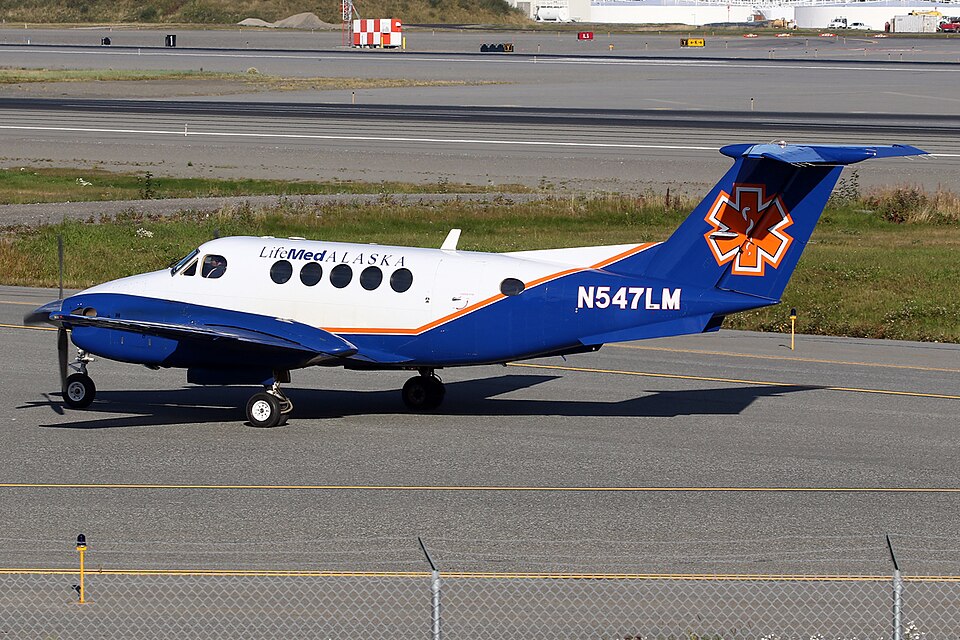
On January 16, 2020, at about 0806 Alaska standard time, a Beech 200, registration N547LM (Lifeguard), sustained substantial damage during a takeoff accident near Unalaska, Alaska. The airline transport pilot was seriously injured, and the two passengers were uninjured. The flight was operated as a Title 14 Code of Federal Regulations Part 135 air ambulance flight. At the time of the accident, dark night conditions prevailed.
According to the pilot, after checking the weather on the automated weather observing system, he completed the before takeoff checks. The airplane was equipped with a cockpit voice recorder (CVR), which recorded an automated weather report for 0754. The passengers reported that the pilot conducted a preflight briefing that mentioned the downwind takeoff but included no discussion of the potential effect of the wind conditions on the takeoff. The pilot stated that he taxied for a runway 31 departure and initiated the takeoff roll, recalling wind conditions of 100° at 9 knots.
As the airplane accelerated, the airspeed was about 75 knots at midfield and increasing. When the airspeed reached about 90 knots, the pilot applied back pressure to initiate the takeoff and noted a brief positive rate of climb, followed by a sinking sensation. The passengers indicated that the initial takeoff run and acceleration appeared normal, but the airplane remained on the runway longer than usual. The pilot stated that the airspeed rapidly decayed, and the stall warning horn sounded; the CVR recorded a tone consistent with a stall warning horn. To correct for the decaying airspeed, the pilot lowered the nose and immediately noticed the airplane’s lights reflecting off the water.
One passenger reported feeling the nose lift and settle back down, followed by another rotation and a substantial bump. Another passenger felt the nose lift off, then a substantial bump as if the airplane struck something at the runway’s end. The pilot pulled back on the control yoke and leveled the wings just before impact with the ocean. After the airplane came to rest and began filling with water, the three occupants exited through the over-the-wing emergency exit into a liferaft. The pilot reported no preaccident mechanical malfunctions or anomalies.
Weight and Balance
The last documented weight and balance information from September 21, 2018, listed the basic empty weight as 8,478.5 lbs with a center of gravity (CG) of 187.44 inches. At the maximum takeoff gross weight of 12,500 lbs, the CG range was 185.0 to 196.4 inches.
Accident weight and balance were estimated based on the pilot’s weight (267 lbs from his most recent FAA medical exam), passengers (260 lbs and 225 lbs), and equipment (484.3 lbs). The aircraft was fueled the day before; the fueler reported filling both main and auxiliary tanks. Fuel onboard was about 544 gallons (3,644.8 lbs). The calculated gross weight at the time of the accident was about 13,269.6 lbs, with an estimated CG of 204.64 inches.
The pilot stated that the typical fuel load for Dutch Harbor Airport (DUT) was full main tanks and 45 gallons in each auxiliary tank for a total of about 450 gallons, which he believed was on board. Using 450 gallons (3,015 lbs) instead of 544 gallons results in a gross weight of about 12,640 lbs and a CG of 214.84 inches.
Two aircraft flight logs were recovered; only a copy of the accident flight log was found, missing weight and balance information and other required data. The original document containing the pilot’s computed weight and balance was not discovered.
The day before the accident, the airplane was repositioned from Anchorage (ANC) to DUT. Its estimated gross weight was about 13,619.8 lbs with a CG of 192.67 inches. A flight log for that flight indicated a loaded weight of 12,497 lbs and a CG of 188.9 inches.
The Pilot’s Handbook of Aeronautical Knowledge states that a heavier gross weight results in longer takeoff run and shallower climb, and that increased gross weight may adversely affect stability. It also notes that an airplane becomes less controllable at slow speeds as the CG moves aft.
Flight Risk Assessment
According to Aero Air’s program manager, the operator used two flight risk assessments. A low-risk category required a simplified assessment; a full assessment was required for other flights. No flight risk assessment was completed for the accident flight, though a full assessment would have been required. The director of operations stated flight risk assessments were reviewed by the company’s administrator on-call group.
Cockpit Voice Recorder
The airplane was equipped with a Fairchild A-100S CVR recording 30 minutes of digital audio across multiple channels. The NTSB Vehicle Recorder Division successfully downloaded audio from the crash-survivable memory unit.
Safety Management System
The operator had an SMS in place, including a safety assurance component. The SMS manual stated that safety assurance requires active monitoring to identify new hazards, measure effectiveness, and monitor risk controls.