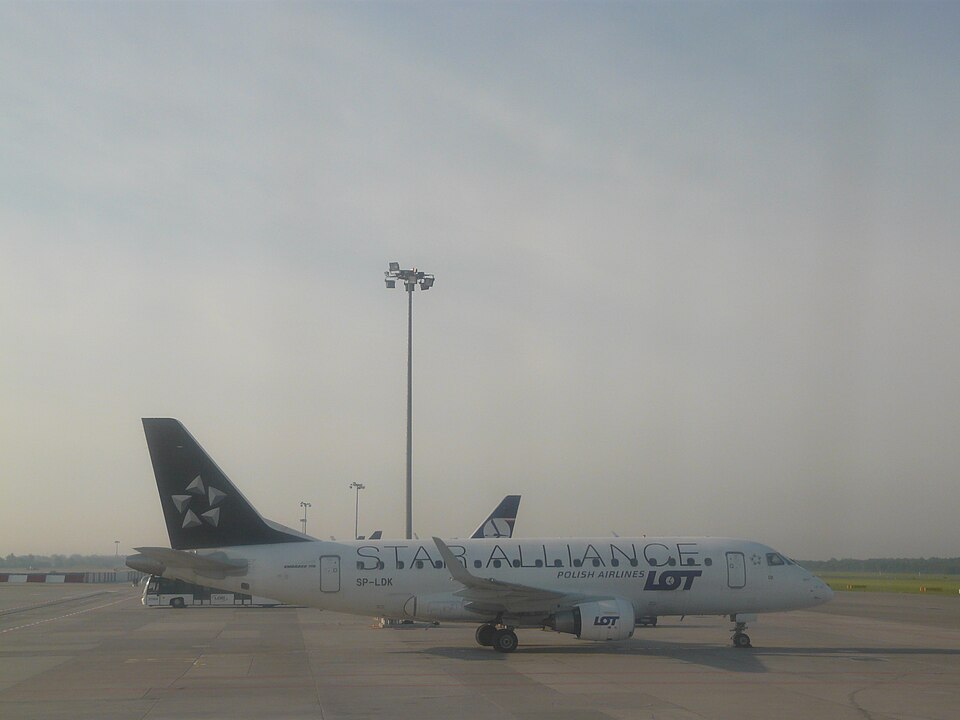
On February 11, 2020, an Embraer ERJ170-100-100LR (registration SP-LDK) operated by b.d. was involved in an aviation accident near Niemcy, EDDN, PL. Investigators recorded the probable cause as: An overly abrupt correction for the crosswind, resulting in an exceedance of the permissible roll rate. This summary draws on records from the Polish State Commission on Aircraft Accidents Investigation (PKBWL); 6 related events involving the same aircraft type or operator are linked below.
On 11 February 2020, an Embraer ERJ-170-100LR (SP-LDK) made a hard landing at Nuremberg Airport (EDDN) during a crosswind approach. The investigation attributed the event to an abrupt wind correction.
Incident Overview and Aircraft Details On 11 February 2020, an Embraer ERJ-170-100LR with registration SP-LDK was involved in an incident at Nuremberg Airport (EDDN) in Germany. The aircraft was on approach to runway 28 when the event occurred. The second pilot was the pilot flying. ## Sequence of Events During the approach, variable weather conditions were present, including turbulence. The wind was recorded from 250° at 24 knots. The aircraft touched down on its left main gear first, followed shortly by the right main gear with significantly greater force. The Flight Data Recorder (FDR) detected the event and generated a report indicating a hard landing. ## Investigation Findings The Polish State Commission for Investigation of Aviation Accidents (Państwowa Komisja Badania Wypadków Lotniczych) determined that the cause of the incident was an overly abrupt correction for the crosswind. This action resulted in an exceedance of the permissible roll rate, which reached 8.79 degrees per second to the right. The vertical acceleration recorded during landing was 1.46 g. ## Contributing Factors The investigation identified several contributing factors, including unfavorable meteorological conditions characterized by turbulence and strong crosswind. Additionally, the pilot flying had limited experience on the aircraft type, with 816 flight hours. ## Safety Actions and Recommendations The operator had previously implemented preventive measures. On 4 December 2019, the operator issued Operational Bulletin No. 11/2019, introducing a “Junior First Officer” status. This status imposed additional operational restrictions, including a prohibition on takeoffs and landings when the reported crosswind exceeded half of the aircraft’s maximum limit. The incident was recorded in the operator’s Safety Management System (SMS) database, classified according to established criteria, and included in aviation safety performance indicators (SPI) monitored in accordance with the Safety Management Manual. The Commission did not issue any additional safety recommendations.
Probable cause
An overly abrupt correction for the crosswind, resulting in an exceedance of the permissible roll rate.
An X-AIR HAWK ultralight crashed in Chonburi, Thailand, killing the pilot and injuring a passenger. The accident was caused by deteriorated wing fabric and…
A Challenger II Special ultralight aircraft (U-B23) landed off-runway at Pai Airport, Mae Hong Son, on September 17, 2024, due to a gust of wind. No injuries…
The Polish aviation safety authority is investigating a serious incident involving an AT-3R100 aircraft that occurred on September 2, 2024. The investigation…
A SZD-48-3 glider suffered damage when its left wing struck a ground obstacle during a low final approach at EPWK on June 20, 2025. The pilot was uninjured.
A 39-year-old skydiver died after a hard landing near Leszno on May 1, 2026. The PKBWL preliminary report indicates the fatal impact resulted from a late,…
A student pilot crashed an SZD-50-3 Puchacz glider into the airfield fence during a solo training flight on June 6, 2026. The pilot was uninjured, but the…