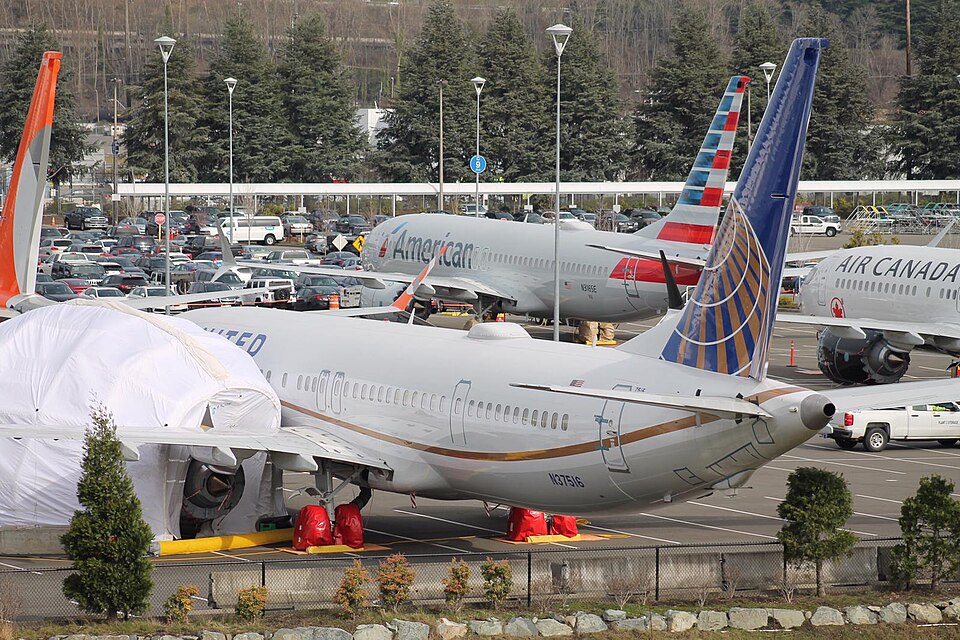
Incident Summary
On June 28, 2023, about 1019 eastern daylight time, a Boeing 737 MAX-9, registration N37516, operated as United Airlines Flight 2376 from Fort Lauderdale-Hollywood International Airport to Newark Liberty International Airport, experienced a No. 1 engine fire warning during taxi-in after landing. The flight crew received a fire warning indication and audible bell, shut down the engine, and discharged one fire bottle, after which the warning ceased. No visible smoke or fire was seen from the engine, and the airplane was towed to the gate. Maintenance personnel observed evidence of a fuel leak under the No. 1 engine at the gate. When the thrust reverser doors were opened, heat damage and sooting were noted on engine cases and external components.
Aircraft and Flight Information
The airplane was a Boeing 737 MAX-9 powered by two CFM International LEAP-1B28 turbofan engines. The flight was conducted under 14 CFR Part 121. The airplane was not damaged during the incident.
Examination Findings
The No. 2 engine was shipped to GE Aerospace Lafayette Engine Facility for examination. Investigators from CFM International, Boeing, United Airlines, ALPA, FAA, and NTSB participated. The left side of the engine showed discoloration and sooting of the engine core between the high-pressure compressor rear case and the high-pressure turbine case aft flange, concentrated from the 6 to 9 o'clock positions. No engine case burn-through or radial uncontainment was found. Leak checks on fuel manifolds and nozzles revealed a leak at fuel nozzle 17 pilot secondary inlet b-nut connection. Torque measurements showed that the secondary inlet b-nuts of fuel nozzles 17 and 18 had zero torque and backed off with no resistance.
Maintenance History
The fuel nozzle set on the incident engine was replaced on-wing by United Airlines mechanics on January 12, 2023, following Boeing 737 MAX-9 aircraft maintenance manual procedures. The airplane accumulated 551 flight cycles / 1,705 flight hours between replacement and the incident. Materials analysis of four fuel nozzles (positions 4, 16, 17, 18) showed that fuel nozzles 17 and 18 had zero b-nut torque, while nozzles 4 and 16 had torque within specifications. No mechanical deformation or cross-threading was found. Coking was observed around the mating surfaces of fuel nozzles 17 and 18. The analysis concluded insufficient evidence to determine how long a fuel leak may have occurred.
Corrective Actions
United Airlines revised its fuel nozzle set replacement procedures to include additional steps: removal of external hardware for better access, a pressurized nitrogen leak check after torquing, application of leak detection fluid, visual inspection, and an engine wet motor with cowl doors open to check for leaks. A part-power leak check at approximately 70% N1 speed is performed with cowl doors closed, followed by inspection after shutdown. CFM International introduced a reverse bleed system on LEAP-1A engines in 2024 to address fuel nozzle coking, with plans to introduce it on LEAP-1B engines in 2025.