Accident Summary
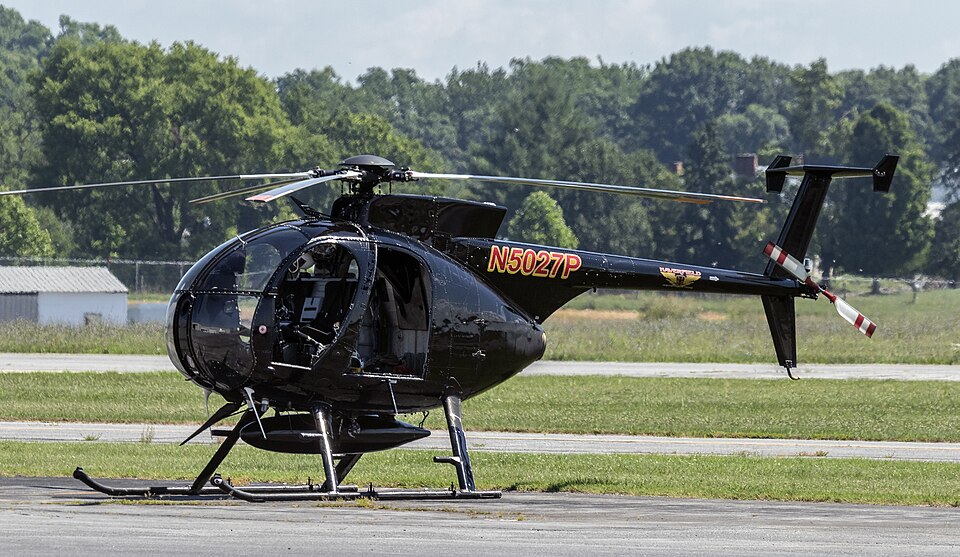
On July 9, 2023, at approximately 1027 eastern daylight time, a Hughes 369D helicopter, registration N5027P, was substantially damaged during an accident near Waldorf, Maryland. The helicopter was operated by Haverfield Aviation, Inc. as a Title 14 Code of Federal Regulations Part 91 powerline inspection flight. The commercial pilot and two observer crewmembers sustained minor injuries.
Flight Sequence
The flight crew reported planning to complete one flight before forecast weather moved into the area. The pre-mission risk assessment, preflight inspection, and inflight power-assurance check were satisfactory, and the helicopter performed without incident for two hours. A crewmember in the back of the helicopter then heard an “abnormal noise.” The crew concurred that the sound was “suspicious” but subtle; the pilot felt a vibration in the collective control. They agreed to return to Maryland Airport (2W5) in Indian Head, Maryland, where the flight originated.
About 4 nautical miles from the departure airport, the crew heard a “loud bang or pop noise” and experienced a hard left yaw. The pilot entered an autorotation and selected a forced landing site adjacent to a pond in a residential area. Company GPS track data showed the helicopter in cruise flight at about 900 ft mean sea level and 100 knots groundspeed for about 8 minutes on a southwesterly heading toward 2W5. The data then indicated a steep, descending left turn through about 180° before the track ended at 0 knots near ground level.
Home security video captured the final seconds. Sounds of the engine and turning main rotor were heard before the helicopter appeared, descending steeply in a level attitude. It dropped from sight behind a house, then reappeared as the nose flared upward and the tail rotor impacted the pond surface. The tailboom separated due to main rotor contact at or about water contact. The skids impacted a fence bordering the pond, and the helicopter came to rest upright. The engine briefly continued running before the pilot shut it down, and the crew egressed without assistance.
Examination Findings
The helicopter, manufactured in 1981, was powered by a Rolls-Royce 250-C20B turboshaft engine. Its most recent 100-hour inspection was completed on June 7, 2023, at 24,799.4 total aircraft hours, which included an inspection of the overrunning clutch for oil leakage, correct operation, and regreasing of splines, with no discrepancies noted.
The helicopter came to rest upright straddling the damaged fence. The cockpit and cabin appeared intact. The transmission, main rotor mast, and main rotor head were intact and secure. Two of five main rotor blades displayed significant impact damage; all blades were secure in their hubs. The tailboom was severed just aft of its mount, with damage consistent with main rotor contact and impact with water and terrain. A fractured tail rotor gearbox with tail rotor attached was found separated from the tailboom; one tail rotor blade was severed near its grip.
A detailed examination revealed that the overrunning clutch outer race’s splined shaft had fractured. The overrunning clutch assembly had been removed from another helicopter in February 2023 to complete an FAA Airworthiness Directive (AD) 90-19-02 inspection, which required disassembly and inspection of the clutch inner race, outer race, and sprag assembly at 300-hour intervals, with sprag assembly replacement at 1,800 hours time since new (TSN). The inspection was completed in April 2023, and the assembly was installed on the accident helicopter in June 2023, with 1,199.4 hours TSN on the sprag assembly. At the time of the accident, the overrunning clutch had accumulated 22 hours time in service since the AD inspection.
The NTSB Materials Laboratory examined the fracture surface and found fatigue signatures. Other findings included a gap between the forward-most bearing’s inner race and the clutch inner race shoulder, off-axis sprag contact marks on the outer race, asymmetric contact marks on the wave washer, and secondary microcracks on the shaft portion of the clutch outer race. The black oxide layer from manufacturing appeared to continue onto the microcrack surfaces in the first grain. Further details are available in NTSB Materials Laboratory Report No. 24-030.