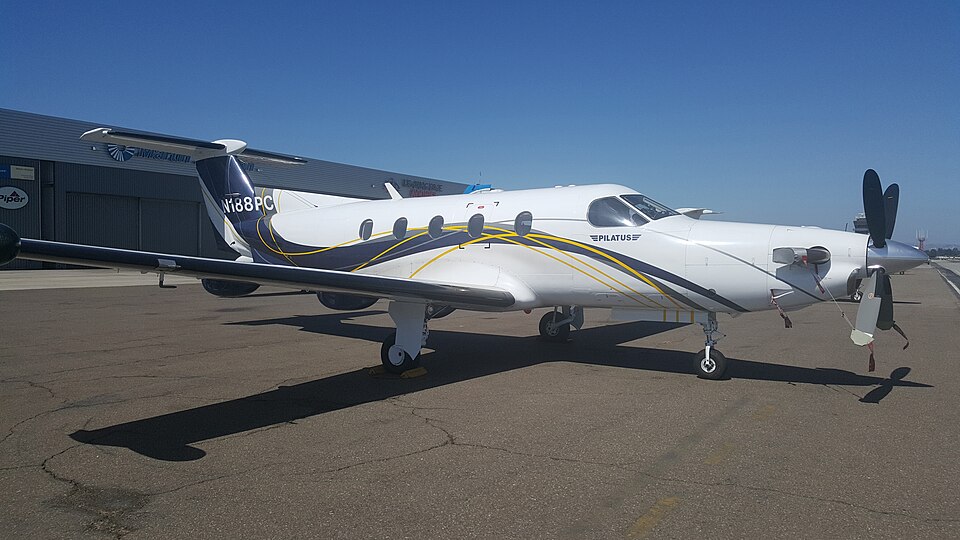
Accident Overview
On December 14, 2023, at about 1218 central standard time, a Pilatus PC-12/45, registration N188PC, was destroyed when it struck trees and terrain near Christoval, Texas. The pilot, one passenger, and three pets were fatally injured. The flight was conducted under 14 Code of Federal Regulations Part 91 as a personal flight.
Flight History
The airplane departed Jacksonville Executive at Craig Airport (CRG), Jacksonville, Florida, around 0751 CST, bound for San Angelo Regional Airport (SJT), San Angelo, Texas. Air traffic control (ATC) recordings and automatic dependent surveillance–broadcast (ADS-B) data show the pilot was receiving radar vectors for the RNAV (GPS) runway 36 approach to SJT and was level at about 4,300 ft mean sea level (msl). At approximately 1211, the pilot advised ATC that cloud tops varied between 4,100 ft and 4,400 ft msl.
At 12:17:24, ATC instructed the pilot to turn right heading 030, maintain 4,300 ft until established on the final approach course, and cleared the RNAV 36 approach. At 12:17:32, the flight track crossed the final approach course and continued a shallow right turn. At 12:17:36, the pilot stated, "we overshot it." ATC replied at 12:17:39, "I know that's why I gave you a 030." At 12:17:40, the flight track initiated a right descending turn at about 1,000 feet per minute (fpm). By 12:17:44, the descent rate increased to about 5,000 fpm and the right turn steepened. At 12:17:47, the pilot transmitted, "we got a problem," which was the final recorded communication. At 12:17:49, the flight track continued in a steep right turn with a descent rate of about 15,000 fpm.
Weather Conditions
Archived meteorological information and the pilot's report to ATC indicate the airplane was likely in instrument meteorological conditions (IMC) during the approach. Potential for turbulence in clouds existed, with no icing below 11,000 ft and no significant precipitation observed.
Wreckage Examination
The airplane struck trees and terrain about 15 miles south of SJT, with debris aligned on a 100° magnetic heading. The initial impact point was defined by a small tree cut at a 24° angle slanting downward toward the south, surrounded by small debris including pieces of the right wing tip and a green navigation light. Adjacent to the tree, the initial ground impact crater measured about 1 ft deep by 20 ft long and contained small debris and one propeller blade. The main wreckage lay about 500 ft east of the initial impact. A large section of the left wing remained mostly intact and was found on the right side of the debris field. Between the initial impact and the main wreckage, a substantial amount of airplane parts and debris was scattered. The main engine section was located about 870 ft from the initial impact. The farthest piece, a main landing gear tire, was found about 1,320 ft away. Several wreckage portions exhibited thermal damage and black soot.
Engine components showed torsional deformation and rotational signatures. The propeller impact-separated from the engine, with the propeller shaft and reduction gearbox bearings still attached. The cylinder, piston, and feathering spring assembly impact-separated from the propeller hub and were found near the propeller assembly about 50 ft from the engine. The propeller assembly and two blades remained attached; two blades impact-separated: one fractured from the blade retention pocket and was found in the initial impact crater, the other fractured at the shank and was found just east of the crater. All four blades exhibited chordwise rotational scoring, leading edge gouges, and compound bend and twist signatures.
Aircraft and Pilot Information
Maintenance records indicate the airplane underwent an annual inspection completed on November 22, 2023, at a total time of 3,990.1 hours. The pilot's electronic flight logbook showed he accumulated about 111 hours in the accident airplane over the previous year, with 16.3 hours logged in actual IMC.
In 2020, the airplane was upgraded with Garmin avionics including two Garmin G600TXi touchscreen flight displays, two Garmin GTN750Xi flight navigators, a Garmin GI275 electronic attitude indicator, and a Garmin GMC 605 autopilot controller. These components were recovered from the wreckage and sent to the NTSB Vehicle Recorders Laboratory for examination and data extraction. The wreckage was retained for further examination and testing.