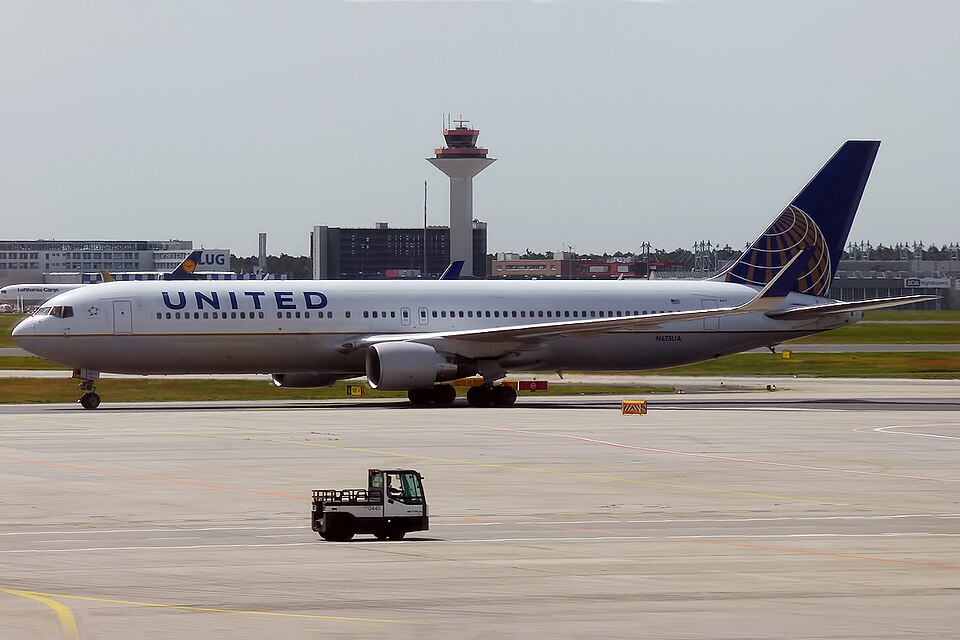
History of the Flight
On 28 March 2022, a Boeing 767-322ER, registration N675UA, was operating a scheduled passenger flight from Newark Liberty International Airport (KEWR) to Zurich (LSZH). The aircraft departed at 03:35 hrs, five hours behind schedule, with 116 passengers and 10 crew on board. Four pilots were assigned: the Commander, two International Relief Officers (IROs), and an Operational Experience (OE) Pilot.
The first four hours of the flight were uneventful. The Commander and OE Pilot operated the aircraft initially while the two IROs rested. Upon crew rotation, the IROs returned to the flight deck, and the Commander and OE Pilot left for a scheduled rest break.
At approximately 07:50 hrs, a few minutes after a step climb to Flight Level 370, the right engine surged multiple times. The IROs identified the affected engine and, following the 'Engine limit or surge or stall' checklist, reduced its power to idle. They initiated a descent to an appropriate single-engine altitude and offset the aircraft 5 NM right of track to avoid traffic.
The resting pilots heard the surge and returned to the flight deck. The IROs briefed the Commander. At that time, the N1 indication for the affected engine was blank, exhaust gas temperature was high, and a slight burning smell was present in the flight deck. The four pilots concluded the engine was severely damaged and executed the 'Severe Damage' checklist, which included securing the engine and pulling the fire switch.
The Commander took control, completed the diversion checklist, notified Shanwick Radio, transmitted a MAYDAY, squawked 7700, activated external lights, adjusted the TCAS, called on 121.5 MHz, and contacted the operator's dispatch for alternate airport information. The nearest suitable airport was identified as Shannon Airport (EINN). The Commander updated the flight management computer, briefed the cabin crew, and informed passengers. The most experienced First Officer (IRO1) assumed the right seat as Pilot Monitoring.
As the aircraft approached the west coast of Ireland, the Commander requested and received clearance to descend to FL200 to avoid icing and remain in visual meteorological conditions. Flight Crew received clearance for an ILS approach to Runway 06 from Shannon Approach Control. A one-engine inoperative approach was performed, and the aircraft landed safely at approximately 09:43 hrs. The Airport Fire and Rescue Service met the aircraft and escorted it to the parking stand.
Injuries and Damage
No injuries were reported to the Investigation. The right engine sustained substantial damage; the horizontal stabilizer received minor damage from a low-pressure turbine blade ejected from the engine exhaust. The engine containment system remained intact.
Recorded Data
Flight data recorder analysis showed four surges in the right engine over approximately three minutes at FL370, resulting in drops in fuel flow, EPR, and combustion chamber pressure.
Personnel and Aircraft Information
All pilots held valid ATP certificates and first-class medicals. The Commander had 16,000 total hours (7,171 on type). The aircraft, manufactured in 2000, had 75,453 total hours. The occurrence engine had 97,839 hours / 14,881 cycles since new.