History of the Flight
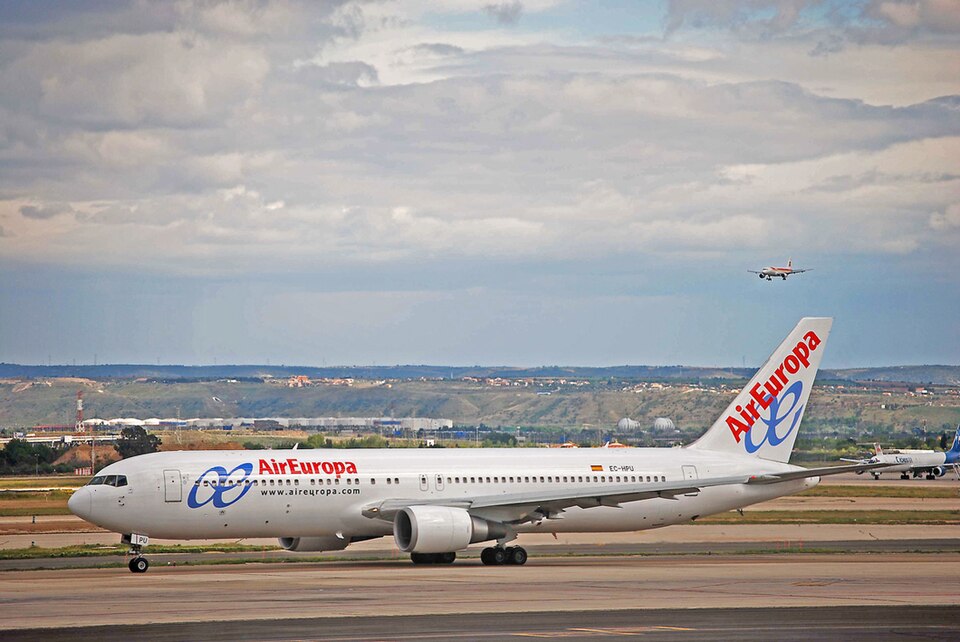
On 20 January 2005, a Boeing 767-300, registration EC-HPU, operated by Air Europa, departed Santo Domingo Airport (Dominican Republic) at 00:53 UTC on a scheduled passenger flight to Madrid, Spain. The aircraft carried 11 crew members and 269 passengers. The flight crew had reviewed meteorological forecasts before departure, which indicated a cold front and embedded cumulonimbus clouds along the route.
The flight proceeded normally until crossing approximately 29°N 50°W, the area where storms had been forecast. The aircraft was cruising at Flight Level 330 (FL330) at Mach 0.81 when the captain, who was at the controls, initiated a turn to avoid lightning flashes visible ahead. At 03:26:13 UTC, light turbulence prompted the crew to illuminate the fasten seat belt signs. Seven seconds later, the aircraft entered severe turbulence.
During the turbulence, the aircraft experienced rapid changes in vertical acceleration, reaching a maximum of 2.081 g upward and a minimum of 0.318 g downward. The airspeed exceeded limits, triggering four overspeed warnings. The autopilot and auto-thrust remained engaged throughout most of the event. The aircraft climbed from 33,011 ft to 35,865 ft before descending. The crew disconnected the autopilot at 03:27:11 and later re-engaged it. The turbulence subsided by approximately 03:35.
Injuries
Four flight attendants were injured: one suffered a fractured tibia and fibula, and three others sustained injuries from impacts with the floor, ceiling, seats, or service carts. A passenger in the restroom sustained a foot injury. No other injuries were reported. A doctor traveling as a passenger provided initial assistance.
Flight Recorders
The cockpit voice recorder (CVR) data were overwritten due to the flight's duration after the event. However, the digital flight data recorder (DFDR) provided detailed parameters. The DFDR showed that at 03:26:13, the aircraft was at FL330, 300 knots calibrated airspeed, with a ground speed of 581 knots. The angle of attack indicated -11.3 degrees.
Key DFDR readings included:
- At 03:26:20, an overspeed warning sounded.
- At 03:26:25, maximum vertical acceleration of 2.081 g was recorded.
- At 03:26:36, minimum vertical acceleration of 0.318 g occurred at 34,823 ft.
- The aircraft reached a maximum altitude of 35,865 ft at 03:26:49.
- The autopilot was disconnected at 03:27:11 and re-engaged at 03:28:15.
The rudder deflections ranged between -2.02° and 2.29° during the event.
Meteorological Information
The forecast from the World Area Forecast Centre (WAFC) London indicated a front with isolated embedded cumulonimbus clouds from below FL250 to FL350 near the accident area. A jet stream at FL390 with wind speeds around 100 knots was also present. Clear air turbulence (CAT) was forecast between FL330 and FL440. The WAFC Washington forecast similarly showed a cold front with embedded cumulonimbus.
DFDR data showed the static air temperature began to drop around 03:21:40, suggesting proximity to the jet stream and possible clear air turbulence.
Aircraft and Operational Procedures
The aircraft sustained minor damage from the turbulence and overspeed conditions; maintenance inspections found no discrepancies. The Boeing 767 Operations Manual allows the autopilot to remain engaged in moderate turbulence unless manual control is needed for speed, attitude, or altitude changes. The flight continued to Madrid, landing at 08:57 UTC without further incident.